
Robert's Rules of Order cheat sheet
The basics of parliamentary procedure for union meetings, on two printable pages: how a motion works, the order of business, what the chair says, and a chart of common motions.
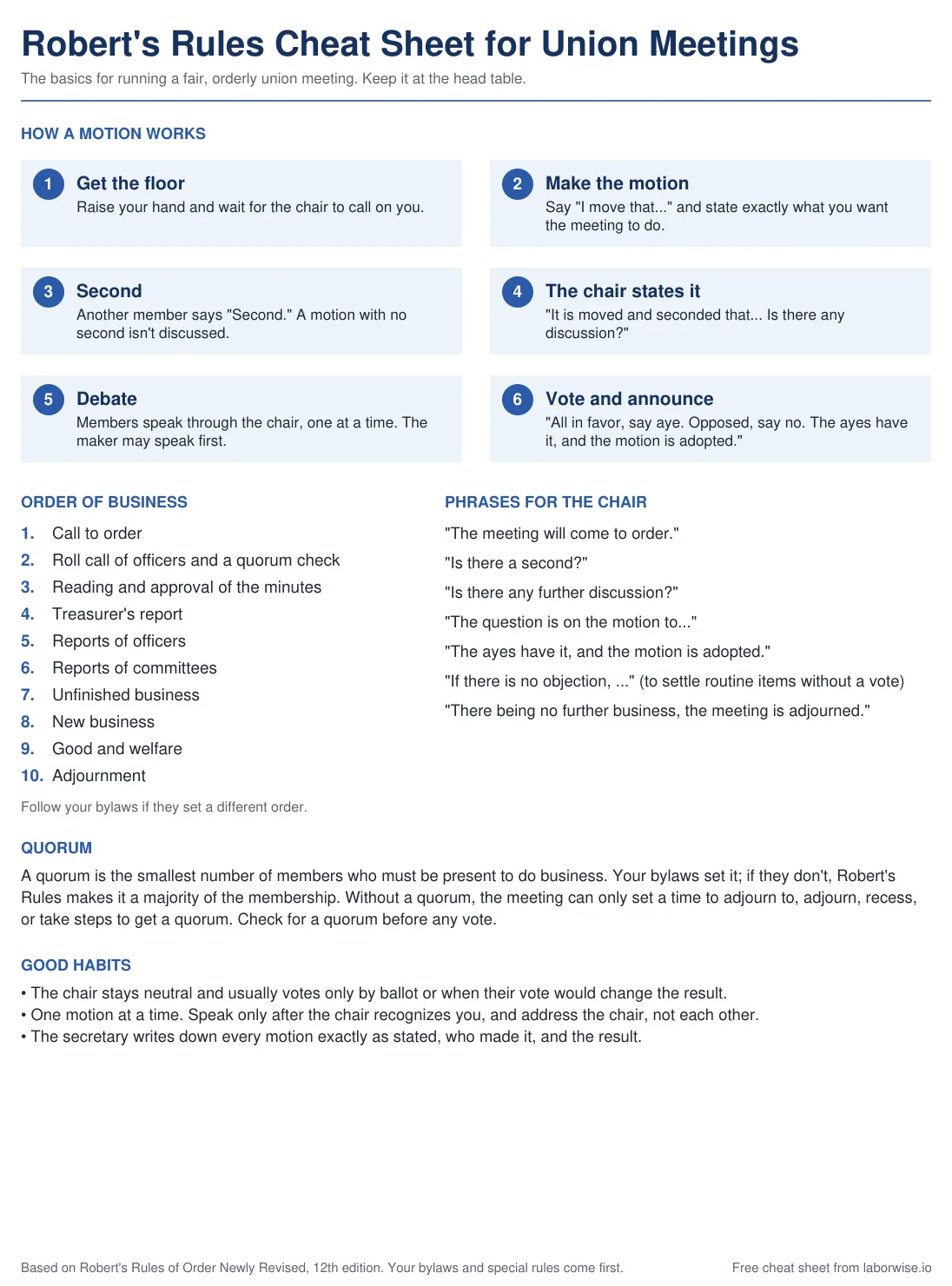
How a motion works
- 1Get the floor
Raise your hand and wait for the chair to call on you.
- 2Make the motion
Say “I move that…” and state exactly what you want the meeting to do.
- 3Second
Another member says “Second.” A motion with no second isn’t discussed.
- 4The chair states it
“It is moved and seconded that… Is there any discussion?”
- 5Debate
Members speak through the chair, one at a time. The maker may speak first.
- 6Vote and announce
“All in favor, say aye. Opposed, say no. The ayes have it, and the motion is adopted.”
Order of business
- Call to order
- Roll call of officers and a quorum check
- Reading and approval of the minutes
- Treasurer’s report
- Reports of officers
- Reports of committees
- Unfinished business
- New business
- Good and welfare
- Adjournment
Follow your bylaws if they set a different order.
Phrases for the chair
- “The meeting will come to order.”
- “Is there a second?”
- “Is there any further discussion?”
- “The question is on the motion to…”
- “The ayes have it, and the motion is adopted.”
- “If there is no objection, …” (to settle routine items without a vote)
- “There being no further business, the meeting is adjourned.”
Quorum
A quorum is the smallest number of members who must be present to do business. Your bylaws set it; if they don't, Robert's Rules makes it a majority of the membership. Without a quorum, the meeting can only set a time to adjourn to, adjourn, recess, or take steps to get a quorum. Check for a quorum before any vote.
Common motions
* Debatable only if the motion it applies to is debatable.
| Motion | What you say | Second | Debate | Amend | Vote |
|---|---|---|---|---|---|
| Main motion | “I move that…” | Yes | Yes | Yes | Majority |
| Amend | “I move to amend by striking… and inserting…” | Yes | Yes* | Yes | Majority |
| Refer to a committee | “I move to refer this to the … committee.” | Yes | Yes | Yes | Majority |
| Postpone to a later time | “I move to postpone this until the next meeting.” | Yes | Yes | Yes | Majority |
| Postpone indefinitely | “I move to postpone the motion indefinitely.” (kills it) | Yes | Yes | No | Majority |
| Limit or extend debate | “I move to limit debate to two minutes per speaker.” | Yes | No | Yes | 2/3 |
| Previous question | “I move the previous question.” (ends debate) | Yes | No | No | 2/3 |
| Lay on the table | “I move to lay the motion on the table.” (sets it aside) | Yes | No | No | Majority |
| Take from the table | “I move to take from the table the motion to…” | Yes | No | No | Majority |
| Recess | “I move to recess for ten minutes.” | Yes | No | Yes | Majority |
| Adjourn | “I move to adjourn.” | Yes | No | No | Majority |
| Reconsider | “I move to reconsider the vote on…” (winning side only) | Yes | Yes* | No | Majority |
| Rescind or change an earlier decision | “I move to rescind the motion adopted on…” | Yes | Yes | Yes | 2/3 (see note) |
| Suspend the rules | “I move to suspend the rules and…” | Yes | No | No | 2/3 |
| Appeal the chair’s ruling | “I appeal the decision of the chair.” | Yes | Usually | No | Majority (a tie keeps the ruling) |
Rescind or change an earlier decision: 2/3 with no notice, or a majority if notice was given at the previous meeting or in the call to this one, or a majority of the entire membership.
Points: no second, no debate
| Point | What you say | What happens |
|---|---|---|
| Point of order | “Point of order.” | The chair rules on whether a rule is being broken. |
| Point of information | “Point of information.” | Ask the chair or a speaker for facts. No vote. |
| Parliamentary inquiry | “Parliamentary inquiry.” | Ask the chair how to do something under the rules. No vote. |
| Point of personal privilege | “I rise to a point of personal privilege.” | Raise an urgent comfort or rights issue, like noise or heat. |
| Division | “Division!” | Any member can require a standing vote after a voice vote. |
Don't use "table" to kill a motion
Lay on the table only sets a motion aside for now. To kill a motion without voting on it directly, move to postpone it indefinitely.
Based on Robert's Rules of Order Newly Revised, 12th edition. Your bylaws and any special rules your union adopts come first.
Keep the meeting records together
In LaborWise, the shared calendar holds your meeting dates, Docs & files keeps minutes and bylaws where the next officer can find them, and member email sends the meeting notice straight from your roster.