Robert's Rules of Order for union meetings: a plain-English guide
How to run a union meeting with Robert's Rules of Order: making motions, the order of business, point of order, tabling, reconsidering, and a free cheat sheet.
Robert’s Rules of Order is the most widely used guide to parliamentary procedure, the rules for running a fair, orderly meeting. Most union constitutions and bylaws name it as their parliamentary authority, which means it governs any question your own rules don’t answer.
You don’t need to know all 800-plus pages. A union meeting runs smoothly on a dozen or so rules, and the ones below come up at almost every meeting. Our free Robert’s Rules cheat sheet puts them on two printable pages.
If your constitution or bylaws say something different about quorum, voting or the order of business, follow them. Robert’s Rules only fills the gaps. Everything here follows the current edition, Robert’s Rules of Order Newly Revised, 12th edition.
What is parliamentary procedure?
Parliamentary procedure is a set of rules for how a group makes decisions together. The majority decides, but only after the minority has been heard and everyone has had a fair chance to speak, with no one dominating. The meeting takes one question at a time, and each decision is stated clearly and recorded, so nobody argues later about what was decided.
Members are deciding how to spend their dues. That’s worth doing right.
The order of business
Most union meetings follow a set order. Here’s a typical union order, built on the standard one in Robert’s Rules:
- Call to order
- Roll call of officers and a quorum check
- Reading and approval of the minutes
- Treasurer’s report
- Reports of officers
- Reports of committees
- Unfinished business
- New business
- Good and welfare
- Adjournment
“Good and welfare” is a union tradition: a time for members to raise concerns, share news, or recognize each other. If your bylaws set a different order, follow them.
Quorum
A quorum is the smallest number of members who must be present to do business. Your bylaws should set it. If they don’t, Robert’s Rules makes it a majority of the membership, which is too high for most locals, so it’s worth setting one.
Without a quorum, the meeting can only set a time to adjourn to, adjourn, recess, or take steps to get a quorum. Votes taken without one aren’t valid. The chair should check for a quorum at the start and before any important vote.
How to make a motion
A motion is a formal proposal for the meeting to do something. Every decision starts as one.
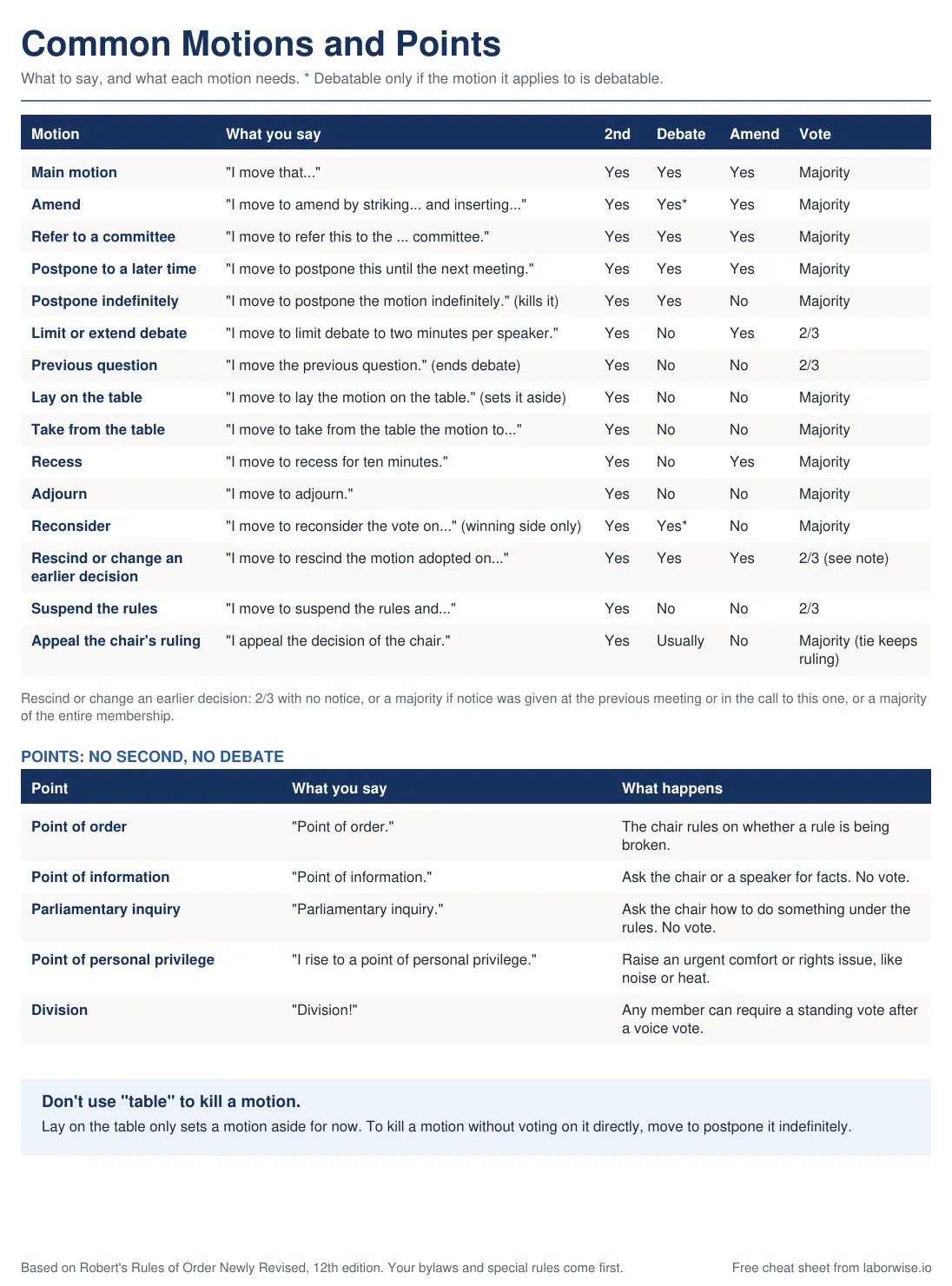
The chart of common motions from our free cheat sheet.
- Get the floor. Raise your hand and wait for the chair to call on you.
- Make the motion. Say “I move that…” and state exactly what you want the meeting to do. “I move that the local donate $500 to the food bank” beats “I think we should help the food bank.”
- Get a second. Another member says “Second.” This shows at least two people want to discuss it. A motion with no second isn’t discussed.
- The chair states it: “It is moved and seconded that the local donate $500 to the food bank. Is there any discussion?” Now the motion belongs to the meeting.
- Debate. Members speak through the chair, one at a time. The person who made the motion may speak first.
- The chair takes the vote and announces it: “All in favor, say aye. Opposed, say no. The ayes have it, and the motion is adopted.”
The secretary writes down every motion exactly as stated, who made it, and the result, for the minutes.
Motion to amend
A motion to amend changes a motion before it’s voted on: adding words, striking words, or striking some and inserting others. “I move to amend by striking $500 and inserting $750.”
An amendment needs a second, can be debated, and passes by a majority. You can amend an amendment, but only one level deep. And amendments have to relate to the motion; you can’t use one to bring up a different subject.
There’s no such thing as a “friendly amendment” that the maker simply accepts. Any change has to be adopted by the meeting, by a vote or with no one objecting.
Call the question
Shouting “Question!” from the floor doesn’t end debate. To cut debate off, a member has to get the floor and move the previous question: “I move the previous question,” or “I call the question.”
It needs a second, can’t be debated, and takes a two-thirds vote, because it takes away the minority’s chance to keep talking. If it passes, the meeting votes on the pending motion right away. The chair can also ask whether anyone objects to ending debate and, if no one does, move to the vote.
Motion to table
This is the most misused motion in union halls. To lay on the table sets a motion aside temporarily, usually because something more urgent has come up, so it can be taken up again later at the same or the next meeting.
It needs a second, can’t be debated, and passes by a majority. Because of that, Robert’s Rules says it can’t be used to kill a motion. That would let a bare majority shut down debate. To dispose of a motion without voting on it directly, move to postpone indefinitely instead. That can be debated, so the other side still gets heard.
Motion to reconsider
A motion to reconsider brings a vote the meeting already took back for another vote. It’s useful when new information comes up or a vote was rushed.
Only a member who voted on the winning side can make it, and it has to be made at the same meeting as the original vote. It needs a second and a majority vote, and it’s debatable if the original motion was. If it passes, the original motion is back in front of the meeting as if it had never been voted on.
To undo something decided at an earlier meeting, use a motion to rescind instead. That takes a two-thirds vote, a majority if notice was given in advance, or a majority of the entire membership.
Point of order
A point of order says a rule is being broken: a member is off topic, a motion is out of order, or the vote count is wrong. You don’t need to be recognized. Stand and say “Point of order,” and the chair asks what it is.
The chair rules on it. If you disagree with the ruling, you can appeal: “I appeal the decision of the chair.” That needs a second, and the meeting votes on whether to keep the ruling. A majority against the ruling reverses it; a tie keeps it. Raise a point of order right away, when the problem happens. Waiting usually means it’s too late.
Point of personal privilege
A point of personal privilege, formally a question of privilege, is for urgent problems with the comfort or rights of members: you can’t hear the speaker, the room is too hot, or someone’s conduct is a problem. Say “I rise to a point of personal privilege,” and the chair deals with it before going on.
Two related requests: a point of information asks for facts (“Point of information: how much is in the strike fund?”), and a parliamentary inquiry asks how to do something under the rules. Neither needs a second or a vote.
Motion to adjourn
“I move to adjourn” ends the meeting. It needs a second, can’t be debated, and passes by a majority. When the business is done, the chair usually doesn’t need a motion: “If there’s no further business, the meeting is adjourned.”
Voting and elections
- Voice votes are the default. If the result isn’t clear, any member can call “Division!” to require a standing vote.
- A majority means more than half of the votes cast, not counting blanks or abstentions.
- The chair usually votes only by ballot or when their vote would change the result.
- Officer elections follow your constitution and bylaws, and the law. Under federal law, local unions that represent private-sector workers must elect officers by secret ballot at least every three years (29 U.S.C. § 481). Public-sector locals follow their own rules and state law.
Tips for the chair
The chair runs the meeting and doesn’t argue for one side. If you want to speak on a motion, hand the gavel to the vice president first.
For routine items, like approving the minutes, use “If there’s no objection…” instead of a formal vote. Restate every motion before debate and again before the vote, so everyone knows exactly what they’re voting on.
Many members haven’t been to a meeting run this way, so explain as you go. A sentence of explanation prevents a lot of points of order.
Keep the cheat sheet at the head table, and give a copy to the secretary.
If your union uses LaborWise, put the meeting dates on the shared calendar, send the notice with member email straight from your roster, and file the minutes and bylaws in Docs & files, where the next officer will find them. See tasks and the calendar.