LM-2, LM-3 and LM-4: a treasurer's guide to union financial reports
Which LM report your union files, when it's due, what goes in the LM-2, LM-3 and LM-4, how to file in EFS, and the mistakes that cause trouble with OLMS.
Every year, most unions that represent private-sector or federal workers have to file a financial report with the U.S. Department of Labor’s Office of Labor-Management Standards (OLMS). It’s called an LM report, and there are three versions: the LM-2, LM-3 and LM-4. Which one your union files depends on how much money it takes in.
The reports are public, so members and anyone else can see where the union’s money comes from and where it goes. If you’re the treasurer, this is the deadline that matters most. Nothing here is legal or accounting advice. The OLMS instructions are the final word, many unions have an accountant prepare or review their report, and we link the official instructions as we go.
Who has to file an LM report?
The reporting rules come from the Labor-Management Reporting and Disclosure Act (LMRDA) and, for federal unions, related laws. According to the LM-3 instructions, they cover:
- unions that represent private-sector workers,
- unions that represent U.S. Postal Service workers,
- unions that represent most federal government workers.
Unions that represent only state, county or city government workers aren’t covered, so they don’t file LM reports. For them, check your state’s laws and your parent union’s rules instead.
Which form does your union file?
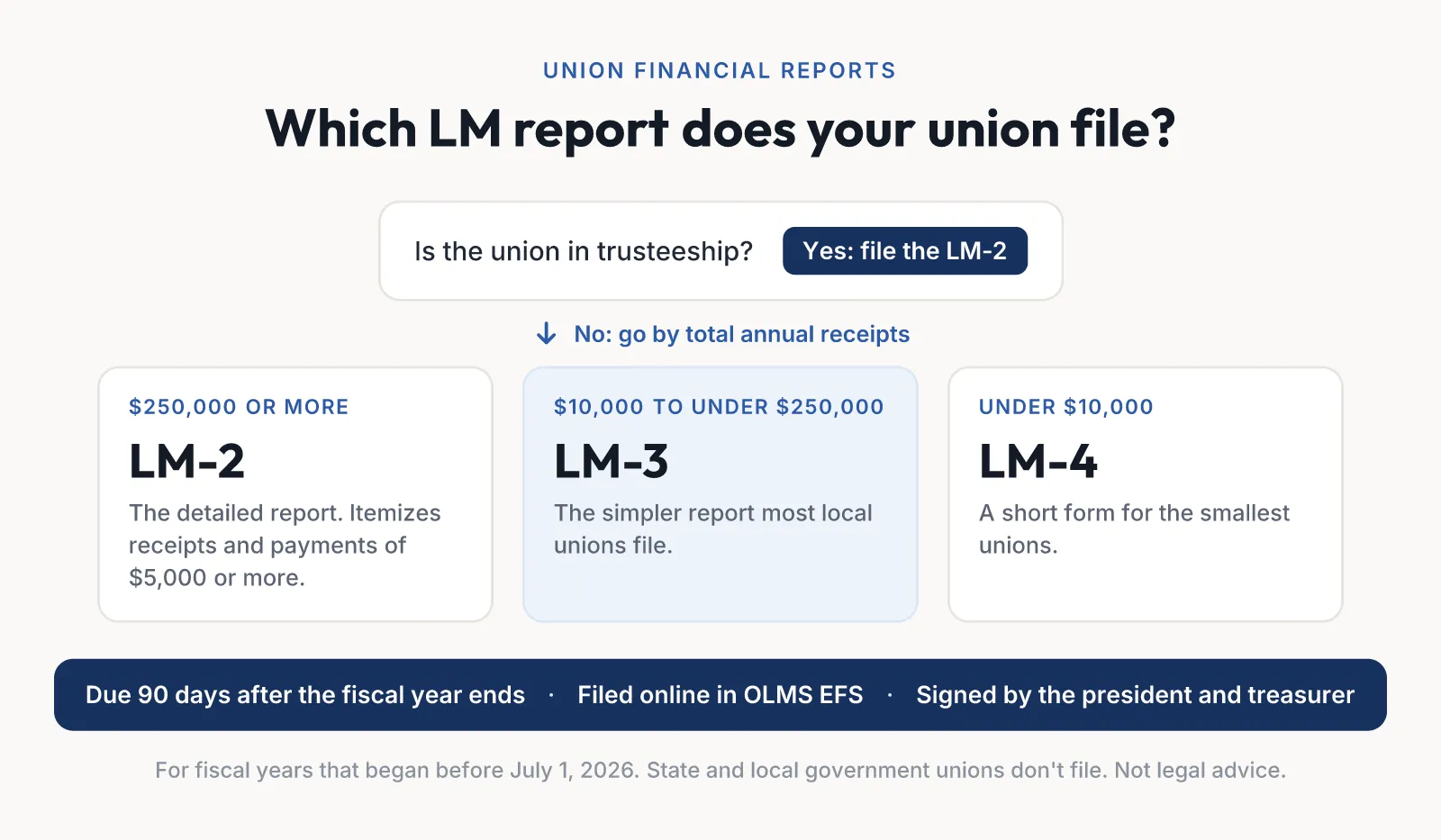
Which LM report to file, based on total annual receipts, for fiscal years that began before July 1, 2026.
The form is set by your union’s total annual receipts: all the money it took in during the fiscal year, from every source, including special funds.
| Form | Who files it | Detail |
|---|---|---|
| LM-2 | $250,000 or more in receipts, or any union in trusteeship | The most detailed: itemized receipts and disbursements |
| LM-3 | $10,000 to under $250,000 | A simpler report: totals by category, assets and liabilities, officer and staff pay |
| LM-4 | Under $10,000 | A short form |
The thresholds are going up. A 2026 Department of Labor rule raises them for fiscal years that begin on or after July 1, 2026: the LM-4 for under $25,000 in receipts, the LM-3 for $25,000 to under $350,000, the LM-2 for $350,000 or more, and a new, longer LM-2 for unions with $40 million or more. The first reports under the new rule are due after June 30, 2027. See the OLMS notice.
A union can always choose to file a more detailed form than it has to. A union in trusteeship must file the LM-2 no matter how much it takes in.
When is the LM report due?
Within 90 days after the end of your union’s fiscal year. For a union on a calendar-year fiscal year, that’s March 31. The law doesn’t let OLMS grant extensions, for any reason.
How to file
LM-2, LM-3 and LM-4 reports are filed online, through the OLMS Electronic Forms System (EFS). Paper filing is allowed only with a hardship exemption.
Two officers sign: the president and the treasurer, or the officers who hold those duties. Both are personally responsible for the report’s accuracy. If your constitution or bylaws were amended, upload a dated copy with the report.
OLMS publishes the forms and instructions on its LM report page.
What goes in an LM-3
Most local unions file the LM-3. It asks for:
- the union’s name and file number, its fiscal year, and its officers,
- assets and liabilities at the start and end of the year: cash, investments, property, loans, and money owed to and by the union,
- receipts by category, such as dues, per capita, fees, interest and other sources,
- disbursements by category, such as per capita paid to the national union, office and administrative costs, benefits, contributions, and more,
- what the union paid each officer, including salary, allowances and expenses, and the total paid to staff,
- yes-or-no answers about things like audits, losses, loans to officers, and whether the union has a bond for officers who handle money.
What’s different about the LM-2
The LM-2 goes much further. Larger unions have to itemize receipts and payments involving any one person or business that add up to $5,000 or more in the year, and break disbursements into schedules like representational activities, political activities, contributions, and general overhead. Most unions that file an LM-2 have an accountant prepare it.
Records to keep
Keep the records behind the report for at least five years after it’s filed. That means bank statements, receipts, vouchers, worksheets, payroll records, and the resolutions that approved spending. If you used software to keep the books, keep that data too.
The union also has to make the annual report available to its members, and a member can examine the supporting records for just cause.
Common mistakes
- Missing the deadline. There are no extensions. Put the due date on the calendar the day the fiscal year ends.
- Numbers that don’t add up. The year-end cash on this report has to match the starting cash on next year’s, and both should match the bank statements.
- Leaving out funds. Building funds, strike funds and other special accounts count toward total receipts and belong on the report.
- Officer pay in the wrong place. Reimbursed expenses and allowances paid to officers are reported, along with salaries.
- No bond, or too small a bond. Officers and staff who handle union money must be bonded for at least 10 percent of the funds they handled the year before, up to $500,000, once the union’s property and yearly receipts exceed $5,000 (29 U.S.C. § 502).
- Signing without reading. Both signers are personally responsible. Willfully failing to file, or filing a false report, can bring criminal penalties.
Other OLMS reports
- LM-1: a union’s first information report, filed when it becomes covered, along with its constitution and bylaws.
- LM-30: a report individual officers and staff may have to file about certain financial interests that could conflict with their union duties.
- Trusteeship reports: filed by a parent union that places a local in trusteeship.
Where to see LM reports
Reports filed since 2000 are public in the OLMS Online Public Disclosure Room. Look up your union’s past reports to see how they were filled out, or compare how similar unions report.
Getting the numbers ready
The report is easy if the books were kept all year. If they weren’t, the treasurer spends the weeks before the deadline rebuilding twelve months of dues from bank statements and payroll remittances.
LaborWise records every member’s dues payments, payroll deductions and balance as they happen, so the treasurer works from the same numbers all year. See dues and payments.