Unfair labor practices: what counts as a ULP and how a union files a charge
What an unfair labor practice is, common examples by employers and unions, how to file a ULP charge with the NLRB or a state board, and what happens next.
An unfair labor practice, or ULP, is an action by an employer or a union that breaks labor law. For private-sector workers, the main law is the National Labor Relations Act, and ULP charges go to the National Labor Relations Board (NLRB). Public-sector unions file with a state labor board, and federal unions with the Federal Labor Relations Authority.
When something happens at work, the first call a local has to make is where it goes: the grievance procedure, a labor board, or both. Labor law is detailed and its deadlines are strict, so read what follows as general information rather than legal advice. Talk to your union’s attorney or staff rep before filing, especially in a strike or organizing situation.
What is an unfair labor practice?
An unfair labor practice is conduct the law forbids because it interferes with workers’ rights to organize, bargain collectively, and act together. The National Labor Relations Act lists ULPs by employers in Section 8(a) and by unions in Section 8(b).
A ULP is different from a contract violation. Breaking the contract is usually a grievance. Breaking the law is a ULP. Some actions are both, like an employer that changes a contract term without bargaining.
Employer unfair labor practices
Under the NLRA, an employer can’t:
- Interfere with, restrain or coerce workers in using their rights. Threatening to close if workers unionize is one example; questioning workers about union activity in a coercive way is another. The NLRB explains this in its guide to Section 8(a)(1).
- Dominate or interfere with a union, or support one with money or favors.
- Discriminate against workers to encourage or discourage union membership. Firing, demoting or cutting hours because of union activity are classic examples.
- Retaliate against a worker for filing a charge or testifying.
- Refuse to bargain in good faith with the union. That includes making changes to wages, hours or working conditions without bargaining, refusing to meet, or refusing to give the union information it needs.
Union unfair labor practices
Unions can commit ULPs too. A union can’t:
- restrain or coerce workers in using their rights, including the right not to join the union (in some states workers can still be required to pay fees),
- cause an employer to discriminate against a worker,
- refuse to bargain in good faith with the employer,
- fail to represent workers fairly. That’s the duty of fair representation, covered in our union steward guide.
Some strikes, pickets and boycotts are also unlawful under Section 8(b). Get legal advice before taking action against anyone other than the primary employer.
Unfair labor practice examples
- A supervisor tells workers they’ll lose overtime if they vote for the union.
- The employer moves a shift start time without notifying or bargaining with the union.
- A steward is written up days after filing a string of grievances.
- The employer refuses the union’s written request for overtime records needed for a grievance.
- The employer deals directly with workers on a term covered by the contract, going around the union.
How to file an unfair labor practice charge
Private sector: the NLRB
- File within six months of the unlawful conduct, and serve a copy on the employer within the same six months. The NLRB may mail it too, but serving it is the union’s job. This deadline is strict.
- File at the NLRB regional office for the area where it happened, online or on the NLRB’s charge form. The NLRB’s charge page explains the process, and regional information officers can help.
- Name the employer, describe what happened and when, and say which part of the law it broke. Keep it factual.
- Gather evidence: dates, witnesses, emails, letters, schedules, and the union’s information requests.
Public sector: state and local boards
State and local government workers aren’t covered by the NLRA. Each state with public-sector bargaining has its own law and its own board, often called a Public Employment Relations Board (PERB) or Commission. Deadlines and forms vary by state, and some are shorter than six months.
Federal workers: the FLRA
Federal unions file ULP charges with the Federal Labor Relations Authority, generally within six months. Recent executive orders have also removed bargaining rights at many federal agencies, and the court cases are still going, so federal locals should check their current status with their national union.
Railroad and airline unions fall under a different law, the Railway Labor Act, with its own rules.
What happens after you file
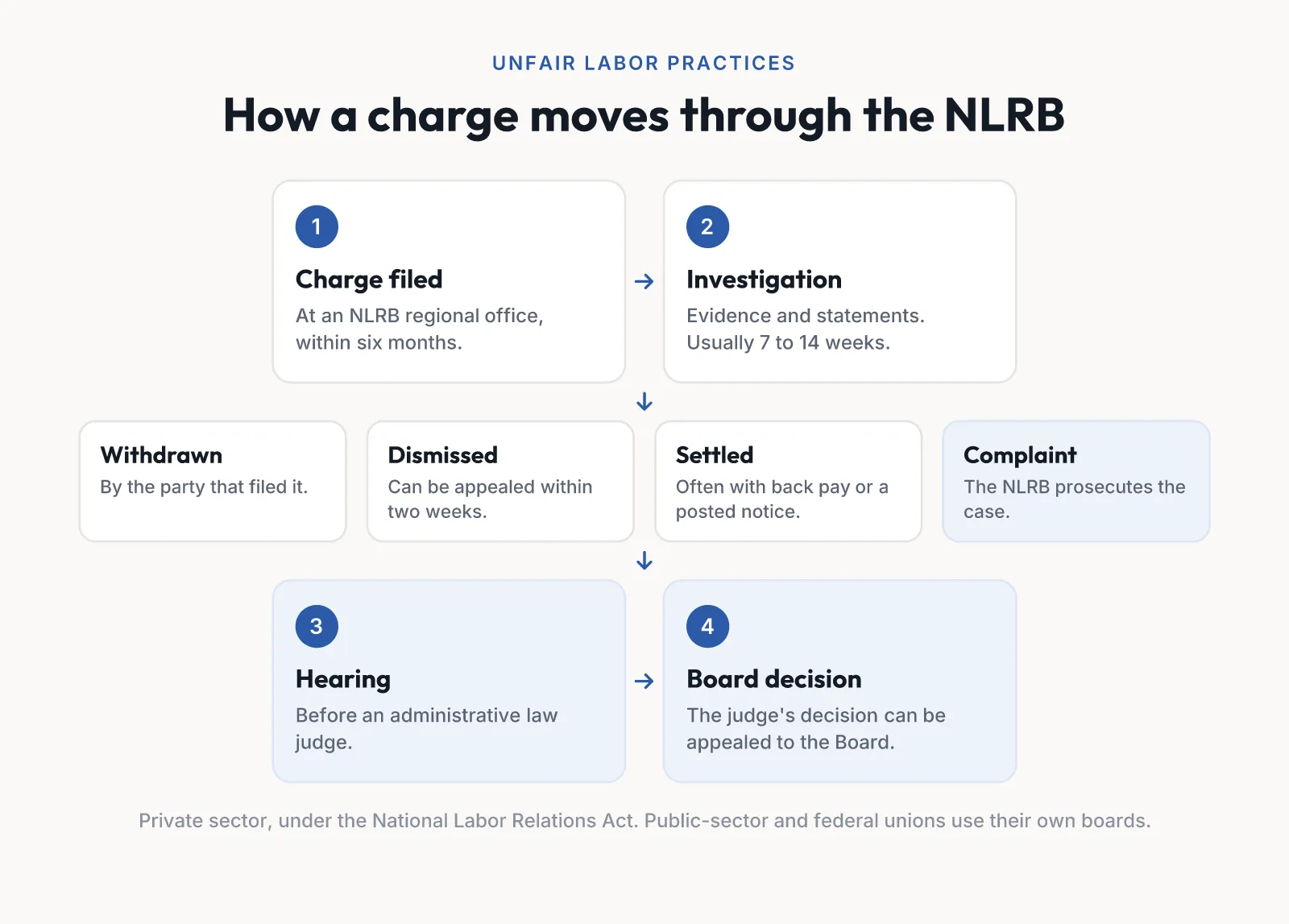
How a ULP charge moves through the NLRB.
- Investigation. An NLRB agent gathers evidence and may take sworn statements from the union, the employer and witnesses. The NLRB says a decision on the merits usually comes in 7 to 14 weeks.
- A decision on the charge. The charging party can withdraw it, or the Regional Director can dismiss it. A dismissal can be appealed to the NLRB’s Office of Appeals within two weeks. If the charge has merit, the NLRB tries to settle it.
- Complaint. If there’s no settlement, the NLRB issues a complaint and prosecutes the case.
- Hearing. An administrative law judge hears the case and issues a decision, which can be appealed to the Board.
- Remedy. The NLRB can’t fine employers, but it can order make-whole remedies like reinstatement and back pay, and require the employer to post a notice. In serious cases it can ask a federal court for an injunction.
ULP or grievance?
A problem like a contract term changed without bargaining can often go either way, and the choice decides who runs the case.
- A grievance enforces the contract, and the union controls the case through arbitration.
- A ULP charge enforces the law. The labor board investigates and prosecutes it for free, but once it’s filed, the board runs the case.
- When a dispute is covered by the contract, the NLRB sometimes waits for the grievance and arbitration process instead of deciding it first.
- Filing both is common. Just don’t let either deadline pass while you decide.
Unfair labor practice strikes
A strike to protest an employer’s unfair labor practices is called a ULP strike. Under the NLRA, ULP strikers have stronger rights than workers striking over wages: they generally can’t be permanently replaced. Whether a strike counts as a ULP strike depends on the facts, so get legal advice before calling one.
Start the file the same day
Board agents decide ULP cases on dates and paper. Write down what happened on the day it happens, keep a copy of every information request and every response, and note the six-month deadline as soon as something comes up.
LaborWise cases keep the notes, files, letters and deadlines together, with a reminder before each one is due.