The shop steward guide: what union stewards do and how to do it well
What a union steward does, what a steward isn't, the rights that come with the job, how to become one, and a checklist for your first month.
A shop steward, or union steward, is a member who represents coworkers on the job. Stewards work alongside the people they represent. When something goes wrong at work, the steward is usually the first person a member talks to.
Some locals say delegate, building rep or chief steward instead, and the job can be elected or appointed. The work is mostly the same everywhere, but the details vary by local. Your local’s bylaws say how stewards are chosen and what they can decide on their own, and your contract sets the grievance procedure and any time off for union business. Check both, and ask your officers or staff rep when you’re unsure.
What a steward does
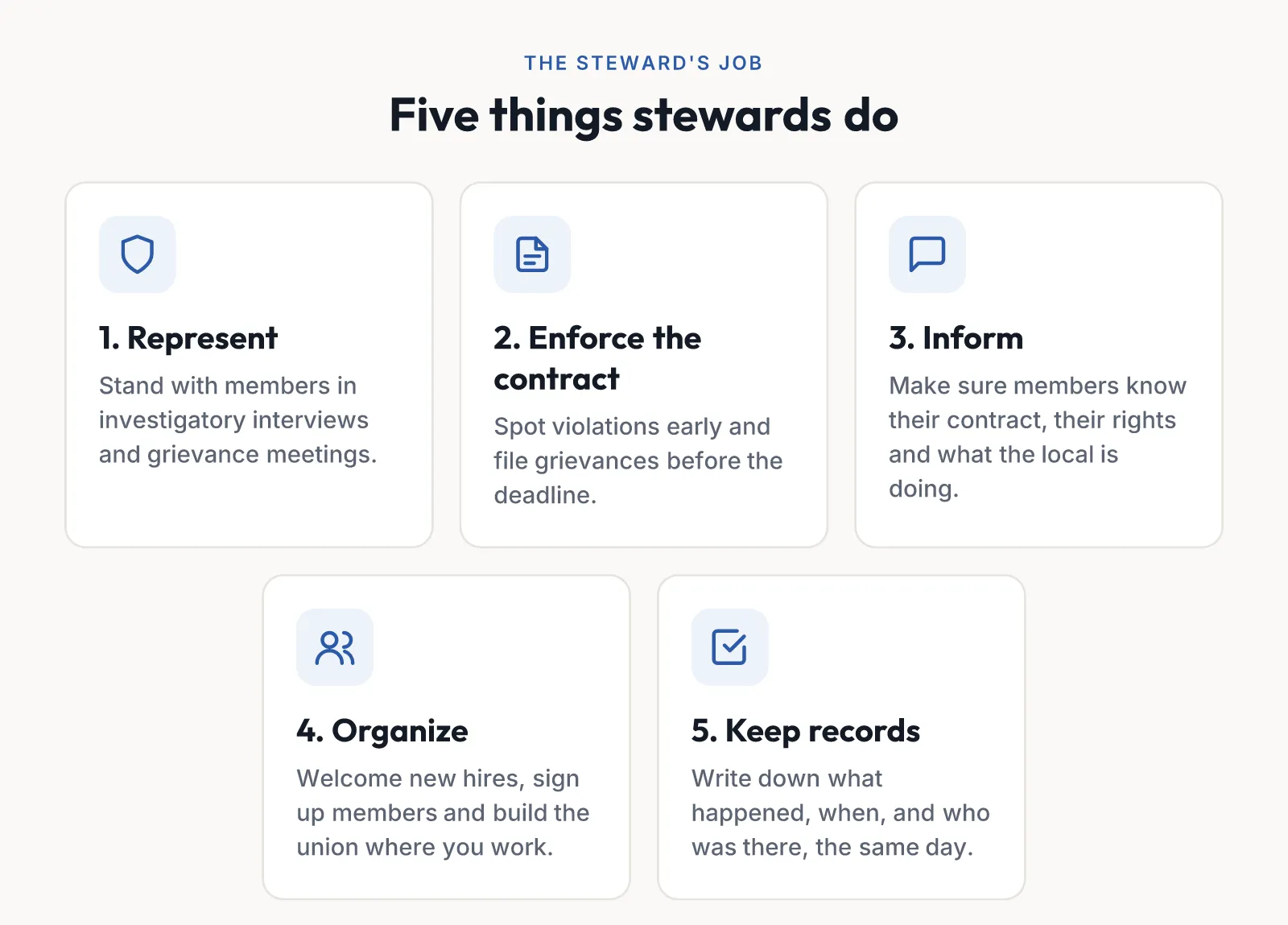
The five parts of a steward’s job.
1. Represent members
Stewards stand with members when management asks questions that could lead to discipline, and in grievance meetings. A member who asks for a steward before an investigatory interview they reasonably believe could lead to discipline generally has a right to one. See the Weingarten rights guide.
2. Enforce the contract
The contract only works if someone notices when it’s broken. Stewards hear about problems first: the wrong person gets overtime, a schedule changes without notice, discipline comes out of nowhere. Stewards look into it, check the contract, and file a grievance before the deadline when it’s needed. See how to write a grievance.
3. Keep members informed
Stewards pass on news from the local, explain what the contract says, and make sure members know their rights before they need them. A member who already knows the overtime rule is the one who notices when it’s skipped.
4. Organize
Stewards welcome new hires, sign up members, and bring people to meetings. When the local needs to show strength, during bargaining for example, stewards are the ones who get people moving.
5. Keep records
Write down what happened, when, who was there, and what was said, on the day it happens. A grievance can take months to reach a hearing, and by then nobody remembers it the same way. Keep copies of everything you file and everything management sends back.
What a steward isn’t
- Stewards don’t supervise anyone, and they shouldn’t do management’s job for it.
- Stewards aren’t lawyers and don’t have to know every law. They need to know the contract, and when to call the staff rep or the local’s attorney.
- Not every problem is a contract violation. A good steward still listens, explains, and helps the member find the right path.
- A steward can promise to fight for a member but can’t promise the outcome.
The union has to represent everyone in the bargaining unit fairly, whether or not they’ve joined the union and whether or not the steward likes them. That’s called the duty of fair representation. The union can still decide not to take a grievance forward, as long as it decides honestly, on the merits, and without favoritism.
A steward’s rights on the job
The details depend on your contract and on the labor law that covers your workplace, but stewards generally can count on these:
- Protection from retaliation. Management can’t discipline a steward for doing union work. Stewards still have to follow the same work rules as everyone else.
- Time for union business. Many contracts give stewards paid time, often called release time, to investigate grievances and attend meetings. Check your contract for how to ask for it.
- Information. The union can usually ask management for information it needs to enforce the contract, like schedules, overtime lists and discipline records. Put requests in writing.
- A seat in the interview. When a member asks for a steward before questioning that could lead to discipline, the steward can be there. See Weingarten rights.
Do stewards get paid?
Most stewards are volunteers. They keep their regular job and pay, and do steward work on top of it. Many contracts give paid release time for union business during work hours, and some locals pay a small stipend. Your contract and your local’s bylaws say what applies.
How to become a steward
Talk to your local’s officers. Depending on your bylaws, stewards are elected by the members in a department or worksite, or appointed by the executive board. Ask about training too. Many locals and their state and national organizations run steward trainings, and it’s worth going even after you start.
Your first month as a steward
Learn the contract
- Read the whole contract once, then reread the grievance procedure, the discipline article, seniority, overtime and scheduling
- Write the grievance time limits somewhere you’ll see them
- Ask for copies of side letters and recent settlements that affect your area
Learn your area
- Get a current list of the members you cover, with contact details
- Introduce yourself to every member in person
- Find out who’s new, and who has an open issue
Learn the people
- Meet the other stewards and your chief steward or staff rep
- Learn who’s who in management, and who has the authority to settle grievances
- Find out how your local wants grievances logged and reported
Get set up
- Keep a notebook, or a notes app, just for steward work
- Print a few Weingarten rights cards to hand out
- Save the grievance form and the just cause checklist where you can find them fast
Guides for stewards
These are the guides and free tools so far. We’ll add new ones here as they’re published.
- How to write a grievance: the five parts of a written grievance, how to word the statement and remedy, and the mistakes that sink good cases
- The grievance procedure, step by step: filing a grievance, time limits, step meetings and arbitration
- Weingarten rights: when a member can have a steward in the room, and what the steward can do there
- The seven tests of just cause: how to test whether discipline was fair
- Loudermill rights: a public-sector member’s right to answer the charges before being fired
- Garrity rights: what the Garrity warning means when a public-sector member is ordered to answer questions
- Insubordination: the obey now, grieve later rule, when a member can refuse an order, and how to defend the charge
- Progressive discipline and written warnings: the steps of discipline, how long a warning stays on a member’s record, and how to respond
- The duty of fair representation: what the union owes everyone it represents, and how to keep a record that shows it
- Seniority, bumping and layoffs: seniority lists, bumping and recall rights, and what to check when layoffs come
- Last chance agreements: what to negotiate before a member signs, with a sample agreement
- Union contract terms: a glossary of the bargaining, contract and discipline terms stewards hear most
- What a union rep does: stewards, chief stewards, business agents, staff reps and organizers, and how to become a rep
- Union grievance form: a free fillable PDF and Word form
- Just cause checklist and worksheet: the seven tests with what to look for
- Weingarten rights cards: ten wallet cards to a page
In LaborWise, stewards pull up members and their history on a phone at the worksite, and each case keeps its notes, files and step reminders, with the whole history going along when it moves to another steward.