The duty of fair representation: what it requires and how unions stay protected
What the duty of fair representation requires of a union, what counts as a breach and what doesn't, the six-month deadline, and how reps stay protected.
The duty of fair representation (DFR) is a union’s legal obligation to represent everyone in the bargaining unit fairly, in good faith, and without discrimination, whether or not they’re members of the union. It comes with being the exclusive bargaining representative: because the union speaks for everyone, it has to treat everyone fairly.
Most of what the duty asks for is ordinary casework done carefully. A union that handles each case honestly and on its merits, and keeps a clear record of what it decided, is meeting its duty.
Where the duty of fair representation comes from
The U.S. Supreme Court first recognized the duty in 1944, in Steele v. Louisville & Nashville Railroad, and later applied it to unions under the National Labor Relations Act. The NLRB treats a breach as an unfair labor practice by the union and summarizes the rule on its right to fair representation page.
Federal-sector unions have a written duty to represent everyone in the unit “without discrimination and without regard to labor organization membership” (5 U.S.C. § 7114). Public-sector unions in the states follow their state’s labor law, which usually sets a similar standard.
Because the rules differ by sector and state, and DFR claims are decided on their facts, read this post as general information, not legal advice. If a member threatens a DFR claim or files one, talk to the union’s attorney.
What the duty requires
The leading case, Vaca v. Sipes (1967), set the test that’s still used. A union breaches the duty only when its conduct toward someone it represents is:
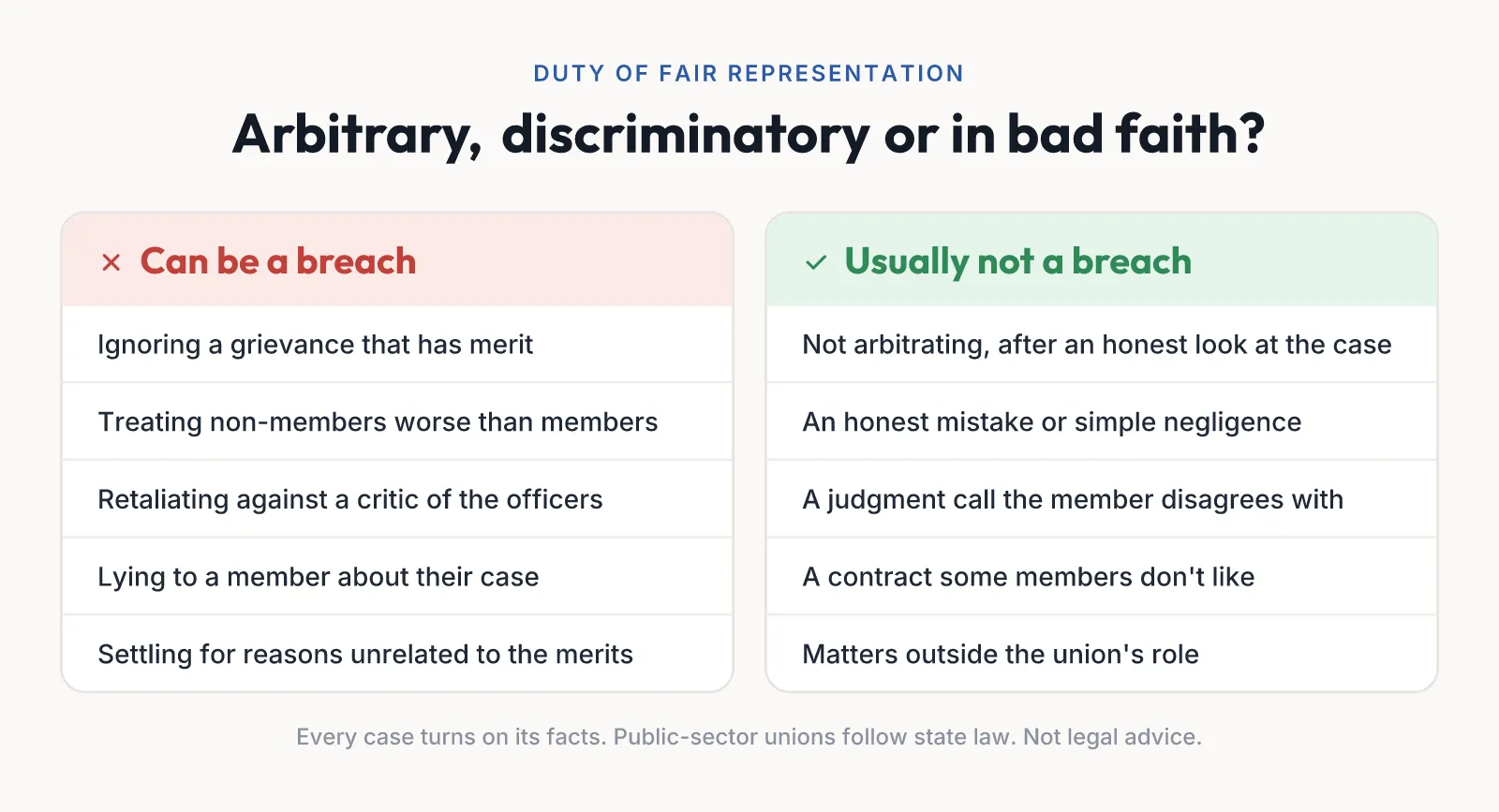
What can be a breach of the duty of fair representation, and what usually isn’t.
- Arbitrary: without a rational reason, like ignoring a strong grievance or handling it in a careless, going-through-the-motions way.
- Discriminatory: treating someone worse because of race, sex, or another unlawful reason, or because they aren’t a member, criticized the leadership, or backed the other side in an election.
- In bad faith: dishonest, like lying to a member about their grievance, or acting out of personal hostility.
The duty covers most of what a union does for the people it represents: handling grievances, bargaining the contract, and running an exclusive hiring hall. In Air Line Pilots Association v. O’Neill (1991), the Supreme Court confirmed it applies to bargaining, but gives unions a “wide range of reasonableness” in the deals they make.
What usually isn’t a breach
Deciding not to take a grievance to arbitration usually isn’t a breach. In Vaca, the Court said a member doesn’t have an absolute right to have a grievance arbitrated. A union can settle or drop a grievance in good faith, after looking at the merits.
An honest mistake usually isn’t one either. In United Steelworkers v. Rawson (1990), the Court said mere negligence isn’t a breach, and courts look for more than a simple error. The same goes for a judgment call the member disagrees with. Weighing the strength of a case, the cost of arbitration, or the effect on others in the unit is part of the union’s job.
Bargaining means trade-offs, so a contract some members don’t like isn’t a breach just because they wanted something else, as long as the deal is within that “wide range of reasonableness.”
The duty also generally doesn’t reach matters outside the union’s role, such as rights a worker can enforce on their own (a workers’ compensation claim, for example) or internal union affairs.
What can be a breach
- Ignoring a grievance with merit, or letting it die without looking at it.
- Treating non-members worse than members, for example refusing to file their grievances.
- Retaliating against a member who criticized officers or ran against them.
- Lying to a member about the status of their grievance or what management offered.
- Missing a deadline on purpose, or out of indifference rather than an honest mistake.
- Settling a grievance for reasons that have nothing to do with its merits, like a favor to management.
The six-month deadline
A worker who claims the union breached its duty, usually together with a claim that the employer broke the contract, generally has six months to sue. The Supreme Court borrowed that period from the NLRA’s deadline for unfair labor practice charges in its 1983 DelCostello decision. A charge with the NLRB also has to be filed within six months. Public-sector deadlines depend on state law.
How reps and officers stay protected
If a claim ever comes, the union answers it with its record: notes and letters that show it took the case seriously and decided honestly. These habits build that record.
- Look at every complaint. Talk to the member, gather the facts, and check the contract, even when the answer will probably be no.
- Decide on the merits. Use the same standards for everyone: the contract, the evidence, past practice, and the chances in arbitration.
- Treat everyone the same. Members and non-members, supporters and critics, get the same steward and the same effort.
- Meet every deadline. Calendar them the day a grievance comes in, and get extensions in writing.
- Keep the member informed. Tell them what you’re doing, what management said, and what the union decided.
- Explain decisions in writing. If the union won’t file, settles, or won’t arbitrate, send the member a short letter saying why. If your bylaws have an internal appeal, such as to the executive board, tell them how to use it.
- Write it all down. Notes from every meeting, copies of every letter, and the reasons behind each decision.
The steward’s part of this is covered in our shop steward guide, and the steps of a grievance in the grievance procedure, step by step.
Can a member sue the union?
In the private sector, yes, usually together with a claim against the employer, and generally within six months. Federal employees file with the Federal Labor Relations Authority instead, and state and local government workers follow state law. These cases are hard to win when the union acted honestly and kept a record.
That record, with its notes, letters, files and a reminder before each deadline, is what LaborWise cases are built to keep.