Loudermill rights: what happens at a Loudermill hearing and how to prepare
What a Loudermill hearing is, who has Loudermill rights, what the employer has to tell a member first, and how stewards help a member respond before discipline.
A Loudermill hearing is a meeting where a public-sector worker gets to answer the charges against them before the employer fires them. It’s named for the U.S. Supreme Court’s 1985 decision in Cleveland Board of Education v. Loudermill, which held that public workers who can only be fired for cause have a constitutional right to notice and a chance to respond first.
The hearing is often the union’s last chance to stop a firing before it happens. How it works for your members depends on your contract, civil service rules and state law, so every situation is different. Treat what follows as general information, not legal advice, and talk to your staff rep or the union’s attorney about any serious case.
What is a Loudermill hearing?
It’s a pre-disciplinary meeting, sometimes called a pre-termination hearing or a Loudermill meeting. The employer explains the charges and its evidence, and the member gets to tell their side before a final decision is made.
The Supreme Court said the hearing “need not be elaborate.” It isn’t a trial. There’s usually no judge, no sworn testimony and no cross-examination. It’s a check against mistakes: a chance to show the employer that the charges are wrong, or that the penalty is too harsh, before it acts.
Who has Loudermill rights?
Loudermill rights come from the Constitution’s due process clause, so they apply to government employers: federal, state and local government, school districts, public colleges and other public bodies. Private-sector workers don’t have Loudermill rights, though their contract may give them something similar.
The right also depends on having a property interest in the job. That usually means a law, civil service rule or union contract says the worker can only be fired for cause. Probationary workers and at-will workers generally don’t have it.
Loudermill is about discharge, but courts have applied the same idea to other serious discipline, like long unpaid suspensions or demotions. How far it reaches depends on your state and your rules.
What the employer has to give the member
The Supreme Court set out three things a covered worker gets before termination:
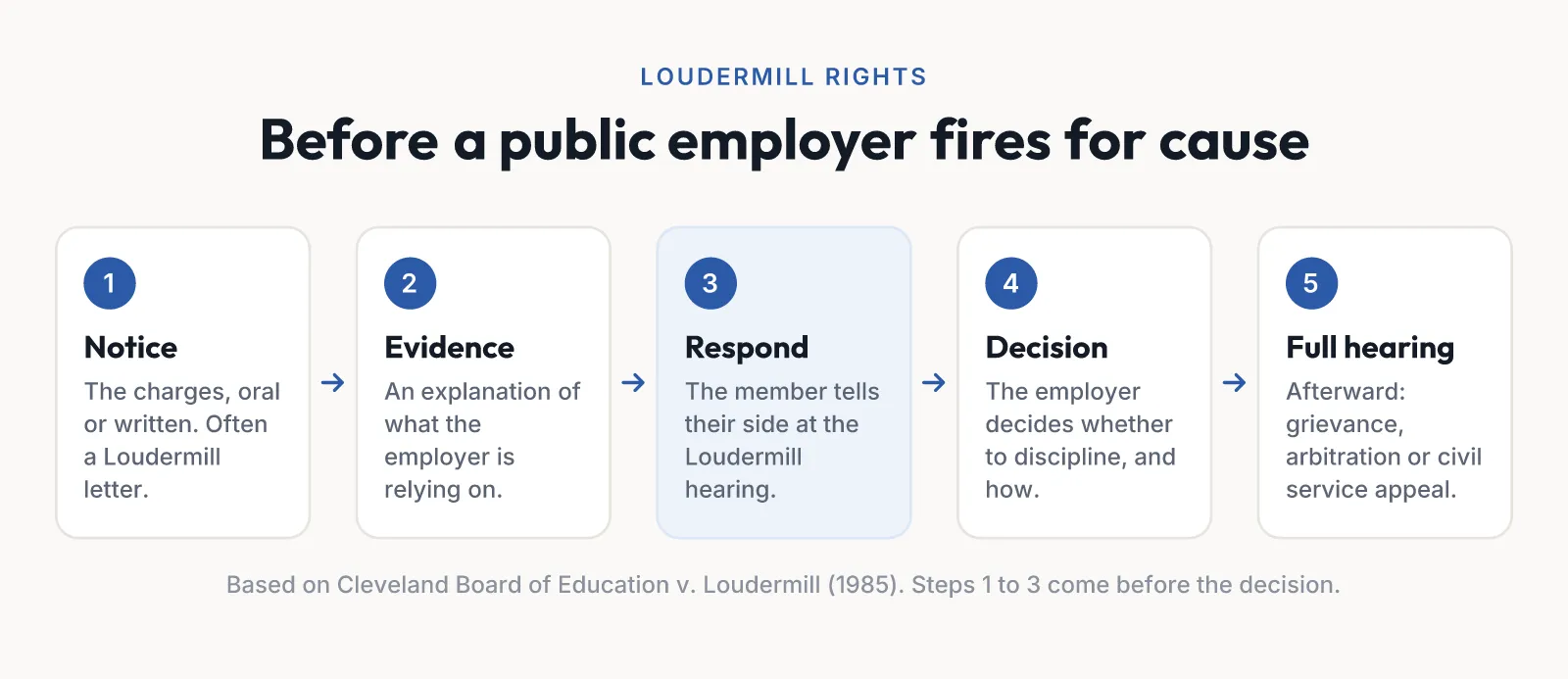
The Loudermill process, from the notice to the full hearing after a decision.
- Notice of the charges. Oral or written. In practice it usually comes as a letter, often called a Loudermill letter or Loudermill notice.
- An explanation of the employer’s evidence. What the employer thinks happened, and what it’s relying on.
- A chance to respond. The member can explain, deny, correct the record, or give reasons for a lighter penalty.
Loudermill also assumes there’s a fuller hearing after the decision, like a civil service appeal, a grievance, or arbitration.
Suspensions without a hearing first
One exception: in Gilbert v. Homar (1997), the Supreme Court said a public employer could suspend a police officer without pay before a hearing because he had been arrested and formally charged with a felony. The arrest and charges already showed the suspension wasn’t baseless. The Court stressed that a prompt hearing afterward still matters.
Loudermill, Weingarten and Garrity
Stewards often hear these three named together, but they come up at different points in a case. Weingarten covers the investigatory interview that could lead to discipline, where a member can ask for a union representative (see our Weingarten rights guide). Garrity keeps answers a public worker was ordered to give out of any criminal case. Loudermill comes later, once the employer is ready to fire for cause. Our Garrity rights guide compares all three side by side.
Does the member get a union rep at a Loudermill hearing?
The Constitution doesn’t guarantee one. But many contracts, civil service rules and state laws do, and most employers allow it. Check your contract’s discipline article. If it’s silent, ask in writing for the steward or rep to attend.
How stewards prepare a member
Most of the work happens before the hearing:
- Get the notice and every piece of evidence the employer is relying on. If something is missing, ask for it in writing.
- Read the charges against the contract and the work rules. Is the rule real, was it known, and was it applied the same way to others?
- Walk through the seven tests of just cause to find the weak spots in the employer’s case.
- Talk with the member alone. Get their full account, names of witnesses, and anything that explains or softens what happened.
- Decide together what the member will say and what the steward will say. If there’s any chance of criminal charges, get legal advice before the member says anything.
At the hearing itself, keep it short and factual. Correct errors in the employer’s account and point to evidence it left out. Raise anything that argues for a lighter penalty: years of good service, no prior discipline, a clear explanation, unequal treatment of others. Take notes, including who was there, what was said, and the time. If new information comes up and you need more time to respond, ask for it.
Afterward, put the member’s response in writing if the employer allows, and keep a copy. Then watch the calendar. If the employer goes ahead, grievance or appeal deadlines usually start right away.
Quick answers
Is a Loudermill hearing the same as a disciplinary hearing? No. It comes before the decision and is meant to be brief. A full hearing, like arbitration or a civil service appeal, comes after.
Does the member have to speak? No one can force a member to talk at a Loudermill hearing, but staying silent gives up the chance to change the outcome. Decide with the rep in advance. If criminal charges are possible, get legal advice first.
What if there was no Loudermill hearing? A covered worker fired without notice and a chance to respond may have a due process claim, and the contract may give grievance rights too. Raise it right away with your staff rep or attorney.
If your union uses LaborWise, open a case when the Loudermill notice arrives, and the notice, the evidence, your notes and the deadlines stay together on it from the hearing through any appeal. See how cases work.