Weingarten rights: a guide for stewards and members
When a member can have a steward in the room, what management can and can't do, what the steward can say, and how New York's public-sector rule differs.
A supervisor calls a member into the office and starts asking about something that happened on the last shift. If the answers could get the member disciplined, the member has the right to ask for a steward first. That’s what people mean by Weingarten rights, named for the 1975 Supreme Court case NLRB v. J. Weingarten, Inc.
The right only works if members know about it and use it, so teach it before anyone is sitting across the desk from a supervisor.
Weingarten rights come from the federal labor law that covers private-sector workers. Federal workers have a similar right under their own law (5 U.S.C. § 7114), and agencies must remind them of it every year. State and local government workers get their rights from state law and their contract, and those can be stronger or weaker. Every contract and situation is different, and this is general information, not legal advice. For a specific case, check your contract and ask your staff rep or the local’s attorney.
When Weingarten rights apply
For private-sector workers, the right applies when all four of these are true:
- The worker is represented by a union. Under current National Labor Relations Board law, the right belongs to workers who have a union, whether or not they’ve joined it.
- It’s an investigatory interview. Management is asking questions to find out what happened. Giving instructions doesn’t count.
- The member reasonably believes it could lead to discipline. What matters is what a reasonable person would think. The supervisor’s description of the meeting doesn’t decide it.
- The member asks for a representative. The right doesn’t kick in on its own.
A meeting can start as a routine talk and turn into an investigation partway through. If the questions shift toward something the member could be disciplined for, the member can ask for a steward at that point.
Meetings that usually don’t count
- A meeting only to hand over discipline that’s already been decided
- Training or correction on how to do the work
- A meeting where management says in advance, and means it, that no discipline will come from it
If management starts asking questions in any of these, the picture can change. When in doubt, the member should ask for a steward.
The member has to ask
Under the federal rule, management doesn’t have to tell the member about the right. The member has to ask, before or during the interview. Asking once is enough; the member doesn’t have to keep repeating it.
The words don’t have to be perfect. Something like this works:
“If this discussion could lead to my being disciplined or fired, or affect my working conditions, I ask that my union steward or representative be present. I’d like to wait until my representative is here before answering questions.”
That’s the wording on the free printable cards. Members can keep one in a wallet or on their phone.
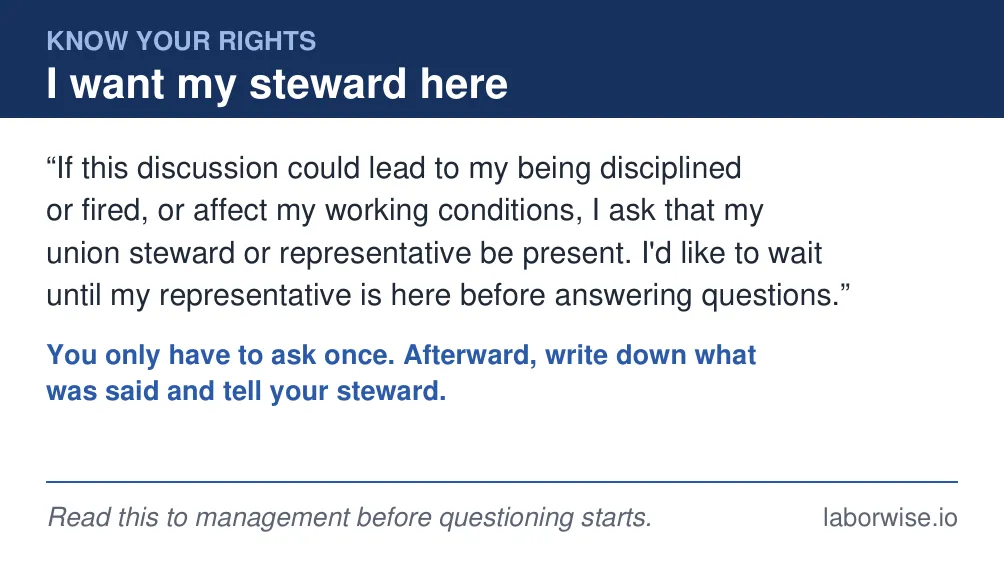
One of the ten cards on the printable sheet.
What management can do after the member asks
Once the member asks, management has three choices:
- Agree, and wait until a steward or rep can be there
- Say no and end the interview
- Give the member the choice of going ahead without a representative or ending the interview
What management may not do is refuse and keep asking questions. The NLRB’s guidance says that can be an unfair labor practice, and so is disciplining a member for refusing to answer without their representative.
What the steward can do in the room
The steward can do more than sit and listen. Under the NLRB’s guidance, the steward can:
- Be told what the interview is about before it starts
- Meet with the member before questioning to hear their side and talk through the interview
- Ask management to clarify confusing questions
- Advise the member on how to answer, within limits
- Object to questions that are badgering, intimidating or offensive
- Add information after the questions are done
There are limits. The steward has to stay civil, can’t block a legitimate investigation, and can’t tell the member what to say or to give false answers. A steward who turns hostile or disruptive can be removed from the meeting.
How a steward handles the interview
Before questioning starts, ask management what the interview is about, and check the contract for anything that applies. Then meet with the member alone. Get their account, and remind them to answer truthfully, stay calm, and not guess or volunteer extra.
In the room, take notes: who’s there, the questions and the answers, and the times. Ask for clarification when a question is vague or loaded. At the end, add any facts that help the member.
Write up your notes the same day and keep them with the member’s file. Tell the member what happens next. If discipline follows, check the deadline for filing a grievance right away.
If management refuses and keeps going
If management says no and keeps questioning, the member should stay calm and stay in the room. Walking out can create a separate problem. They should repeat that they want a representative, take notes if they can, and contact a steward as soon as it’s over.
In the private sector, the local can file an unfair labor practice charge with the NLRB. Charges generally have to be filed within six months, so don’t wait. Talk to your staff rep about whether to file.
Public-sector locals in New York
Weingarten is a federal private-sector rule. The National Labor Relations Act doesn’t cover public employers, so city, county, state and school district workers get their rights elsewhere.
In New York, Civil Service Law § 75(2) gives a public-sector worker who appears to be a potential subject of discipline the right to union representation when questioned. In some ways it goes further than Weingarten:
- The employer has to give notice. The member must be told about the right in advance, in writing, so they don’t have to know to ask.
- If the member asks, they get a reasonable time to bring a rep in. If they can’t get one in that time, the employer can go ahead with the questions.
- If a hearing officer finds the member wasn’t given a reasonable time, statements from the questioning and evidence that came from them are excluded.
Two cautions. Section 75 covers many public-sector workers but not all; who it covers depends on things like job class and years of service. And many contracts set their own discipline procedures, which the statute doesn’t replace. Read your contract’s discipline article alongside § 75, and ask your staff rep how they fit together for your unit.
Outside New York, public-sector rights depend on each state’s labor law and your contract.
Getting the cards to members
Hand out the cards at new member orientation and at meetings, post one on the bulletin board, and send them in your next member email. Stewards should keep a few on hand.
A LaborWise discipline case can hold the interview record: the steward’s notes, the date and the outcome sit on the member’s case, so the next rep who picks it up sees what happened. See how discipline cases work.
Sources: NLRB: Weingarten rights (guidance from the NLRB’s Office of the General Counsel) · NLRB v. J. Weingarten, Inc., 420 U.S. 251 (1975) · New York Civil Service Law § 75