The seven tests of just cause: a steward's guide
What each of the seven tests of just cause asks, how stewards use them to fight unfair discipline, and a free checklist and worksheet to work through.
Most union contracts say management can only discipline or fire a member for just cause. Few of them say what just cause means. Over the years, arbitrators filled that gap, and the best-known version is a list of seven questions. Stewards call them the seven tests of just cause.
Arbitrator Carroll Daugherty set them out in a 1966 decision, Enterprise Wire Co., 46 LA 359. He wrote that a “no” to any one of the questions normally means just cause didn’t exist, though a weak “no” might only justify a lighter penalty. Arbitrators today rarely apply the list that mechanically, but its questions still shape how discipline cases are argued.
Start with your own contract’s discipline article. Some contracts use different words, like “proper cause” or “for cause”, or spell out their own discipline rules, and public-sector workers may also have rights under state civil service law. Every contract is different. What’s here is general information, not legal advice, so ask your staff rep about a specific case.
How stewards use the seven tests
Use the tests from the start of a case to decide what to find out and what to ask management for, then use the same list to organize the grievance and your argument in the meeting, in an order management and any arbitrator will recognize.
You don’t need a “no” on all seven. A strong case usually has clear problems on one or two. Work through every test anyway, because the problem is often somewhere you didn’t expect.
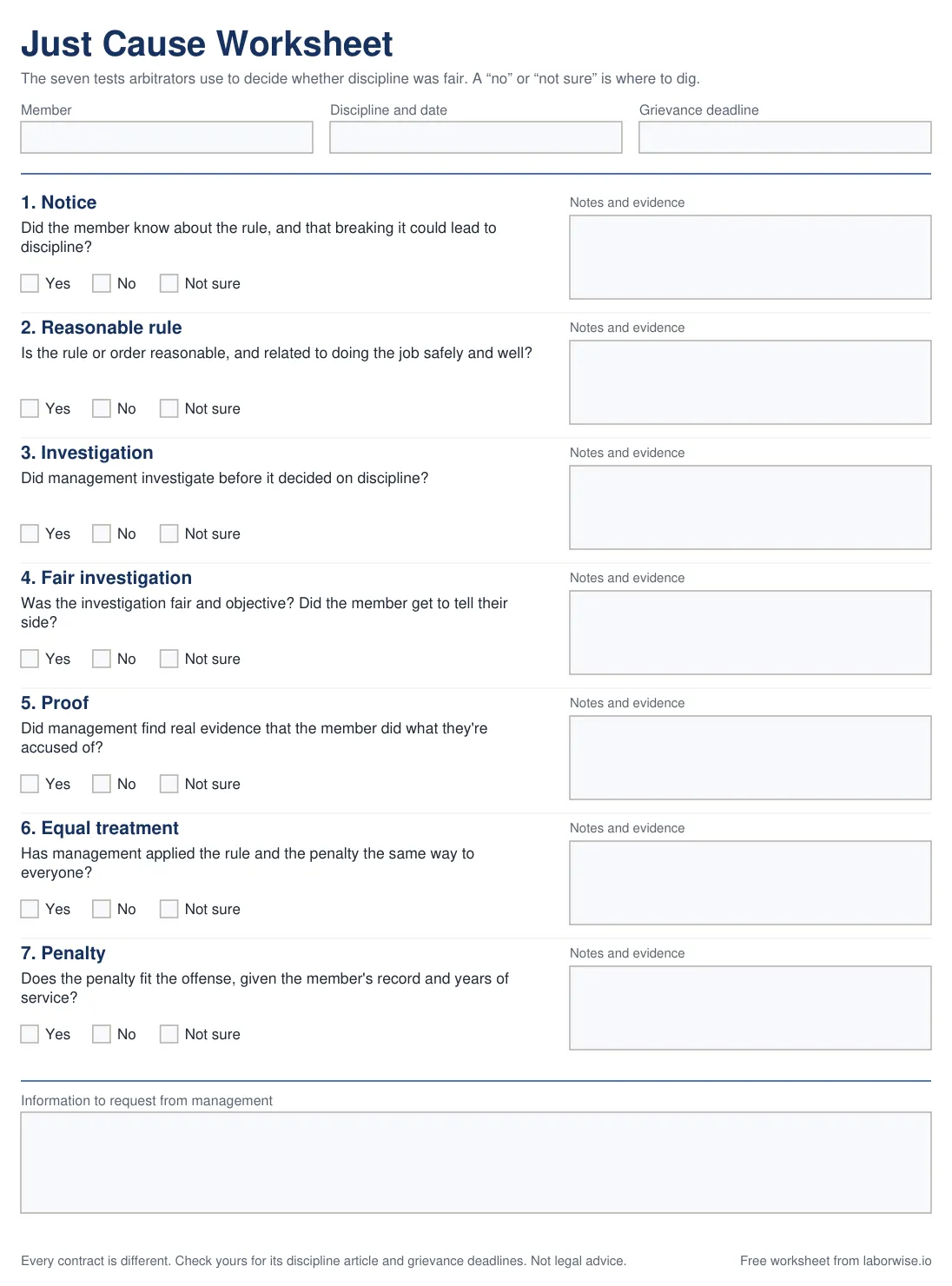
The one-page worksheet. Keep a filled-in copy with every discipline case.
The seven tests
1. Notice
Did the member know about the rule, and that breaking it could lead to discipline?
A rule that isn’t written down, posted or explained is hard to enforce. Check the handbook, posted policies and training records. Some conduct, like theft or violence, is widely understood to be wrong even without a written rule.
2. Reasonable rule
Is the rule or order reasonable, and related to doing the job safely and well?
Management can make reasonable rules about how the work gets done. A rule with no real work reason behind it, or one that conflicts with the contract, can be challenged. This test is usually the hardest for the union to win on its own.
3. Investigation
Did management investigate before it decided on discipline?
Management should look into what happened and only then settle on a penalty. Ask when the penalty was decided, and whether anyone talked to the member first.
4. Fair investigation
Was the investigation fair and objective? Did the member get to tell their side?
Look at who investigated and how. A supervisor who was part of the incident isn’t neutral. If the member asked for a steward during questioning and was refused, raise that too. See Weingarten rights.
5. Proof
Did management find real evidence that the member did what they’re accused of?
Suspicion isn’t proof. Ask for every piece of evidence management relied on, and check that it proves the exact charge in the discipline notice. Evidence of something close to the charge isn’t enough.
6. Equal treatment
Has management applied the rule and the penalty the same way to everyone?
If others broke the same rule and got a lighter penalty, or nothing, that matters. Ask for discipline records for the same rule over the last few years; names can be blacked out.
7. Penalty
Does the penalty fit the offense, given the member’s record and years of service?
Even when the member did it, the penalty can be too harsh. A long, clean record counts. So does a contract that calls for progressive discipline, usually a warning before a suspension and a suspension before a firing.
An example from Local 418
Here’s how the tests work on a fictional case. A Local 418 member in the Parks Department gets a three-day suspension for not wearing a high-visibility vest on a roadside job.
The steward works through the checklist:
- Notice: The vest rule is in the safety manual, but the member was hired after the last safety training, and there’s no sign-off sheet for them. Not sure.
- Reasonable rule: Vests on roadside work are a clear safety rule. Yes.
- Investigation and fair investigation: The supervisor wrote it up on the spot and never asked the member why. No.
- Proof: The supervisor’s photo shows the member without a vest. Yes.
- Equal treatment: Two other crew members say they’ve worked without vests and were only told to put one on. No.
- Penalty: The member has six years with a clean record, and the contract calls for progressive discipline. No.
The member broke the rule, but management’s case is weak on notice, investigation, equal treatment and penalty. The steward files a grievance asking that the suspension be removed and the member paid for the three days.
Before the grievance meeting
- Fill in the worksheet and list what you still need
- Send a written request for the information on your list, early; the grievance clock keeps running while you wait
- Check the contract’s discipline article and its grievance time limits
- Talk the case through with the member, and with your staff rep if it’s serious
Public-sector locals in New York
New York’s Civil Service Law § 75 sets its own discipline standard for many public-sector workers: incompetency or misconduct, proven at a hearing on written charges. Many contracts replace the § 75 procedure with their own, often ending in arbitration under a just cause standard. Which one applies depends on your contract and your members’ job titles, so check with your staff rep, and work through the seven questions before the hearing whichever one it is.
A LaborWise discipline case follows the review from investigation and the member interview to the outcome, with your notes and files kept together.
Sources: Enterprise Wire Co., 46 LA 359 (1966) (Daugherty, Arb.) · Labor Notes: Time to update the union handbook on just cause · New York Civil Service Law § 75