Garrity rights: what the Garrity warning means for union members
What Garrity rights are, when a Garrity warning applies, what a Garrity statement can and can't be used for, and what stewards should do in the interview.
Garrity rights protect public-sector workers who are ordered to answer their employer’s questions. If a member has to answer or face discipline, those answers can’t be used against them in a criminal case. The rule comes from the U.S. Supreme Court’s 1967 decision in Garrity v. New Jersey.
Garrity comes up most for police, corrections officers and firefighters, but it covers every government worker: teachers, transit workers, clerks, nurses at public hospitals. Get Garrity wrong and a discipline case can become a criminal one.
Every case is different, and this is general information, not legal advice. Garrity is about criminal exposure. If there’s any chance a member could face criminal charges, get them a lawyer before they answer questions.
What are Garrity rights?
The Fifth Amendment protects everyone from being forced to incriminate themselves. Public workers face a special problem: their employer is the government, and it can order them to answer questions about their work.
In Garrity, police officers were told they’d lose their jobs if they didn’t answer questions in an investigation. Their answers were then used to convict them. The Supreme Court said that wasn’t allowed: statements obtained under threat of removal from office can’t be used in a later criminal case.
A year later, in Gardner v. Broderick, the Court added the other half. A public employer can’t fire a worker for refusing to give up that protection. But if the questions are “specifically, directly, and narrowly” about the worker’s job, and the worker isn’t asked to waive immunity, the employer can discipline them for refusing to answer.
So the member must answer job-related questions when ordered, or risk discipline for refusing. In exchange, the answers can’t be used to prosecute them, and neither can evidence found because of those answers.
The Garrity warning
Many public employers start these interviews with a written Garrity warning, sometimes called an administrative warning. It tells the worker that:
- the interview is part of an administrative (workplace) investigation,
- they’re ordered to answer, and refusing can lead to discipline up to termination,
- their answers, and evidence derived from them, can’t be used against them in a criminal case.
Federal agencies use a similar notice called a Kalkines warning. Some states have their own versions written into law or into police officers’ bills of rights.
The names aren’t used the same way everywhere. Some employers, especially federal agencies, use “Garrity warning” for the opposite notice: the interview is voluntary, the worker can stay silent, and anything they say can be used in a criminal case. That kind of warning gives no protection. Always read the actual words of the warning, and if it says the interview is voluntary, get advice before the member answers.
What a Garrity statement can and can’t be used for
A Garrity statement is what the member says after being ordered to answer.
- Criminal cases. It can’t be used to prosecute the member for a crime, and neither can evidence the employer or police found because of it.
- Discipline. It can be used here. The employer can fire someone based on what they said in a Garrity interview.
- Dishonesty. Garrity doesn’t protect lies. A member who gives a false Garrity statement can be disciplined for dishonesty, and false statements can bring their own charges. In many workplaces, dishonesty is treated more harshly than the original issue.
- Voluntary statements. Garrity only covers compelled statements. If the member talks voluntarily, Garrity may not apply, so the order to answer has to be clear.
Garrity doesn’t apply in the private sector
Garrity rests on the Constitution, which limits what the government can do. Private employers aren’t the government, so Garrity doesn’t protect private-sector workers. A private-sector member facing possible criminal charges needs a lawyer before answering any questions.
Garrity, Weingarten and Loudermill
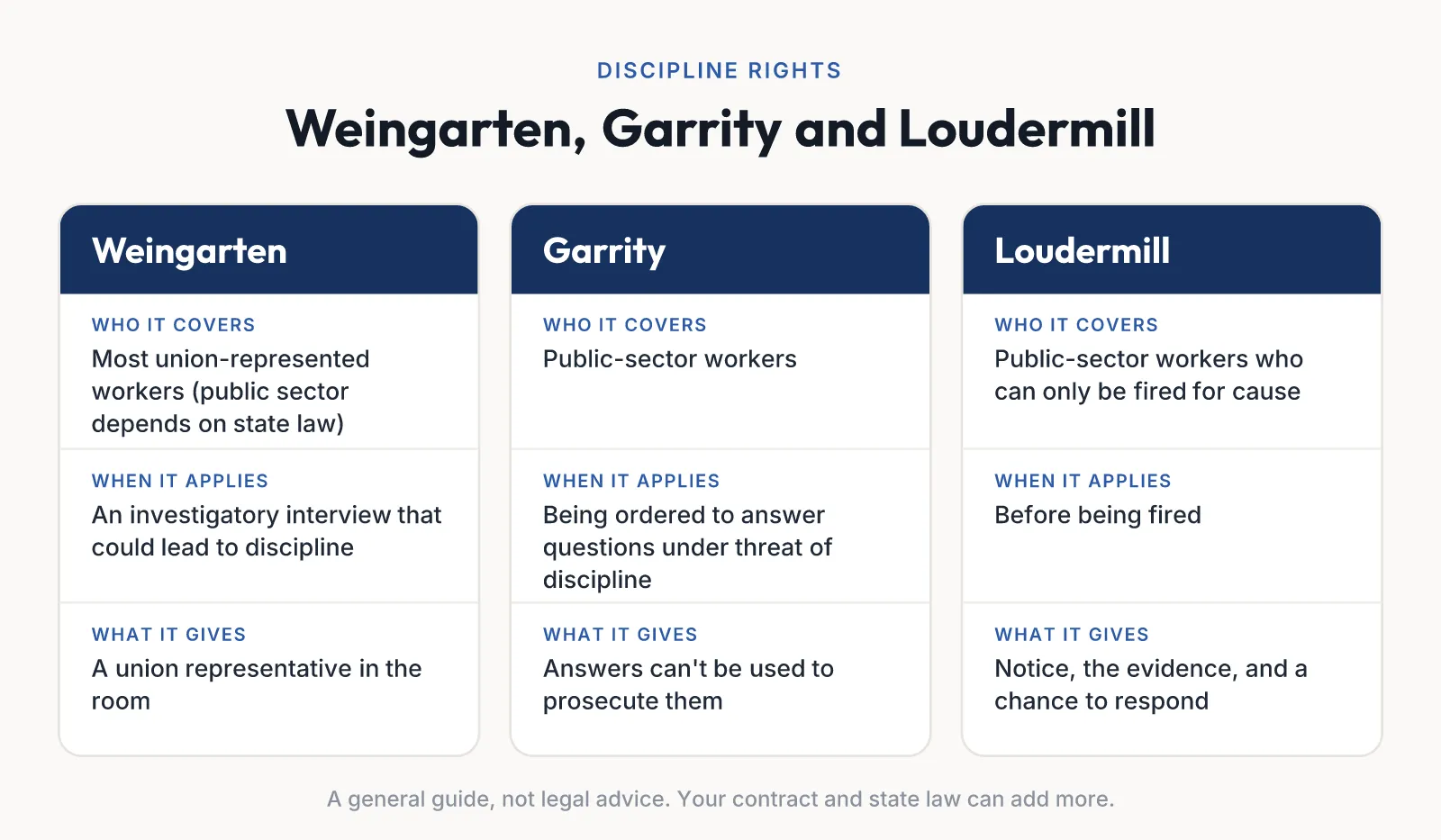
Three rights stewards hear about most, side by side.
- Weingarten is the right to a union representative in an investigatory interview that could lead to discipline. See our Weingarten rights guide.
- Garrity protects a public worker’s answers, given under orders, from use in a criminal case.
- Loudermill is a public worker’s right to notice and a chance to respond before being fired for cause. See our Loudermill rights guide.
One case can involve all three. A member asks for a steward under Weingarten, gets a Garrity warning before questioning, and later has a Loudermill hearing before any firing.
Quick answers
Can a member refuse to answer?
They can, but if the questions are about their job and they’ve been ordered to answer under a proper warning, refusing can lead to discipline.
Does a Garrity warning mean the member is being charged with a crime?
No. A compelled-answer warning means the employer is ordering answers in a workplace investigation and confirming they can’t be used in a criminal case. Read it closely, though: a warning that says the interview is voluntary means the opposite.
Can the police get the Garrity statement?
They can’t use it, or evidence derived from it, to prosecute the member. Many agencies keep administrative and criminal investigations separate for this reason.
What stewards should do
Before the interview
- Ask what the interview is about, and whether it’s administrative, criminal, or both.
- Ask whether the member is being ordered to answer. If they are, ask for the order and any Garrity warning in writing.
- If criminal charges are possible, stop and get the member a lawyer before any questions.
In the interview
- Make sure the order to answer is clear and on the record. If the employer won’t give a written warning, many reps have the member say before answering that they’re answering because they’ve been ordered to, under threat of discipline.
- Help the member answer truthfully and only the question asked. Guessing and volunteering cause trouble.
- Keep the questions to the member’s job. The employer can discipline a refusal to answer only questions about the job. If the questions stray, object and get advice before the member answers.
- Take careful notes, including the time, who was there, and the exact wording of the order.
Afterward
Ask for a copy of the member’s statement or the recording. Keep the Garrity warning with the case file, because if criminal charges ever come up, the member’s lawyer will need it. If your union uses LaborWise, the warning, your interview notes and the member’s statement can stay together on the member’s case, along with every deadline that follows.