Filing a grievance: the union grievance procedure, step by step
How filing a grievance works: the steps in a typical union grievance procedure, time limits, step meetings, policy grievances and arbitration.
A grievance procedure is the process a union contract sets up for settling disputes about the contract. When a member believes management broke the contract, the union files a grievance, and the procedure moves it through a series of meetings, or steps, with higher levels of management. If those don’t settle it, most procedures end in arbitration, where a neutral arbitrator decides.
No two procedures are quite alike. Your contract sets the number of steps, who hears each one and the time limits, so read its grievance article first and keep it open while you work a case. For help wording the grievance itself, see how to write a grievance.
What is a grievance procedure?
It’s the contract’s system for enforcing itself. Instead of going to court or walking off the job, the union and management agree to resolve disputes through a set series of steps, each with a deadline. A grievance usually covers:
- a contract violation: management did something the contract doesn’t allow, or failed to do something it requires,
- unfair discipline: a warning, suspension or firing without just cause,
- past practice: management changed a long-standing practice the contract protects,
- rules and laws the contract brings in, depending on how your grievance article defines a grievance.
Some contracts define a grievance narrowly, as a dispute over the meaning or application of the contract. Others are broader. That definition decides what can be grieved, so check it.
Who can file a grievance?
- An individual grievance is filed for one member, usually by the steward with the member.
- A group grievance, sometimes called a class action grievance, covers several members affected the same way, like everyone denied overtime on a shift.
- A policy grievance, or union grievance, is filed by the union itself over a violation that affects the whole bargaining unit or the union’s rights, like a new policy imposed without bargaining.
In most contracts the union, not the member, controls the grievance once it’s filed. The union decides whether to settle, withdraw or take it to arbitration. It has to make those decisions fairly and in good faith, which is the duty of fair representation. In the private sector, federal law also lets a member take a grievance to the employer on their own, but any settlement has to fit the contract and the union gets the chance to be there.
Watch the time limits
A grievance filed or appealed late can be thrown out before anyone looks at the facts. Most contracts set three time limits:
- a time to file, often counted from the day of the incident or the day the member learned of it,
- a time for management to answer at each step,
- a time to appeal to the next step after an answer, or after management fails to answer.
Note whether your contract counts calendar days or working days. Put every deadline on the calendar the day the grievance comes in. If you need more time, get an extension in writing before the deadline passes.
The steps in a typical grievance procedure
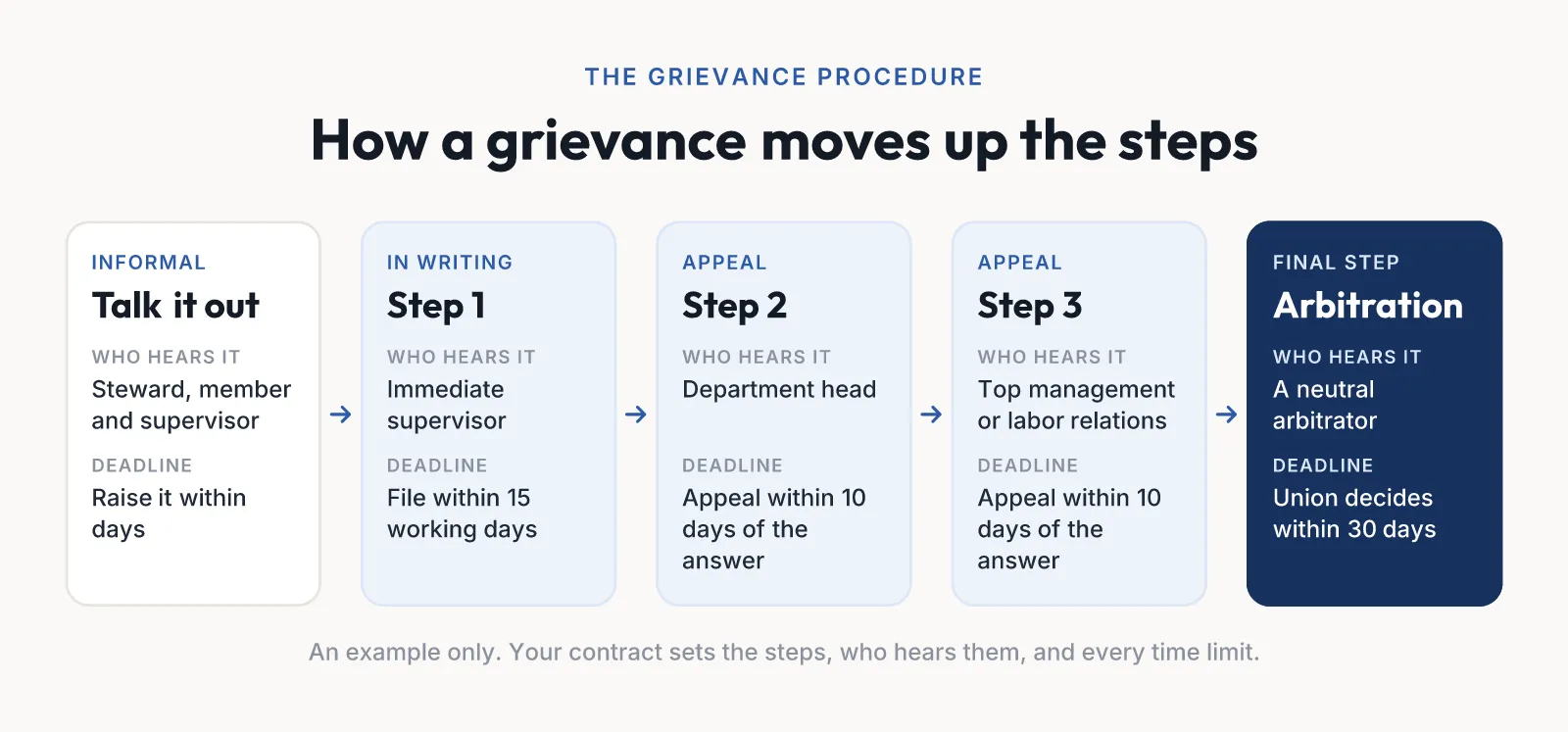
An example grievance procedure. Your contract sets the real steps and time limits.
Informal step: talk it out
Many contracts start with an informal talk between the steward, the member and the supervisor. Plenty of problems end here, quickly and without paper. Keep notes anyway, and keep an eye on the deadline to file in writing if the talk doesn’t settle it.
Step 1: the written grievance
If the informal talk doesn’t work, the union files a written grievance, usually with the immediate supervisor or the first level of management named in the contract. The written grievance states what happened, which contract articles were broken, and the remedy the union wants. Our free grievance form has every part.
Step 2 and beyond: appeal up the line
If the answer at Step 1 denies the grievance, or doesn’t come at all, the union appeals to the next step, often a department head, then the human resources or labor relations director, then the top official. Each step usually has a grievance meeting, sometimes called a step meeting or grievance hearing, where the union presents its case and management responds.
Arbitration
If the last step doesn’t settle it, the union can take the grievance to arbitration. A neutral arbitrator, chosen by both sides, holds a hearing and issues a decision, called an award, that’s usually final and binding. Arbitrators are commonly picked from lists provided by agencies such as the Federal Mediation and Conciliation Service or a state labor agency. The union and the employer usually split the arbitrator’s fees.
Arbitration is expensive and slow, so the union decides carefully which cases to take there. Not every grievance should go, and the union isn’t required to take one there just because the member wants it. For choosing an arbitrator, preparing the case and what happens at the hearing, see labor arbitration hearings.
How to file a grievance
- Talk to the member. Get the full story: what happened, when, who was there, and what the member wants.
- Find the contract violation. Name the article and section. If discipline is involved, test it against the seven tests of just cause.
- Check the deadline. Count from the date the contract says, in calendar or working days.
- Ask for information. Request the records you need from management in writing: schedules, overtime lists, discipline files, emails.
- Write it up. Keep it short and factual, cite the contract, and ask for a full remedy. See how to write a grievance.
- File it the way the contract says. Deliver it to the right person, get the date it was received, and keep a copy.
Preparing for a grievance meeting
- Bring the grievance, the contract, your evidence and your notes.
- Decide in advance who speaks for the union. Usually that’s the steward, not the member.
- Stick to the facts and the contract. Let management explain its side, and take notes.
- Ask what management is willing to offer. Many grievances settle at a step meeting.
- Afterward, confirm any agreement in writing, and calendar the deadline for management’s written answer.
What if management doesn’t answer?
Read your contract. Many say that if management misses its deadline, the union can move the grievance to the next step. Some say the grievance is granted. Either way, don’t let the union’s own deadline pass while you wait.
Settling or withdrawing a grievance
Most grievances settle before arbitration. Put every settlement in writing, signed by both sides, and say whether it sets a precedent or is “without precedent,” meaning it doesn’t bind future cases. If the union decides to withdraw a grievance, tell the member why, and note whether it’s withdrawn “without prejudice,” so the union can raise the issue again later.
Common mistakes
- Letting a deadline slip, including the union’s own appeal date while you wait for management to answer.
- Settling without telling the member. The union decides, but the member should know what’s happening at every step.
- Asking for too little. Ask for a full remedy, like back pay, a cleared record, and making the member whole.
- Leaving no paper trail. Write down every meeting, answer and extension, with dates.
LaborWise lays each grievance out in your contract’s own steps, sends reminders before each deadline, and keeps the notes, files and letters with the case. See how cases work.