Labor arbitration: how a union arbitration hearing works, step by step
How union arbitration works: binding arbitration, arbitrability, choosing an arbitrator, preparing the case, the hearing itself, costs, timing and the award.
Labor arbitration is the last step of most union grievance procedures. When the union and the employer can’t settle a grievance, a neutral arbitrator holds a hearing, listens to both sides, and issues a decision, called an award, that both must follow. It’s how most union contracts are enforced without strikes or lawsuits.
Arbitration also costs more than any earlier step of a grievance, and it can take months, so the union has to choose carefully which cases go there.
This is general information, not legal advice, and every contract is different. Your contract’s arbitration clause sets the rules. Many unions bring in an attorney or an experienced staff rep for arbitration, especially for discharge cases.
What is binding arbitration?
In binding arbitration, both sides agree in advance to accept the arbitrator’s decision as final. Most union contracts call for it as the last step of the grievance procedure. The trade-off is in the contract itself: the union usually gives up the right to strike over grievances during the contract, and the employer agrees to let a neutral decide disputes.
Labor arbitration is different from the consumer and employment arbitration people see in phone contracts and job applications. It’s agreed to by the union and the employer through bargaining, both sides pick the arbitrator, and the arbitrator applies the contract.
The U.S. Supreme Court has strongly backed labor arbitration. In Enterprise Wheel, one of three 1960 decisions on labor arbitration, it said courts shouldn’t review the merits of an award, as long as the award “draws its essence” from the contract.
Deciding whether to arbitrate
The union, not the individual member, usually decides whether to take a grievance to arbitration. Weigh:
- How strong are the facts and the contract language? For discipline, does the case pass the seven tests of just cause?
- What’s at stake? A discharge, a pattern of contract violations, or a precedent that affects the whole unit is worth more than a one-time dispute.
- What will it cost, and how long will it take? See below.
- What happens if you lose? A loss can set a bad precedent that’s hard to undo.
Make the decision honestly and on the merits, and tell the member why in writing. That’s what the duty of fair representation requires.
Most contracts set a deadline to demand arbitration after the last step answer, often 15 to 30 days. Don’t miss it while deciding.
Arbitrability
Before the merits, the employer sometimes argues that the grievance isn’t arbitrable, meaning it can’t go to arbitration at all. There are two kinds of arguments:
- Substantive: the dispute isn’t covered by the contract’s arbitration clause.
- Procedural: the union missed a step or a deadline along the way.
Arbitrators often hear arbitrability first, then the merits, at the same hearing. Against a procedural argument, the union’s best answer is its own record showing every step was filed on time.
Choosing an arbitrator
Contracts handle this in a few ways:
- A permanent arbitrator or a panel named in the contract, who take cases in turn.
- A list from an agency. The union or employer asks an agency such as the Federal Mediation and Conciliation Service (FMCS), the American Arbitration Association, or a state labor agency for a list, often seven names.
- Striking names. From the list, the two sides take turns striking names until one is left.
Before striking, research each name: past awards, experience in your industry, and what other unions say. Many awards are published, and your national union or state federation may track arbitrators.
How to prepare for an arbitration hearing
- Know the burden of proof. In discipline cases, the employer usually has to prove just cause. In contract cases, the union usually has to prove the contract was broken.
- Gather the documents: the contract, the grievance, every step answer, the discipline records, emails, schedules, and anything else you’ll rely on. Agree with the employer on joint exhibits where you can.
- Request information from the employer early, in writing.
- Prepare witnesses. Meet with each one, go over what they’ll be asked, and tell them to answer only what’s asked, truthfully.
- Write an outline: your opening statement, the order of witnesses and exhibits, and the remedy you want.
- Expect the other side’s case. Think about their witnesses and how you’ll cross-examine them.
What happens at an arbitration hearing
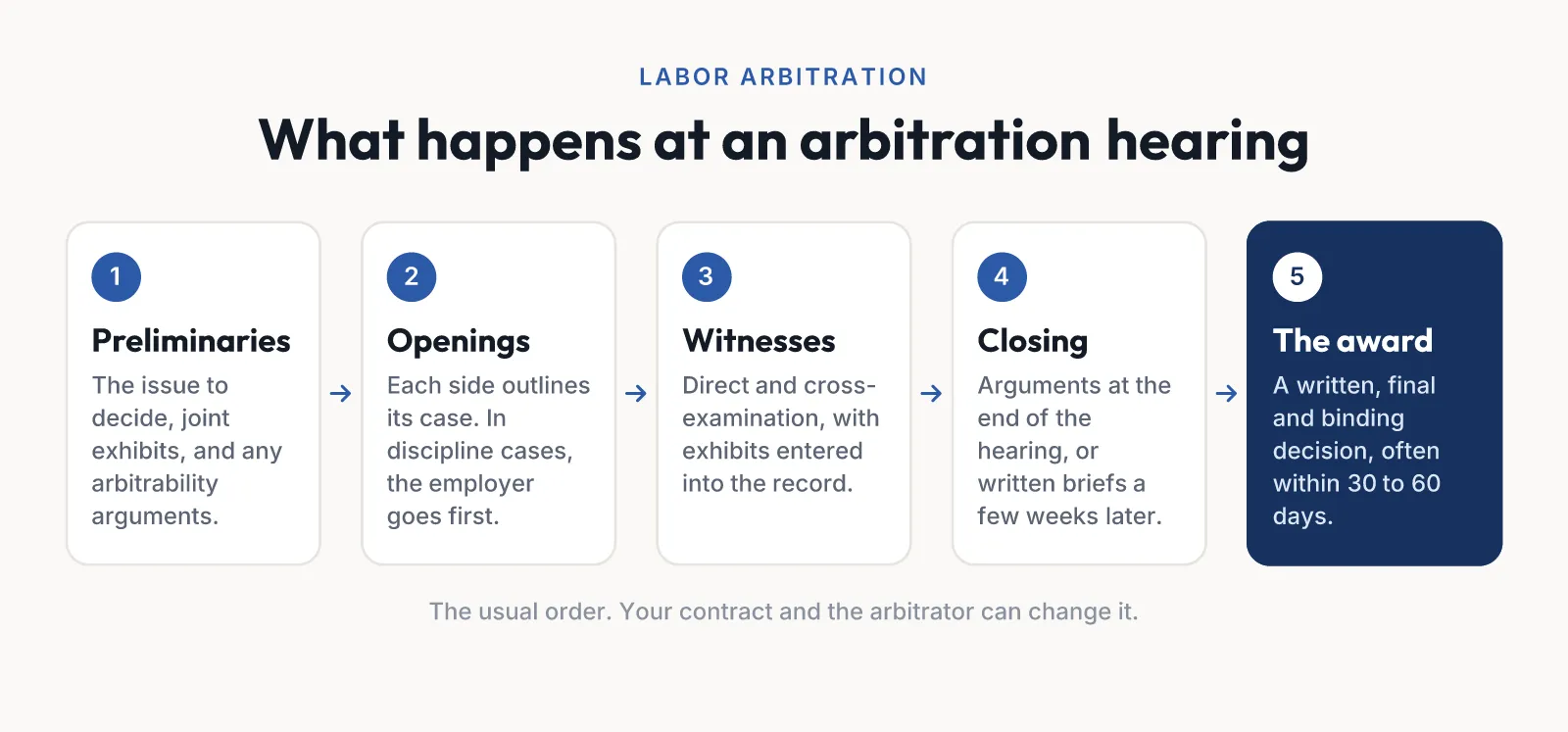
The usual order of an arbitration hearing.
A hearing is less formal than a trial, but it has a set order:
- Preliminaries. The arbitrator confirms the issue to be decided, takes joint exhibits, and hears any arbitrability arguments.
- Opening statements. Each side explains what the case is about and what it will show. In discipline cases, the employer usually goes first.
- Witnesses and evidence. Each side calls its witnesses. The other side can cross-examine. Exhibits go into the record.
- Closing. Each side sums up, either at the end of the hearing or in post-hearing briefs, written arguments filed a few weeks later.
The rules of evidence are looser than in court. Arbitrators usually hear most evidence and decide how much weight to give it. A hearing often takes a day, sometimes more for a complex case. Some are recorded by a court reporter.
The arbitration award
After the hearing, or after the briefs are in, the arbitrator issues a written award with the reasons for it. Many arbitrators decide within 30 to 60 days. The award can:
- sustain the grievance and order a remedy, like reinstatement with back pay,
- deny the grievance,
- sustain it in part, for example reducing a discharge to a suspension.
The award is final and binding. Courts rarely overturn one; they’ll generally enforce it as long as the arbitrator was applying the contract, even if a judge would have decided differently.
How long does arbitration take?
Often months, sometimes more than a year, from the demand to the award. Picking an arbitrator, finding a date on the arbitrator’s calendar, briefs, and the time to write the decision all add up. That delay is one reason many grievances settle before the hearing.
What arbitration costs
Costs usually include:
- the arbitrator’s fees, charged by the day, for hearing days, study days and travel, and usually split between the union and the employer,
- agency fees for a list of arbitrators,
- a court reporter and transcript, if used,
- a room for the hearing,
- attorneys, if the union uses one.
Study days are the part people forget. The arbitrator bills for the days spent reading the record and writing the award, on top of the hearing itself, so the bill can cover more days than the hearing took. With an attorney and a transcript added, a single case can cost the union thousands of dollars. Budget for arbitration, and track every case’s costs.
Arbitration starts at step one
Arbitration depends on what you did at every earlier step: the grievance, the step answers, the dates, the information requests and your notes. Keep it all together from the start.
If your union uses LaborWise, the case you open at the first step is the one you take to arbitration: it follows your contract’s own steps, holds the notes, files, letters and deadlines along the way, and sends a reminder before each deadline. See how cases work.