How to write a grievance: a steward's guide
What to put in a written grievance, how to word the statement and the remedy, and the mistakes that sink good cases. With a worked example.
A grievance is the union’s written claim that the employer broke the contract. Some unions file it on a form; others write it as a grievance letter to management. It might be the wrong person getting overtime, discipline without just cause, or a policy change nobody bargained over. How you write it matters more than most new stewards expect. The person who reads it at the last step, sometimes an arbitrator, may see it a year from now with nothing else to go on.
Your contract’s grievance procedure sets the steps, the time limits and sometimes the form itself. Read it before you write, and ask your staff rep or the local’s attorney when you’re unsure. What follows is general advice, not legal advice.
Before you write anything
Check the clock
Most grievance procedures give you a set number of days to file, counted from the incident or from when the member found out about it. Miss it and the employer can refuse to hear the grievance, however strong it is. Find the time limit in your contract on day one and write the deadline down.
Get the facts
Talk to the member and write down their account the same day. Then fill in the gaps:
- who was involved, including witnesses
- what happened, in order
- when and where it happened
- which documents back it up: schedules, overtime lists, emails, the discipline notice
If the employer has records you need, your contract or the law may let you ask for them in writing. Ask early; the clock keeps running while you wait.
Find the contract language
Identify the article and section the employer broke. Read the whole article, not just the line you remember. Then check for past practice, side letters and any other articles that touch the same issue.
What goes in a written grievance
A complete grievance has five parts. The free grievance form has a space for each.
- Who is grieving. The member’s name, job title and department. For a group grievance, list everyone affected or describe the group. When the union files on its own behalf, often called a policy or union grievance, name the local.
- What happened. A short statement of the facts, with dates.
- What was violated. The contract articles and sections, plus “and all other applicable articles, laws, rules and past practices.”
- The remedy. Exactly what the union wants done to fix it.
- Signatures and dates. Usually the member and the steward, plus the date it’s filed and the step it’s filed at.
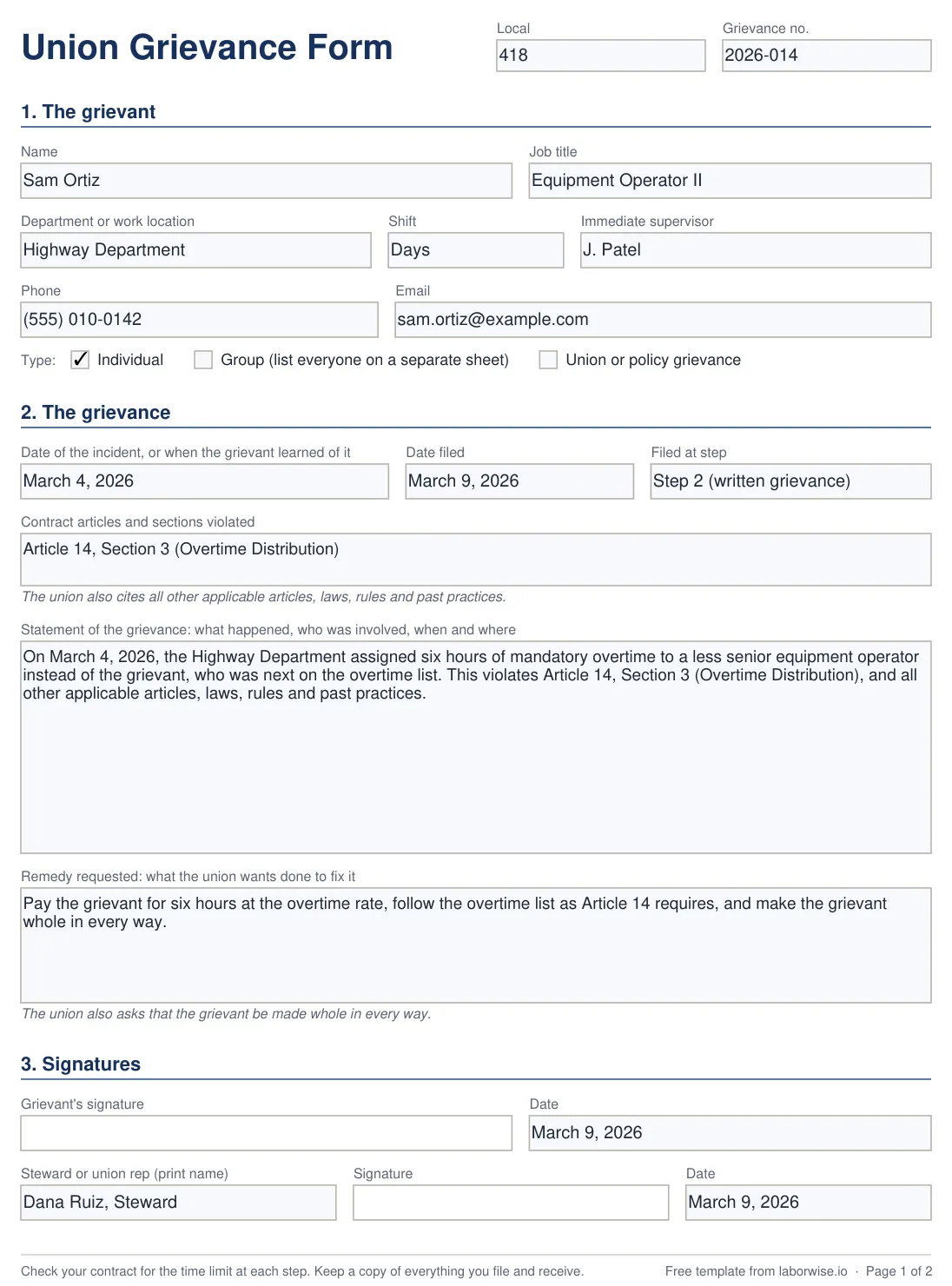
The free grievance form, filled in with the fictional Local 418 example from this guide.
Writing the statement
Keep it short and factual. The written grievance states the problem; the argument happens in the grievance meeting. A long statement gives management more to pick apart and can lock you into one theory of the case.
Good statements:
- Stick to facts you can prove
- Give dates and places
- Leave out opinions, insults and guesses about motives
- Use plain words, so anyone reading it later can follow
Here’s an example from the fictional Local 418:
Statement: On March 4, 2026, the Highway Department assigned six hours of mandatory overtime to a less senior equipment operator instead of the grievant, who was next on the overtime list. This violates Article 14, Section 3 (Overtime Distribution), and all other applicable articles, laws, rules and past practices.
That’s two sentences. It says who, what, when and which article, and stops there.
Asking for the remedy
Ask for everything it would take to put the member back where they’d be if the contract had been followed. Don’t ask for less, hoping to look reasonable; you can always settle for less later, but you usually can’t ask for more.
Depending on the case, a remedy might include:
- Back pay, overtime pay or lost benefits
- Restored seniority, shifts or a position
- Removing discipline from the member’s file
- An order to follow the contract from now on
Close with “and that the grievant be made whole in every way.” The remedy for the Local 418 example:
Remedy: Pay the grievant for six hours at the overtime rate, follow the overtime list as Article 14 requires, and make the grievant whole in every way.
Grievance letter sample
If your contract doesn’t require a form, the same five parts work as a letter. Here’s the Local 418 overtime grievance written as a grievance letter:
To: Director, Highway Department
From: Local 418, by [steward’s name], Steward
Date: March 11, 2026
Re: Step 1 grievance, overtime distributionLocal 418 files this grievance on behalf of [grievant’s name], Equipment Operator, Highway Department.
Statement: On March 4, 2026, the Highway Department assigned six hours of mandatory overtime to a less senior equipment operator instead of the grievant, who was next on the overtime list. This violates Article 14, Section 3 (Overtime Distribution), and all other applicable articles, laws, rules and past practices.
Remedy: Pay the grievant for six hours at the overtime rate, follow the overtime list as Article 14 requires, and make the grievant whole in every way.
Please respond within the time limits of Article 8, the grievance procedure.
[Grievant’s signature and date] [Steward’s signature and date]
Keep it to one page.
Common mistakes
- Filing late. Check the clock before anything else, and if you need more time, get the extension in writing before the deadline passes.
- Citing one article and nothing else. If it turns out to be the wrong one, “all other applicable articles” keeps the others in play.
- Writing it in anger. Personal remarks about a supervisor can be read out loud at arbitration.
- Promising the member a result. Tell them honestly how the case looks and what the union will do for them.
- Not keeping copies. Hold on to everything you file and everything management sends back, with the date you got it.
After you file
Hand the grievance to the person your contract names, and get it dated or signed as received. Then:
- Put management’s response deadline and your next-step deadline on a calendar
- Tell the member what happens next and when
- Keep notes of every meeting and conversation, with dates
When officers or stewards change, those notes let the next person pick the case up where you left it. If your union uses LaborWise, each grievance is laid out in your contract’s own steps with a deadline on every one, and the notes, files and forms stay attached to the case. See how cases work.