Insubordination at work: obey now, grieve later, and when members can refuse
What counts as insubordination at work, the obey now, grieve later rule, when members can refuse an order, and how stewards defend an insubordination charge.
Insubordination is a worker’s refusal to follow a direct, reasonable order from a supervisor. Supervisors charge it often, and it carries real weight: many contracts and arbitrators treat a clear refusal as grounds for a suspension or even discharge, sometimes on the first offense.
The charge is also over-used. Supervisors write up arguments, questions, slow responses and rudeness as “insubordination” when none of them is a refusal. A steward’s first job is to sort out which one actually happened.
Your contract’s discipline article, your work rules and the law that covers your workplace all matter, and every situation is different. This is general information, not legal advice. When a member’s job is on the line, talk to your staff rep or the union’s attorney.
What counts as insubordination?
For discipline to hold up as insubordination, arbitrators generally look for all of these:
- A clear order, not a suggestion or a request the member could reasonably think was optional.
- From someone with authority to give it.
- The member understood it, including what they were being told to do.
- The member was warned, where there was time, that refusing could lead to discipline.
- The member refused, by saying no or by not doing it.
If any one is missing, the charge is weaker. “I asked him to stay late and he said he couldn’t” isn’t the same as “I ordered him to stay, told him he’d be disciplined if he left, and he left anyway.”
What usually isn’t insubordination
- Asking questions about an order, or asking for it in writing.
- Disagreeing with an order while still doing it.
- Being slow to do it, or doing it badly. That may be a performance issue, but it isn’t a refusal.
- Rudeness or swearing on its own. Disrespect can be its own work-rule violation, but it isn’t a refusal to obey. Arbitrators also look at how people normally talk at that workplace.
- Asking for a union representative in an investigatory interview. That’s a protected right. See Weingarten rights.
The “obey now, grieve later” rule
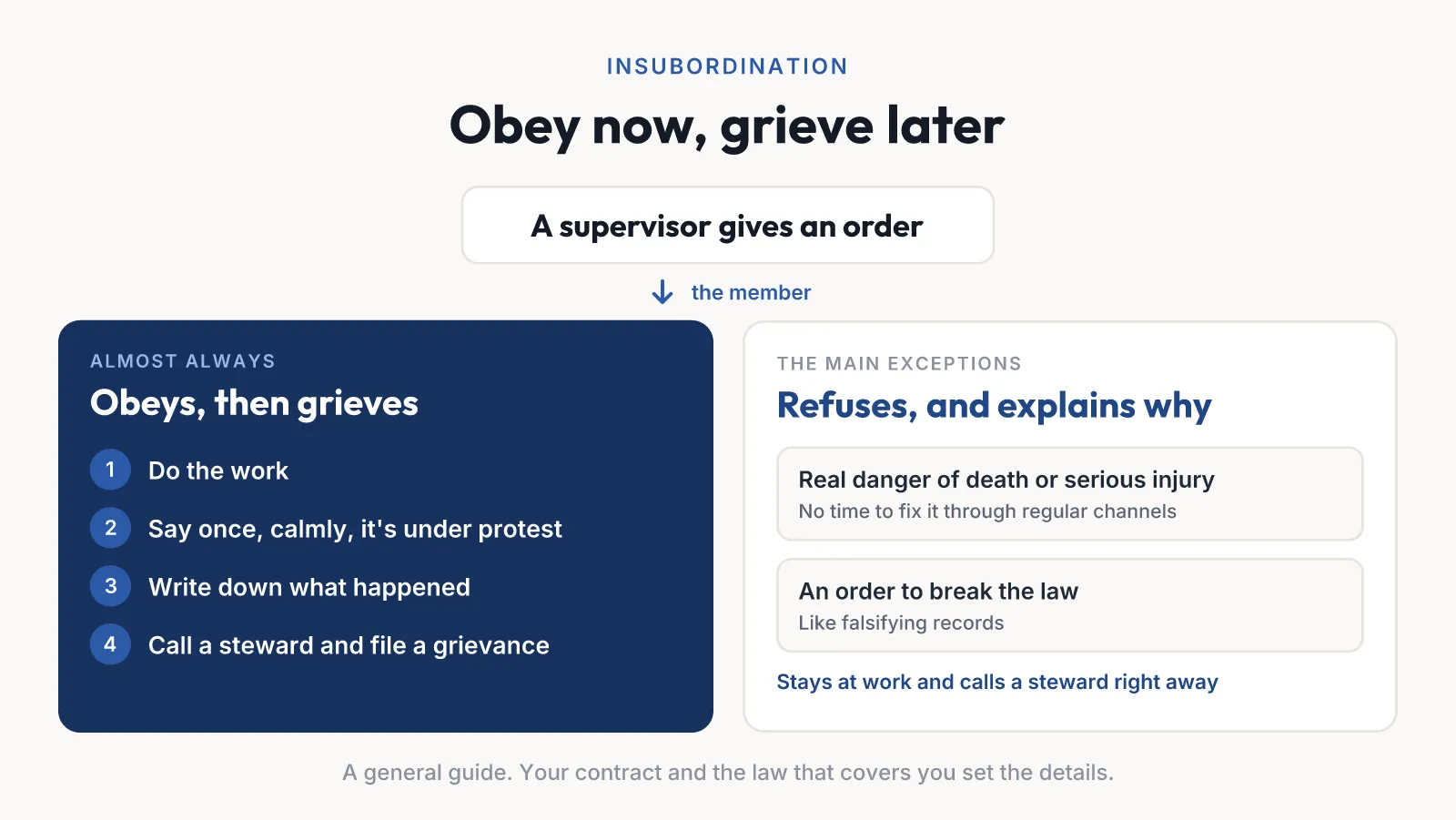
The general rule, and the two main exceptions.
The basic rule: when a supervisor gives an order, the member does it, and then the union files a grievance. Arbitrators have applied it for decades. The grievance procedure exists to settle disputes about the contract, and work has to go on while it does. A worker who refuses an order is settling the dispute on their own.
That holds even when the order breaks the contract. If a supervisor assigns work out of seniority order or changes a schedule the contract protects, the member should still do the work, and the union should grieve it. The grievance can win back the overtime, the pay or the schedule. A refusal usually turns a contract case the union could win into a discipline case the member might lose.
The best defense is a member who never refused. Tell members, especially new ones:
- Do the work, then call the steward. Don’t argue on the floor.
- Say once, calmly, that you’re doing it under protest and that you’ll be filing a grievance.
- Write down what you were told, by whom, when, and who saw it.
- If something is truly dangerous, say exactly what the danger is, offer to do other work, and call the steward right away.
When can a member refuse an order?
There are a few recognized exceptions. They’re narrow, and a member who uses one should be able to explain why, calmly, at the time.
Serious danger to health or safety
Workers don’t have to put themselves in real danger of death or serious injury. In the private sector, OSHA protects a worker’s refusal only when all of these are true (OSHA; 29 C.F.R. § 1977.12):
- Where possible, the worker asked the employer to fix the danger, and it didn’t.
- The worker refused in good faith, really believing there was an imminent danger.
- A reasonable person would agree there was a real danger of death or serious injury.
- There wasn’t enough time to get it fixed through regular channels, like an OSHA inspection.
Federal labor law also says that workers who stop work in good faith because of abnormally dangerous conditions aren’t on strike (29 U.S.C. § 143). A sincere belief isn’t enough, though: the Supreme Court has said there must be objective evidence that the danger was real. State and local government workers are covered by OSHA rules only in states with an OSHA-approved state plan, so check your state’s law. Many contracts also have their own health and safety article, which may give more protection.
A member who refuses unsafe work should stay at work, tell the supervisor exactly what the danger is, offer to do other work, and call a steward. Walking off the job is much harder to defend.
Illegal orders
A member doesn’t have to break the law because a supervisor says so: falsify records, drive a vehicle that isn’t legal to drive, or skip a legally required certification, for example.
Other exceptions arbitrators sometimes recognize
- The member couldn’t do it, because of a medical condition, a lack of training or certification, or a real family emergency.
- The order was clearly outside the job, like a personal errand for the supervisor.
- The order humiliated the member or had nothing to do with the work.
These depend on the facts and the contract, so don’t count on them. When in doubt, obey and grieve.
Stewards doing union business
A steward in a grievance meeting is speaking for the union, not as a subordinate, and labor boards and arbitrators generally give stewards more room to argue forcefully there than at the workstation. That protection has limits. Threats and violence aren’t protected, and a steward who refuses a work order on the job is held to the same rule as anyone else.
How stewards defend an insubordination charge
Treat it like any other discipline case: investigate fast and test the discipline against the seven tests of just cause.
Questions to ask:
- What exactly was said? Get the member’s account and every witness’s, the same day if you can. Was it an order, or a request?
- Did the member actually refuse? Or did they ask a question, object and comply, or comply late?
- Was the member warned that refusing could mean discipline?
- Was the order reasonable and within the job? Did it put the member in danger, or ask them to break the law?
- Did the supervisor provoke it? Shouting, insults or a pattern of targeting the member all matter.
- Is the penalty consistent? How have others been disciplined for similar conduct? Check progressive discipline in your contract, and the member’s record.
- Is there a contract issue underneath? If the order itself broke the contract, file that grievance too. Even if the refusal is upheld, the union can win the underlying issue and argue that it should reduce the penalty.
Then write the grievance, asking for the discipline to be removed and the member made whole. Common outcomes are a reduced penalty, a lesser charge like “failure to follow instructions,” or removal of the discipline from the file after a set time.
When it’s over, write down what the supervisor said, who was there, and how the case ended. The next time a supervisor charges insubordination, you’ll be able to show how similar cases were handled. LaborWise’s discipline cases keep those notes, files and deadlines in one place, so the next steward can see how the last one went. See how cases work.