Progressive discipline and written warnings: a guide for stewards
How progressive discipline works, what a written warning means, how long it stays on a member's record, and how stewards respond to each step of discipline.
Progressive discipline is discipline that gets more serious one step at a time: a verbal warning, then a written warning, then a suspension, and only then termination. The idea is to correct a problem, not to punish, and to give a member a fair chance to fix it before their job is at risk.
Most union contracts require it, either in plain words or through the just cause standard. A written warning that nobody challenges today becomes the reason for a suspension next year, and the suspension becomes the reason for a discharge after that.
Your contract’s discipline article sets the steps, the time limits and how long discipline stays in a file, so read it alongside this post. What follows is general information, not legal advice.
How progressive discipline works
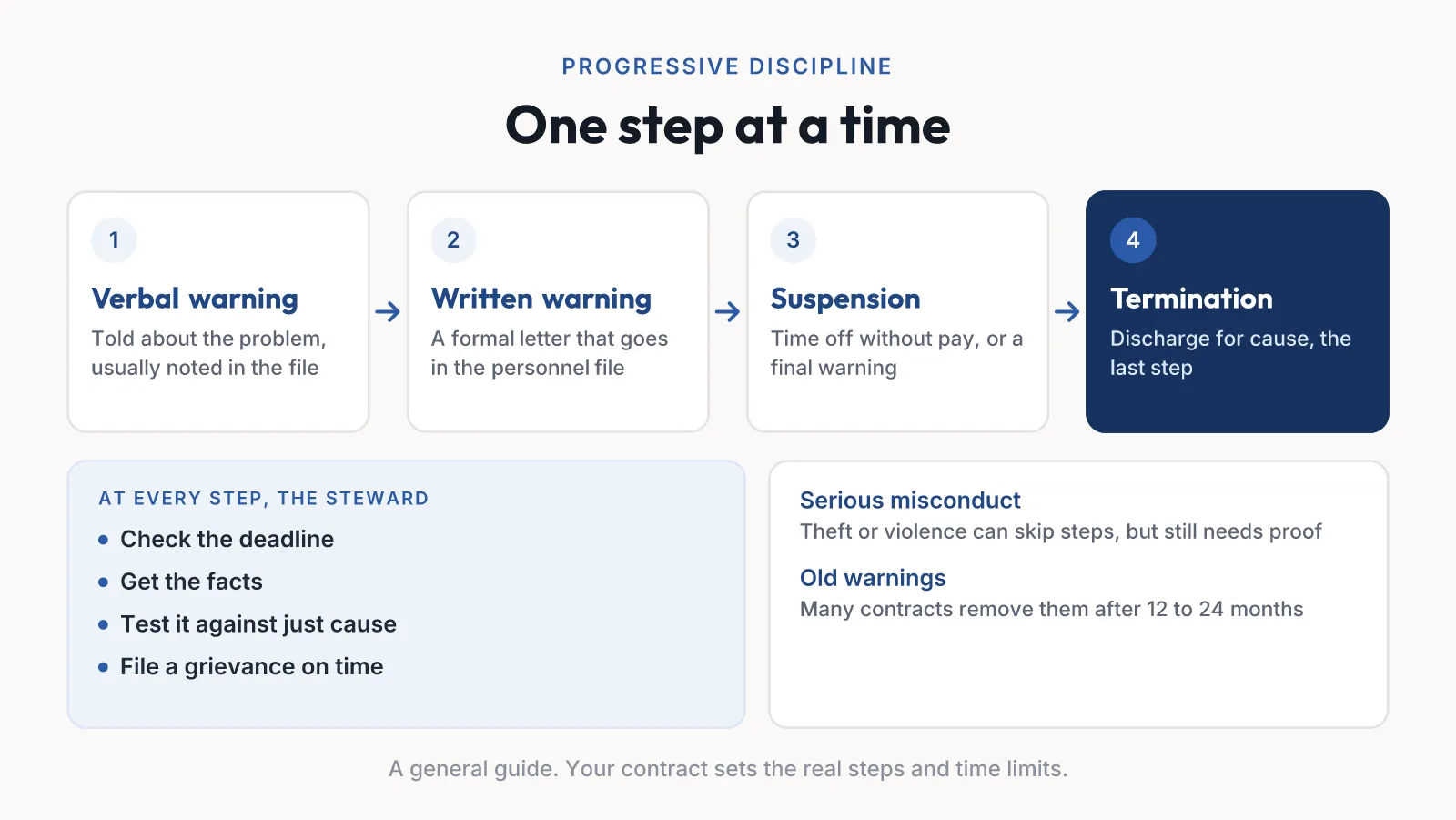
The usual steps. Your contract may have more, fewer, or different ones.
The usual steps are:
- Verbal (oral) warning. The supervisor tells the member about the problem and what has to change. Even a verbal warning is usually written down somewhere, often as a note in the file.
- Written warning. A formal letter describing the problem, the rule or expectation it breaks, and what will happen if it continues. It goes in the member’s personnel file.
- Suspension. Time off without pay, often one to five days, sometimes longer. Some employers use a “last chance” step instead.
- Termination. Discharge, for cause.
Some contracts add a step, like a “final warning,” or let the employer use a paid “decision-making day” instead of an unpaid suspension. Some leave out the verbal step entirely.
Coaching and counseling
Many employers also use “coaching,” “counseling” or “documented conversations” and call them non-disciplinary. Read your contract carefully. If a counseling memo can later be used to justify discipline, treat it like discipline: check the facts, and ask the member to write their side.
When steps can be skipped
Progressive discipline is for problems that can be corrected, like attendance, lateness or work quality. For serious misconduct, like theft, violence, serious safety violations or harassment, employers often go straight to suspension or discharge, and arbitrators often accept that when the misconduct is proven. Some contracts list the offenses that can lead to discharge on the first offense.
Even then, the employer still has to prove the misconduct and show that the penalty fits. See the seven tests of just cause.
Termination for cause vs. at-will employment
Most workers in the United States are employed at will: the employer can fire them for any reason that isn’t illegal, with no warning at all. Montana is the one state that requires good cause for most firings after a probationary period.
A union contract changes that. Most contracts say members can be disciplined or discharged only for just cause, sometimes written as “cause” or “proper cause.” That means the employer has to have a good, provable reason, follow a fair process, and choose a penalty that fits. Progressive discipline is a big part of what arbitrators mean by a fair penalty.
So discharge cases often turn on the earlier steps. If the employer skipped steps, relied on warnings that should have been removed, or treated the member more harshly than others, the discharge may not hold up.
Written warnings
What a written warning is
A written warning is formal discipline in writing. It usually says:
- what the member did, with dates,
- which rule, policy or expectation it broke,
- what the member has to do from now on,
- and what will happen if it happens again.
Should the member sign it?
Many employers ask the member to sign the warning. Signing usually means only that the member received it, not that they agree. If the form doesn’t say that, the member can write “Received, not in agreement” next to their signature. Check your contract and your local’s practice. A member shouldn’t sign anything that says they admit the facts.
Does a written warning go on your record?
Yes. A written warning goes in the member’s personnel file, and the employer can use it later to justify a heavier penalty for a similar problem.
How long does a written warning stay on your record?
It depends on the contract. Many contracts have a “sunset” or “clean slate” clause that removes warnings, or stops the employer from relying on them, after a set time without further discipline, often 12 to 24 months. Suspensions may stay longer.
If your contract has no such clause, a warning may stay in the file indefinitely, though arbitrators often give little weight to old, unrelated discipline. Put a sunset clause on the next bargaining list. Where your contract already has one, track the dates yourself and ask for each warning to be removed on time. The employer won’t always remember.
Some states also give workers the right to see their personnel file, or to add a written response to it. Check your state’s law and your contract.
How stewards respond at each step
Before discipline
If a member is questioned in a meeting they reasonably believe could lead to discipline, they can ask for a union representative. See Weingarten rights. Many discipline cases turn on what’s said in that first meeting.
When discipline is issued
- Find the grievance time limit and write the deadline down. Treat every warning as grievable unless your contract says otherwise.
- Get the member’s account, talk to witnesses, and get any documents the employer relied on. Ask for them in writing if you need to.
- Test the discipline against just cause. Was the rule clear and known? Was there a fair investigation? Were others treated the same way? Was the penalty right for this member’s record? The just cause checklist walks through it.
- Look at the member’s record. Is the employer relying on warnings that should have been removed, or that are about something unrelated?
- If the discipline doesn’t hold up, file the grievance, asking for the discipline to be removed from the file and the member made whole. See how to write a grievance.
When it’s not worth grieving
Sometimes the facts are clear and the penalty is fair. Then help the member respond in writing, make sure the discipline comes out of the file on time, and help them avoid the next step. Deciding not to grieve is the union’s call. Make it for a sound reason after a careful look, and tell the member why. See the duty of fair representation.
Sample response to a written warning
Even when a warning isn’t grieved, the member can often put their side of the story in writing. Here’s a short example from the fictional Local 418:
To: Director, Highway Department
From: [Member’s name], Equipment Operator
Date: May 6, 2026
Re: Written warning dated May 4, 2026I received the written warning dated May 4, 2026 for arriving late on April 27 and April 30. I don’t agree that it was warranted.
On both days, the department’s shuttle from the north yard was late, and I clocked in within ten minutes of the start of my shift. I told my supervisor about the shuttle delays on April 27. Other operators on the same shuttle were not disciplined.
Please attach this response to the warning in my personnel file. Local 418 is reviewing the warning under Article 9 of the contract.
[Member’s signature]
Keep the response short and calm, and stick to what happened. As with a grievance, it’s not the place to argue or vent.
The union’s copy of the discipline history
Progressive discipline depends on history: what happened before, when, and how others were treated. The employer keeps that history, and the union needs its own. Keep a copy of every warning, response, grievance and settlement, and note the date each warning should come out of the file. In LaborWise, each discipline case holds its notes, files and deadlines, with a reminder before each one is due, so the next steward can see the whole history (how cases work).