Union contract terms: a glossary for stewards and officers
Plain-English definitions of the union terms stewards and officers hear most: bargaining, union security, contract clauses, pay, discipline and seniority.
Union contracts and labor relations come with their own vocabulary, and new stewards and officers are expected to pick it up fast, sometimes in the middle of a grievance meeting. The definitions below are short and plain. Where we’ve written a full guide on a term, the definition links to it.
These definitions are general. Your contract may use these words differently, and the law varies between the private sector, the public sector, and from state to state. When it matters, the contract’s own definitions control.
Bargaining terms
Bargaining unit
The group of workers the union represents under the contract, usually defined by job titles, departments or location. Everyone in the unit is covered by the contract, members or not.
Collective bargaining agreement (CBA)
The union contract: the written agreement between the union and the employer that sets wages, hours and working conditions for the bargaining unit for a set term.
Mandatory subjects of bargaining
Topics the employer and union must bargain over if either side asks: wages, hours, and other terms and conditions of employment. Permissive subjects can be bargained if both sides agree, but neither can insist on them to the point of impasse.
Effects bargaining (impact bargaining)
Bargaining over the effects of a management decision, like layoffs or a move, even when management has the right to make the decision itself. Common topics are severance, transfers, notice and recall rights.
Status quo
While a contract is being bargained, the employer generally can’t change wages, hours or working conditions on its own. It has to keep things as they are, the status quo, until there’s an agreement or a legitimate impasse.
Impasse
The point in bargaining where both sides have bargained in good faith and are deadlocked. What happens next depends on the law: mediation, fact-finding, interest arbitration, or in some cases a strike or lockout.
Interest arbitration
Arbitration over what a new contract will say, rather than over what an existing one means. It’s most common in the public sector, especially for police and firefighters, where state law often uses it instead of strikes.
Tentative agreement (TA)
A deal reached at the bargaining table that isn’t final yet. A full TA usually goes to the members for a ratification vote; individual articles can also be “TA’d” one at a time during bargaining.
Contract ratification
The members’ vote to accept or reject a tentative agreement. Who can vote and how it’s done are set by the union’s constitution and bylaws.
Reopener clause
A clause that lets one or both sides reopen bargaining on certain issues, often wages, partway through the contract.
Evergreen clause
A clause that keeps the contract in effect after it expires, until a new one is reached. Some contracts renew automatically year to year unless one side gives notice.
“Me too” clause
A promise that if the employer later gives another bargaining unit a better deal on something, like a raise, this unit gets it too.
Side letter (side letter agreement)
A separate written agreement between the union and the employer that clarifies, adds to, or makes an exception to the contract. Side letters are enforceable, so keep copies with the contract.
Memorandum of understanding (MOU)
A written agreement between the union and the employer, often used to settle an issue during the contract or to put a new agreement in writing. In some public-sector settings, the whole contract is called an MOU.
Zipper clause
A clause saying the contract is the complete agreement, which can limit bargaining over new issues during the contract’s term. Read it closely before agreeing to one.
Past practice
A long-standing, consistent way of doing things that both sides know about and accept, even though it isn’t written in the contract. Arbitrators often enforce a clear past practice as if it were part of the contract.
Maintenance of standards
A clause that protects existing benefits and working conditions not written in the contract, so management can’t take them away during the contract’s term.
Contract interpretation
Working out what the contract means when the language isn’t clear. Arbitrators look at the plain words first, then at bargaining history and past practice.
Union security terms
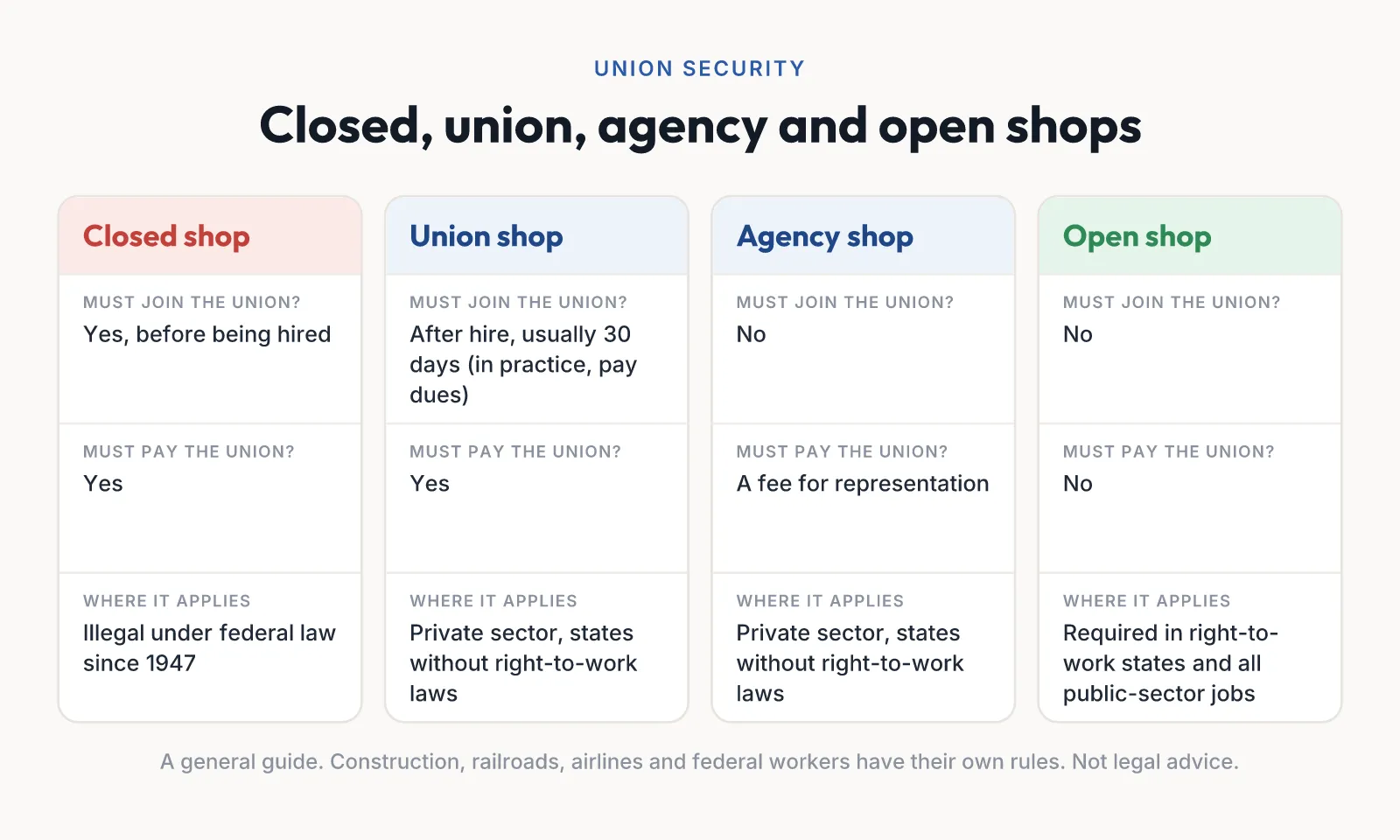
Union security arrangements, side by side.
Union security clause
A contract clause that requires workers in the bargaining unit to join the union or pay a fee as a condition of employment. Whether one is allowed depends on the sector and the state.
Closed shop
An arrangement where an employer may hire only people who are already union members. The 1947 Taft-Hartley Act made closed shops illegal for employers covered by the National Labor Relations Act.
Union shop
A contract that requires workers to become union members within a set time after they’re hired, at least 30 days in most industries. In practice, the requirement is to pay dues and fees, sometimes called financial core membership. Union shops are allowed only in private-sector workplaces in states without right-to-work laws. Railroads and airlines follow a different federal law that allows them in every state.
Agency shop (fair share)
A contract that requires workers who don’t join the union to pay a fee for the cost of representing them. In the private sector, objectors can limit it to representation costs. Since the 2018 Janus decision, public-sector workers can’t be required to pay any fee.
Open shop
A workplace where no one has to join the union or pay anything to keep their job. All public-sector workplaces are open shops, and so are workplaces in right-to-work states, except railroads and airlines.
Right to work
A state law that bans union security clauses, so private-sector workers can’t be required to join or pay a union. The union still has to represent everyone in the unit fairly.
Dues checkoff
Payroll deduction of union dues, authorized by the member and sent by the employer to the union. See our union dues guide.
Contract clauses
Recognition clause
The clause where the employer recognizes the union as the exclusive bargaining representative and defines the bargaining unit.
Management rights clause
The clause listing what management can decide on its own, like directing the work, hiring and scheduling, subject to the rest of the contract.
Just cause
The standard most contracts use for discipline: management needs a good, provable reason, and the penalty has to fit. See the seven tests of just cause.
Grievance and arbitration clause
The clause that sets the steps for resolving disputes about the contract, usually ending in binding arbitration. See the grievance procedure, step by step.
No-strike, no-lockout clause
The union agrees not to strike, and the employer agrees not to lock out, during the contract’s term. Disputes go through the grievance procedure instead.
Successorship clause
A clause that requires the employer, if it sells or merges the business, to make the new owner agree to the contract. A new owner who hasn’t agreed usually isn’t bound by the contract itself, though it may still have to recognize and bargain with the union.
Savings clause
A clause that keeps the rest of the contract in effect if one part is found illegal.
Pay terms
Step increase
A raise for moving up a step on the salary schedule, usually based on years of service.
Longevity pay
Extra pay for long service, often an annual payment or a percentage added after a set number of years.
Cost-of-living adjustment (COLA)
A raise tied to inflation, usually to a price index.
Differential
Extra pay for working a certain shift, like nights, or under certain conditions.
Premium pay
Pay above the regular rate for overtime, holidays, call-ins or other special circumstances, as the contract or law requires.
Discipline and representation terms
Weingarten rights
A worker’s right to have a union representative in an investigatory interview that could lead to discipline. See our Weingarten rights guide.
Loudermill hearing
A public-sector worker’s chance to answer the charges before being fired for cause. See Loudermill rights.
Garrity rights
Protection for public-sector workers ordered to answer questions: the answers can’t be used to prosecute them. See Garrity rights.
Progressive discipline
Discipline that increases step by step, like a verbal warning, then a written warning, then a suspension, before discharge. Many contracts require it.
Last chance agreement
A settlement where a member keeps their job on strict conditions, and breaking them usually means discharge. See last chance agreements.
Duty of fair representation (DFR)
The union’s legal duty to represent everyone in the bargaining unit fairly, in good faith, and without discrimination. See the duty of fair representation.
Unfair labor practice (ULP)
An action by an employer or union that breaks labor law, like refusing to bargain. See unfair labor practices.
Seniority terms
Seniority
Length of service, used to decide layoffs, recalls, bids and sometimes promotions. See seniority, bumping and layoffs.
Bumping
A laid-off worker displacing a less senior worker in another job, as the contract allows.
Recall rights
Laid-off workers’ right to be called back, usually in order of seniority, for a set time.
Superseniority
Top seniority for stewards for layoff and recall, so the union keeps representation on the job.
Where to find these terms
Most of these terms live in your contract. Keep a current copy, every side letter and MOU, and your settlements where every steward can find them.
LaborWise’s Docs & files holds the contract, side letters and settlements together, and each case records the contract articles it’s about. See all features.