Union dues: what they are, how much they cost, and where the money goes
What union dues are, how much they cost and how they're figured, what they pay for, whether they're tax deductible, and who has to pay them.
Union dues are the regular payments members make to their union. They pay for bargaining the contract, enforcing it, and running the union day to day. Most members pay through payroll deduction, so dues come out of each paycheck before it reaches them.
Stewards and officers get asked about dues all the time, often by a new member looking at a first pay stub. The answers vary from union to union. Your union’s constitution and bylaws set your dues, and the law depends on whether you work in the public or private sector and which state you’re in. What follows is general information, not legal or tax advice, and for your own taxes it’s worth checking with a tax preparer.
What are union dues?
Dues are the cost of membership. Paying them makes you a full member, with the right to vote on your contract, run for office, and have a say in how your union is run.
A union’s money comes from its members. The employer and the government don’t fund it. Dues pay for things no one member could afford alone: negotiators, lawyers, grievances taken to arbitration, and an office that keeps running between contracts.
How much are union dues?
There’s no national rate, and two unions in the same building can charge very differently. Where dues are a percentage of pay, they’re often around 1 to 2 percent of base pay. A flat monthly amount is also common, especially in smaller units.
Your union’s bylaws or constitution say exactly what you pay, and your pay stub shows what’s being deducted. If neither is clear, ask your steward or secretary-treasurer.
How are union dues calculated?
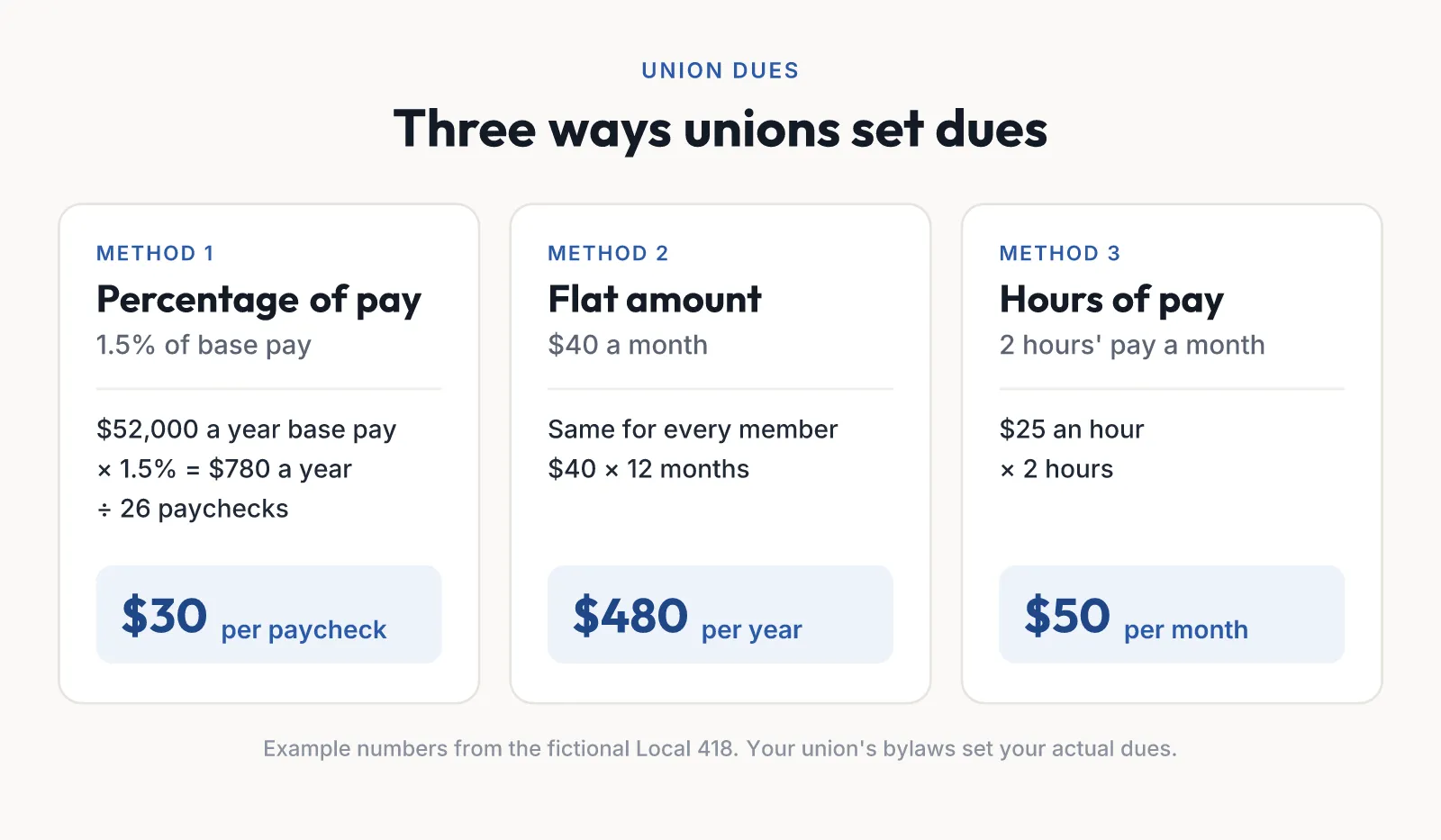
Three common ways to set dues, with example numbers from the fictional Local 418.
Most unions use one of three methods:
- A percentage of pay. Dues rise and fall with what members earn, so higher-paid members pay more. Many unions apply the percentage to base pay only, not overtime. Some set a monthly cap.
- A flat amount. Everyone pays the same, often monthly. Simple to explain and to track.
- Hours of pay. Dues equal a set number of hours’ wages each month, such as two hours’ pay. This also rises with pay, and it’s easy for members to check.
Some unions combine these, for example a flat amount plus a percentage, or different rates for full-time and part-time members. Changing the dues rate usually takes a vote of the membership or of delegates, as the bylaws require.
What do union dues pay for?
Most of the money goes to representing members. Bargaining the contract means research, negotiators, and the time it takes to win raises, benefits and protections. Enforcing it means grievances and arbitration, and the arbitrators’ and attorneys’ fees that come with them. A single arbitration case can cost thousands of dollars.
Dues also cover:
- business agents or staff reps, and the office: rent, phones, software and supplies,
- steward and officer training, so members are well represented on the job,
- newsletters, email, meetings and the union’s website,
- strike or defense funds, in unions that keep them.
Part of each member’s dues usually goes to the union’s national or international union, and often to a state federation or labor council. These are called per capita payments.
Federal law bars unions from giving dues money directly to candidates for federal office (52 U.S.C. § 30118). Unions that make those contributions do it through separate political action funds that members give to voluntarily.
Where to see how your union spends dues
Start by asking for the union’s financial reports or budget. Most unions present them at membership meetings.
Unions that represent private-sector, postal and most federal workers file yearly financial reports with the U.S. Department of Labor, and anyone can look them up in the Office of Labor-Management Standards online disclosure room. Unions that represent only state and local government workers usually aren’t covered by that federal law, so look to your union’s own reports and bylaws.
Are union dues tax deductible?
On your federal return, usually not. Union dues used to count as an itemized deduction for wage earners. That deduction was suspended starting in 2018, and the 2025 federal tax law made the suspension permanent. If you work for yourself and pay dues as part of your business, they may still be a business expense. See IRS Publication 529 for the federal rules.
On your state return, maybe. Some states didn’t follow the federal change. New York lets you deduct union dues if you itemize on your state return, even if you take the standard deduction on your federal return. They go on Form IT-196, New York’s itemized deduction form. Other states have their own rules.
Your union can usually tell you how much you paid in dues for the year, and many pay stubs and W-2s show it too. Tax software and tax preparers can tell you whether itemizing saves you money.
Do I have to pay union dues?
It depends on where you work.
- Public sector (state and local government, including schools): since the U.S. Supreme Court’s 2018 Janus decision, public-sector workers can’t be required to pay a union anything as a condition of employment. Joining and paying dues is a choice, and members who join usually sign a card authorizing dues deduction. The card says when and how it can be canceled.
- Private sector, in right-to-work states: the same. No one can be required to pay.
- Private sector, elsewhere: a contract can require everyone the union represents to pay something, but not to become a full member. People who don’t join can be charged an agency fee, sometimes called a fair share fee. Under the Supreme Court’s Beck decision, they can object to paying for activities that aren’t related to representation. The National Labor Relations Board explains these rights.
Whether or not someone pays, the union has to represent everyone in the bargaining unit fairly. That’s the duty of fair representation, covered in our union steward guide.
Initiation fees and assessments
An initiation fee is a one-time charge some unions make when you join. Many public-sector unions don’t charge one.
An assessment is an extra charge approved for a specific purpose, like a strike fund or a building project. It’s separate from regular dues and usually needs a membership vote. The bylaws or constitution set both.
How dues are collected
Most dues come in by payroll deduction, also called dues checkoff. The employer takes dues out of each paycheck and sends them to the union, usually with a list of who paid what. The contract or state law usually sets how it works. In New York, public employers deduct dues under Civil Service Law section 208.
Other members pay the union directly, by check, cash or online. That’s common for retirees, members on leave, and units where payroll deduction isn’t available.
For officers: knowing who’s paid up
The secretary-treasurer has to answer “who’s paid up?” quickly and accurately, for votes, for good standing, and for the books. Match each payroll remittance to your roster as soon as it arrives, and look for members missing from the list, new hires, and amounts that don’t match the rate. Record direct payments the day they come in, with the date and method.
Follow up with members who fall behind before it becomes a large balance, and report to the board regularly on the total collected, who’s current, and who’s behind. In LaborWise, each member’s dues balance sits on their profile, payroll deductions and checks are recorded or imported, and members can pay online by card or bank account, straight to your union’s own account (see dues and payments).