Seniority, bumping and layoffs: a guide for union reps
How union seniority works: seniority dates and lists, layoffs by seniority, bumping rights, recall rights, superseniority, and what reps check before layoffs.
Seniority decides who gets laid off last and who’s called back first. It also decides who gets the shift or vacation they bid on and, in many contracts, who gets a promotion. When layoffs come, it decides who can bump a less senior worker to keep a job.
Most seniority problems a rep sees start small, like a hire date entered wrong or a member left off the list, and only show up when a layoff makes them matter. The rules come from your contract, and in the public sector often from civil service law too, so read your seniority and layoff articles closely and talk to your staff rep before a layoff.
How union seniority works
Seniority is a member’s length of service, measured from a seniority date. Contracts count it in different ways, and many use more than one:
- Bargaining-unit seniority: time in the unit the union represents.
- Employer or company seniority: time with the employer, in any job.
- Classification or title seniority: time in a particular job title.
- Department seniority: time in a department or work location.
The contract says which kind applies to what. A contract might use classification seniority for shift bids, but bargaining-unit seniority for layoffs.
Seniority dates and ties
A member’s seniority date is usually the date they were hired into the unit or the title. Watch for the details that change it:
- Breaks in service: many contracts say seniority is lost after a quit, a discharge for just cause, or failing to return from layoff when recalled.
- Leaves: some keep seniority running, some freeze it.
- Probation: new hires often earn seniority only after probation, then it counts back to their start date.
- Ties: when two members start the same day, the contract should say how to break the tie, such as by lottery or a set rule. If it doesn’t, settle it with management in writing before it matters.
The seniority list
Most contracts require the employer to keep a seniority list, a ranking of every member by seniority date, and to post it or give it to the union regularly. That list is the starting point for every layoff, recall and bid, so it has to be right.
- Ask for it in writing on the schedule your contract sets, or at least once a year.
- Check it against your own roster. Look for missing members, wrong dates, and members in the wrong title.
- Post it where members can see it, and give them a set time to report mistakes.
- Fix errors in writing with management before a layoff, while there’s still time to correct them.
Layoffs by seniority
Most union contracts say layoffs go in reverse order of seniority: the least senior worker in the affected group goes first. That’s sometimes called last in, first out. In the public sector, civil service law often sets the order, usually by seniority within a title.
Some contracts let management keep a worker out of order for special skills, or use ability as well as seniority. The wording matters:
- “Sufficient ability” clauses keep the senior worker if they can do the work.
- “Relative ability” clauses let management keep a junior worker who’s clearly more able. The burden of showing that usually falls on management.
Bumping rights
Bumping lets a worker whose job is cut displace a less senior worker in another job, instead of being laid off. The worker who’s bumped may then bump someone else, and so on down the line, until the least senior workers are laid off.
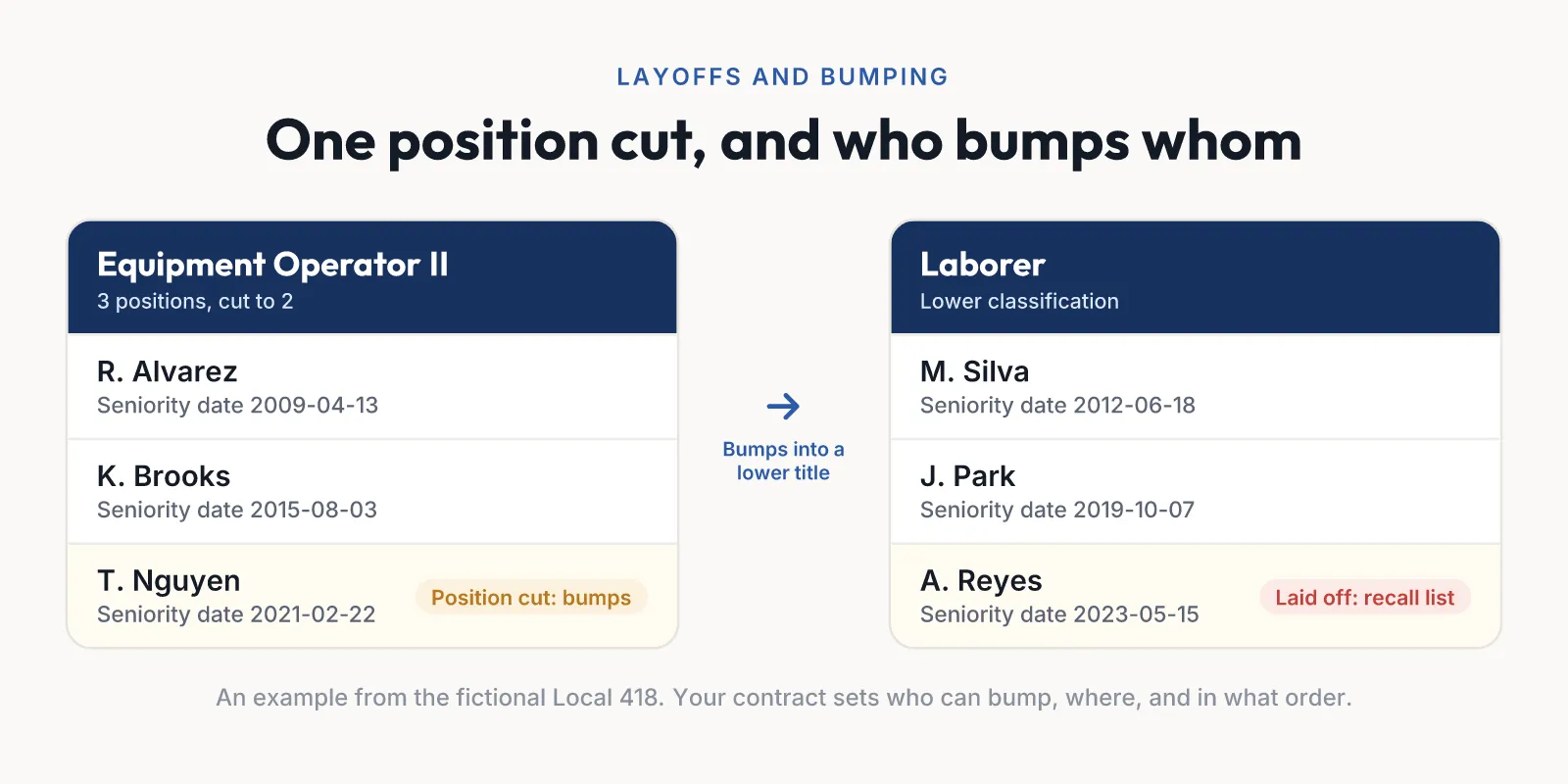
How bumping works in a layoff, with an example from the fictional Local 418.
Contracts limit bumping in common ways:
- only into the same or a lower classification,
- only into jobs the worker previously held, or is qualified for,
- only over workers with less seniority,
- sometimes only within the same department or location.
Bumping can cascade quickly through a unit. Walk through every move on paper before the layoff takes effect, and make sure management does too.
Recall rights
Laid-off members usually have recall rights: when jobs open up, they’re called back in order of seniority, most senior first, for a set period such as one or two years. Check that:
- the recall list is kept and given to the union,
- recalls follow seniority order,
- members get notice the way the contract says, and enough time to respond,
- new hires aren’t brought in while laid-off members are still on the recall list.
Superseniority for stewards
Some contracts give stewards superseniority for layoff and recall, putting them at the top of the list so the union keeps representation on the job during a layoff. In the private sector, the NLRB has generally allowed this only for layoff and recall, and only for stewards and officers who handle contract matters on the job. Public-sector rules depend on state law.
Other things seniority decides
Depending on the contract, seniority may also decide:
- shift and schedule bids,
- vacation picks,
- overtime offers,
- transfers,
- promotions, often together with ability.
What reps check when layoffs come
- Did management give the union the notice the contract requires? Larger private employers may also owe 60 days’ written notice of a plant closing or mass layoff under the federal WARN Act, sent to the union for represented workers (29 U.S.C. § 2102).
- Is the seniority list current and correct?
- Does the layoff follow the contract’s order, by the right kind of seniority?
- Has every eligible member been offered their bumping options, in writing, with time to decide?
- Is every laid-off member on the recall list, with the right dates?
- What about the effects? Even when management can decide to lay off, it usually has to bargain with the union over the effects, like severance, benefits and recall terms.
- Meet with affected members, explain their options, and help them with unemployment and benefits questions.
If you think the contract was broken, file a grievance right away. Layoff grievances often have short deadlines. See the grievance procedure, step by step.
Checking the employer’s list
Don’t rely only on the employer’s list. Keep each member’s hire date, seniority date, title and department in your own roster, so you can check every list management gives you. In LaborWise, each member’s profile already holds their hire date, job title and department, and a custom date field for seniority date lets you sort and check the list yourself in the member database.