Last chance agreements: what stewards should know before a member signs
What a last chance agreement is, when it makes sense, what to negotiate, a sample agreement, and what happens if a member breaks one, for stewards and reps.
A last chance agreement is a settlement of a discipline case, usually a firing, in which the employer agrees to keep or bring back the member on strict conditions for a set time. If the member breaks a condition, the employer can fire them, and the member gives up most of the rights they’d normally have to fight it.
A good last chance agreement saves a job. A badly written one just delays the firing. The difference is usually in the wording, and the union can negotiate that wording before anyone signs.
A last chance agreement gives up rights, and every case is different. Nothing here is legal advice. Talk to your staff rep, and the union’s attorney in serious cases, before the union or the member signs one.
What is a last chance agreement?
It’s a three-way agreement, usually signed by the employer, the union and the member. In a typical one:
- the employer reduces or holds off the discipline, often turning a firing into a suspension,
- the member agrees to specific conditions for a set period, like perfect attendance, completing a treatment program, or no repeat of the conduct,
- everyone agrees that if the member breaks a condition, the employer can fire them, and an arbitrator can only decide whether the condition was actually broken, not whether firing is too harsh.
That last part is what makes it a “last chance.” Normally an arbitrator can weigh the member’s record and reduce a penalty. Under most last chance agreements, that review is gone.
Last chance agreements are common for attendance, drug and alcohol problems, and repeated conduct issues. The EEOC notes that employers may offer them, though the ADA doesn’t require it, when misconduct results from alcoholism or drug addiction (EEOC guidance).
When a last chance agreement makes sense
It can be the right choice when:
- the employer’s case is strong, and the member would probably lose in arbitration,
- the member admits the problem and is ready to fix it,
- the member’s job, pay, seniority and benefits are worth saving, and arbitration would take a year or more,
- the conditions are ones the member can realistically meet.
It’s usually the wrong choice when the employer’s case is weak. If management can’t pass the seven tests of just cause, the union may do better taking the grievance forward than trading away the member’s rights.
Either way, the decision should be the member’s, with the facts in front of them. Explain the options in writing.
What’s in a last chance agreement
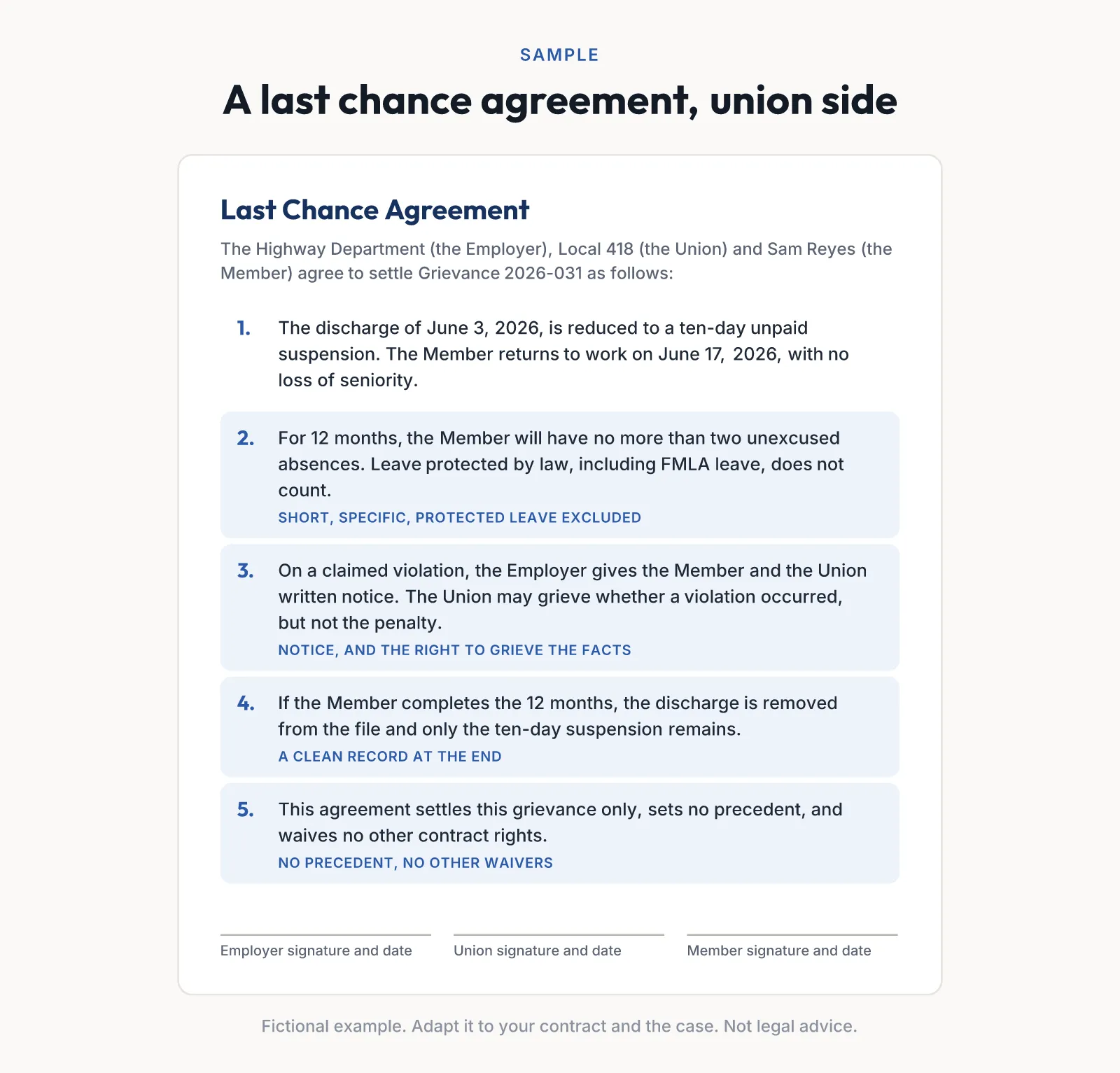
A sample last chance agreement, written from the union’s side, for the fictional Local 418.
Most agreements cover:
- the original discipline and what it’s being changed to,
- the conditions the member must meet,
- how long the agreement lasts,
- what happens on a violation, and what an arbitrator can review,
- back pay for any time off, or the waiver of it,
- what happens at the end, including whether the discipline comes off the record,
- precedent (usually, that the agreement doesn’t set one for other cases),
- signatures of the employer, the union and the member.
What stewards and reps should negotiate
Management usually brings a draft. Read every line, and push for:
- The shortest time that works. Twelve months is common. Open-ended agreements, or ones that last for the rest of a career, are hard to live with.
- Narrow, specific conditions. Tie them to the actual problem. Avoid catch-alls like “any violation of any work rule,” which turn a minor slip into a firing.
- Clear definitions. If attendance is the issue, say what counts: an unexcused absence, not any absence. Exclude legally protected leave, like FMLA leave or leave for a disability.
- The right to grieve whether a violation happened. The union should keep the right to challenge whether the member actually broke a condition, even if it gives up arguing about the penalty.
- Notice. The member and the union should get written notice of any claimed violation.
- A clean record at the end. If the member completes the agreement, the discipline should come off their record, or be reduced.
- No precedent, and no waiver of other rights. Say the agreement doesn’t set a precedent, and that the member keeps their other contract rights.
- Back pay or credit for time off, when the case was uncertain.
- Time off for treatment. If treatment or counseling is required, ask that the employer allow time for it and keep it confidential.
If the problem involves a medical condition, a disability or addiction, check whether the member has rights under the ADA or FMLA before signing, and get advice.
Last chance agreement example
Here’s a short sample, written from the union’s side. Adapt it to your contract and the case.
Last chance agreement
The Highway Department (the Employer), Local 418 (the Union) and Sam Reyes (the Member) agree to settle Grievance 2026-031 as follows:
- The Member’s discharge of June 3, 2026, is reduced to a ten-day unpaid suspension. The Member returns to work on June 17, 2026, in their former position, with no loss of seniority.
- For 12 months from the return date, the Member will have no more than two unexcused absences. Leave protected by law, including FMLA leave, does not count.
- If the Employer believes the Member has broken paragraph 2, it will give the Member and the Union written notice. The Employer may then discharge the Member. The Union may grieve whether a violation occurred, but not the penalty.
- If the Member completes the 12 months, the record of the discharge will be removed from the Member’s file, and only the ten-day suspension will remain.
- This agreement settles this grievance only, sets no precedent, and does not waive any other rights under the contract.
Signed by the Employer, the Union and the Member, with the date.
Should a member sign a last chance agreement?
Only the member can decide, and they should understand exactly what they’re giving up. Before they sign:
- go through the agreement line by line, in plain language,
- explain what happens if they break a condition, and that an arbitrator probably won’t be able to help,
- compare it honestly with the chances of winning the grievance,
- give them time to think, if the deadline allows,
- put the union’s advice in writing, which also protects the union under the duty of fair representation.
What happens if a member breaks the agreement?
Usually, the employer fires them. Arbitrators generally enforce last chance agreements as written, and the arbitrator’s job shrinks to one question: did the member really break a condition? Whether firing is fair is off the table.
The union can still win if:
- the member didn’t actually break the condition as the agreement defines it,
- the employer didn’t follow the agreement’s own process, like giving notice,
- the “violation” was legally protected, like approved FMLA leave,
- the agreement had already ended.
Calendar the end date of every last chance agreement, and check in with the member along the way.
A LaborWise case keeps the agreement and your notes with the member’s history, and a task linked to the case can remind you before the agreement ends. See how cases work.