What does a union rep do? Stewards, business agents and staff reps explained
What a union representative does, the kinds of union reps from shop stewards to business agents, staff reps and organizers, and how to become a union rep.
A union representative, or union rep, is anyone who speaks for members with the employer on the union’s behalf. When a member is called into a disciplinary meeting, has a grievance, or has a question about the contract, the union rep is the person they go to.
“Union rep” covers several different jobs. A shop steward is a volunteer member who does the work alongside a regular job. Business agents and staff reps are usually paid union staff, and they handle the bigger cases and bargain contracts. Your union’s constitution, bylaws and contract decide which of these positions exist, what they’re called, and how people get them.
What is a union rep?
A union rep acts for the union, which is the members’ legal representative with the employer. That matters in two ways:
- The rep speaks for the union and isn’t the member’s private lawyer. The union decides how to handle a grievance, including whether to settle it.
- The rep has to treat every member fairly. The union owes every worker it represents the duty of fair representation, whether or not they’re a member, and its reps carry that duty out.
What does a union rep do?
Depending on the job, a union rep:
- represents members in meetings with management, especially investigatory and disciplinary meetings. See Weingarten rights.
- files and handles grievances when the contract is broken. See the grievance procedure.
- enforces the contract day to day, by watching for violations and raising problems early.
- answers members’ questions about pay, schedules, leave, seniority and their rights.
- negotiates, either settlements of grievances or, for paid reps, whole contracts.
- keeps records of every case, meeting and deadline.
- organizes and communicates: signing up new members, getting members involved, and keeping them informed.
Types of union reps
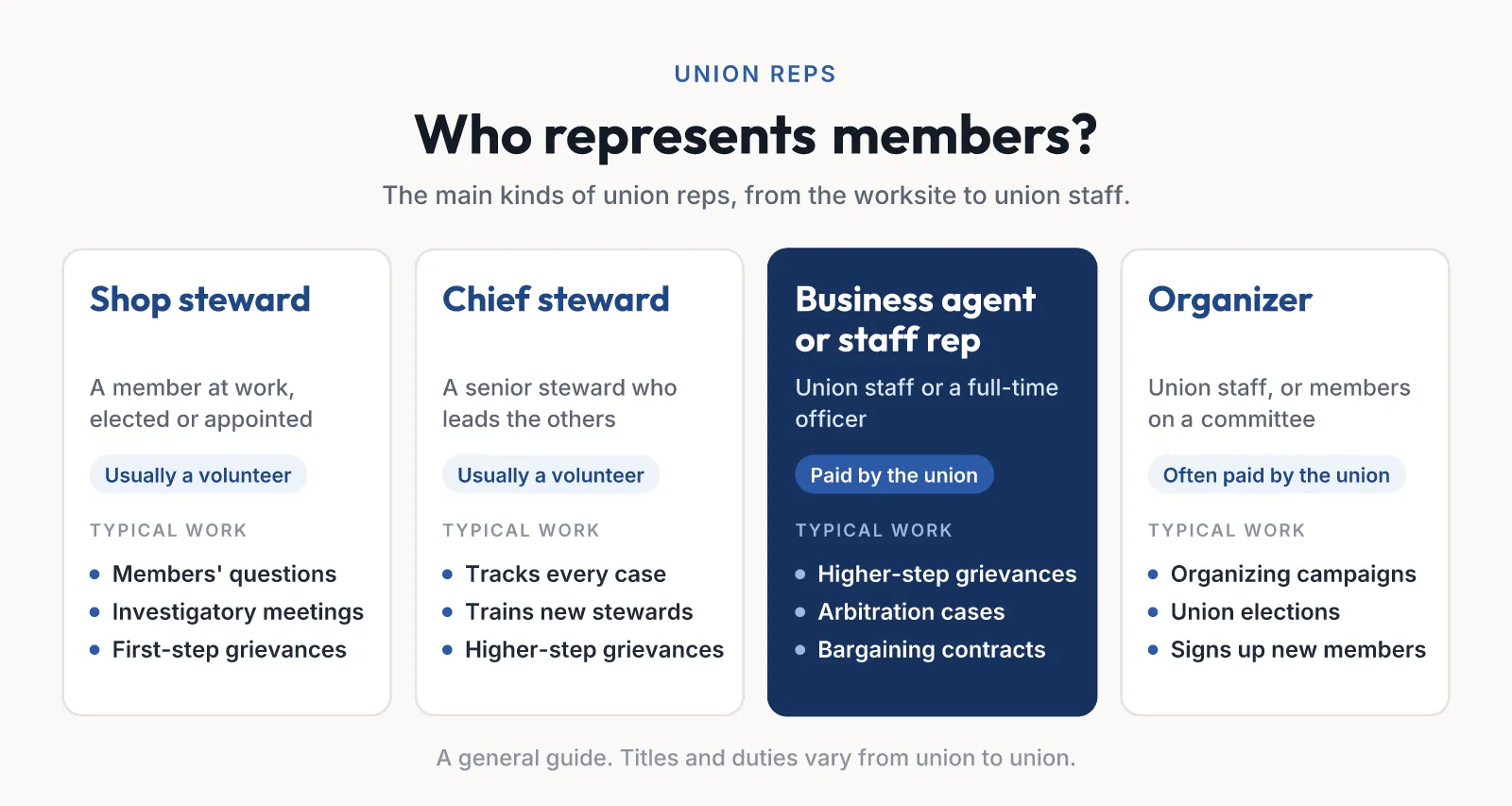
The main kinds of union reps. Titles vary from union to union.
Shop steward
The shop steward, or union steward, is a member who represents co-workers in their own workplace, usually as a volunteer, on top of their regular job. Stewards are elected by the members they represent or appointed by the union’s officers. They’re the first person a member goes to with a problem, and they handle most grievances at the first step. See our shop steward guide.
Chief steward
In unions with several stewards, a chief steward leads them: assigning cases, training new stewards, and keeping track of every open grievance. The chief steward often handles grievances at the higher steps, or the hardest cases, and works closely with the officers and any paid reps.
Union delegate
In some unions, delegate is the name for a steward: a member who represents co-workers at the worksite. In others, a delegate is a member chosen to represent the local at a convention, a district council, or a central labor council. Check which one your union means.
Business agent
A business agent, or BA, is usually a paid, full-time representative of a local union. The title is most common in the building trades, but many unions use it. Business agents are often elected by the local’s members. A business agent typically:
- handles grievances that the stewards can’t settle, and prepares cases for arbitration,
- negotiates contracts with employers,
- visits job sites to check that the contract is followed,
- in some trades, refers members to jobs through the union’s hiring hall.
Some unions call the same job a business representative.
Staff representative
A staff representative, also called a field rep, servicing rep, international rep, or labor relations rep, is usually employed by a national union, a council, or a large local, rather than elected. A staff rep often services several bargaining units at once: backing up the stewards and officers, handling grievances at the higher steps, preparing arbitration cases, leading bargaining, and training stewards.
Union organizer
A union organizer helps workers form a union or join one. Organizers meet with workers, build an organizing committee, collect signed authorization cards, and help win a representation election before the NLRB or a state labor board. Many unions also have organizers who work with existing members, getting more of them involved and signed up.
Union rep vs. shop steward
Stewards are one kind of union rep. What sets them apart from business agents and staff reps is mostly who pays them and how much ground they cover.
| Shop steward | Business agent or staff rep | |
|---|---|---|
| Who they are | A member, working the same job as the people they represent | A paid union employee or full-time officer |
| Paid? | Usually a volunteer. Many contracts give paid time for union work | Yes, by the union |
| Covers | One workplace, department or shift | A whole local or several bargaining units |
| Typical work | Questions, investigatory meetings, first-step grievances | Higher-step grievances, arbitration, bargaining |
How to become a union rep
- Start as a steward. Tell your steward or your union’s officers you’re interested. Your bylaws say whether stewards are elected or appointed.
- Get trained. Most unions run steward training, and many universities have labor education programs with classes for stewards.
- Learn the contract. Read it cover to cover, and keep it with you. Learn the basics of the law, starting with Weingarten rights and just cause.
- Take on more. Volunteer for the bargaining team, a committee, or chief steward, and consider running for office.
- Apply for paid jobs. Business agents are often elected by the members of their local. Staff rep and organizer jobs are posted by national unions, councils and large locals, and most ask for experience as a steward or officer.
What do union reps earn?
It depends on the union, and the pay is usually set by its constitution or executive board. Private-sector unions report what they pay their officers and staff on their LM-2 and LM-3 reports, which anyone can look up.
Sharing cases between reps
When several stewards and reps share the work, a case can stall because the notes are in one person’s notebook or a deadline is on one person’s calendar. Write down every meeting, keep copies of every document, and hand off cases with the full history. In LaborWise, each grievance and discipline case keeps its notes, files, letters and deadlines in one record that every rep on the case sees, with reminders before each deadline (how cases work).