Public employment relations boards (PERBs) by state: a guide for public-sector unions
What a public employment relations board (PERB) does, which state board covers public-sector unions where you work, and when to go to the NLRB or FLRA instead.
A public employment relations board, often called a PERB, is the state agency that enforces the labor law for public-sector workers: state and local government staff, teachers, transit workers and others who work for a public employer. It plays the role for them that the National Labor Relations Board plays for the private sector.
The names vary. Some states have a PERB, others a PERC (Public Employment Relations Commission), a SERB (State Employment Relations Board), a labor relations board, or an employment relations commission. Whatever yours is called, its own statute and rules decide what you can file and when.
Each board enforces its own state’s law, with its own rules, forms and deadlines, so check yours before relying on anything here. This is a general guide, not legal advice.
What is a PERB?
A PERB is a neutral state agency set up by a state’s public-sector bargaining law. Most have a small board of appointed members, plus staff such as hearing officers and mediators. Their decisions are published and often serve as precedent, much as NLRB decisions do in the private sector.
What PERBs do
Most state boards handle some or all of these:
- Representation: deciding which jobs belong in a bargaining unit, and running elections when workers want to form, change or remove a union.
- Unfair labor practice charges: hearing charges that an employer or a union broke the state’s labor law. Some states call them unfair practice or improper practice charges. See our guide to unfair labor practices.
- Impasse procedures: providing mediation, fact-finding or interest arbitration when contract talks stall, since many public-sector workers can’t legally strike.
- Grievance arbitration: some boards keep lists of arbitrators or provide arbitration services. See labor arbitration hearings.
Which labor board handles your case?
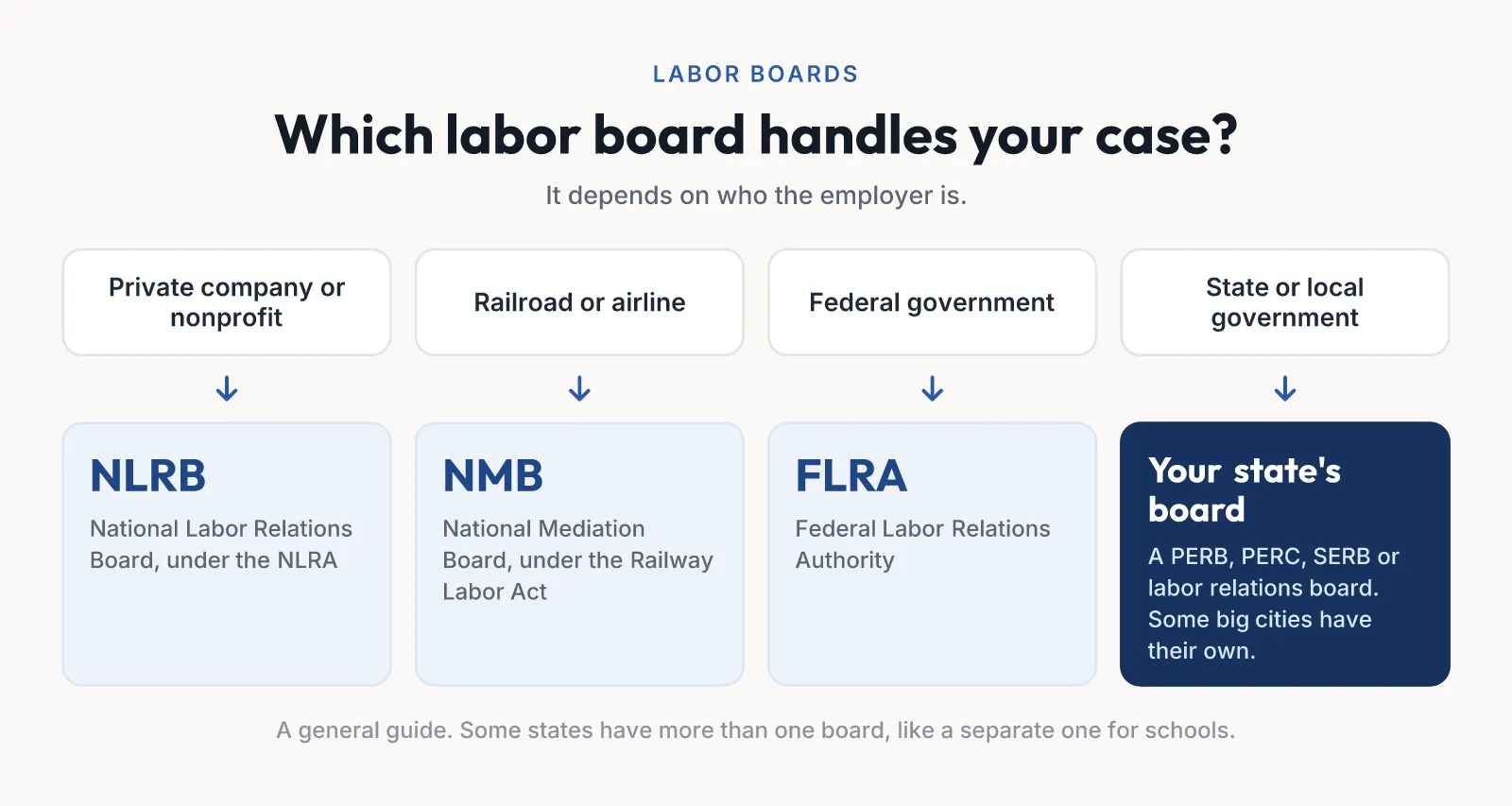
Which labor board covers your union depends on who the employer is.
- Private sector: the National Labor Relations Board.
- Railroads and airlines: the National Mediation Board, under the Railway Labor Act.
- Federal government: the Federal Labor Relations Authority. Recent executive orders have also removed bargaining rights at many federal agencies, and the court cases are still going, so federal locals should check their current status with their national union.
- State and local government: your state’s board, if your state has a public-sector bargaining law. A few large cities and counties have their own boards, like New York City’s Office of Collective Bargaining.
Some states have separate boards for different groups, like one for teachers and another for other public workers, so check which one covers your unit.
Public employment relations boards by state
These are the main state boards listed by the Association of Labor Relations Agencies, the professional group for neutral labor boards. We checked each link.
If your state isn’t listed, it may have no general public-sector bargaining law, or it may handle public-sector labor relations through another agency, a civil service board, or local ordinances. Start with your state’s labor department and your union’s national or state organization.
Filing with a state board
- Deadlines vary by state, and some are much shorter than the NLRB’s six months. Check yours the day a problem starts, before the charge can go stale.
- Use the board’s own forms and rules. Most post them online, and many accept filings electronically.
- Read the board’s decisions. They show how the board has applied the law to cases like yours.
- Ask about mediation. Many boards offer mediators who can help settle a charge or a bargaining dispute before a hearing.
- Date every letter and information request, keep copies of what goes out and what comes back, and write your notes the same day. The board will ask for them.
Know your state’s rules
Public-sector rights differ a lot from state to state: whether workers can bargain at all, what topics are covered, whether strikes are allowed, and what happens at impasse. Before your next filing, look up your board’s deadline and save its forms.
LaborWise keeps each case’s notes, filings, letters and deadlines together, with reminders before each one is due. See how cases work.