How to take minutes at a union meeting, with an example
How to take meeting minutes at a union membership or board meeting: what to include, how to record motions and votes, a full example, and a free template.
Meeting minutes are the official written record of what a meeting decided. A union’s minutes show which motions passed, how the members voted, how dues money was approved, and who was there. When a question comes up months later, or a new officer takes over, the minutes are what everyone goes back to.
Taking them usually falls to the recording secretary, at membership and executive board meetings alike, and most of the skill is knowing what to leave out. Our free meeting minutes template has every section, in Word and fillable PDF.
What are meeting minutes?
Minutes record what the meeting did. New secretaries often try to get down everything that was said, and that’s the first habit to drop. Robert’s Rules of Order, which most unions follow, puts it plainly: minutes are a record of the actions taken, not a transcript of the debate.
Good minutes let someone who wasn’t there answer three questions: was the meeting official, what did it decide, and what happens next?
What to include in meeting minutes
- The basics: the union’s name, the type of meeting (regular membership, executive board, committee or special), the date, time and place.
- Who presided and who took the minutes.
- Attendance: which officers were present or absent, how many members attended, and whether a quorum was present.
- The last meeting’s minutes: whether they were approved as written or as corrected, and the corrections.
- Reports: a short summary of each officer’s and committee’s report. For the treasurer’s report, note the balances given.
- Every motion: its exact wording, who made it, and whether it passed or failed, with the vote count if one was taken.
- Points of order and appeals, and how the chair ruled.
- Unfinished business, new business and good and welfare, in a sentence or two each.
- The next meeting and the time the meeting adjourned.
- The secretary’s signature.
What usually stays out: who said what in debate, opinions, side conversations, and anything the secretary thought but nobody moved.
How to take minutes at a meeting
Before the meeting
- Get the agenda, last meeting’s minutes, and any reports or motions you know are coming.
- Print or open the template and fill in the date, place and type of meeting ahead of time.
- Bring the bylaws, a list of officers, and the sign-in sheet.
During the meeting
- Note the exact time the chair calls the meeting to order.
- Record attendance and check the quorum before any vote.
- For every motion, write the exact wording. If you didn’t catch it, ask the chair to repeat it before the vote. That’s part of the secretary’s job.
- Write who made each motion. Robert’s Rules leaves the seconder’s name out unless your rules say to record it, but many unions do.
- Record the result. For a voice vote, “adopted” or “failed” is enough. For a counted or roll call vote, write the numbers.
- Keep reports short: who reported and the key facts or numbers.
- Note the time of adjournment.
After the meeting
- Write up the minutes within a day or two, while your notes still make sense.
- Follow the meeting’s order of business, so each set reads in the same order.
- Sign them and send a draft to the president, if your union does that, before the next meeting.
How to record motions and votes
When members go back to old minutes, they’re usually looking for a motion. Write each one as it was finally voted on, including any amendments that passed:
- Adopted by voice vote: “Moved by J. Okafor, seconded by M. Silva, to move the December membership meeting to December 10. Adopted.”
- Counted vote: “Moved by R. Patel, seconded by T. Nguyen, that the local donate $500 to the Westside Food Bank. Adopted, 41 to 6.”
- Motion that needed two-thirds: “Moved by C. Bell to limit debate on the pending motion to two minutes per speaker. Failed, 29 to 18 (two-thirds required).” It got a majority, but not the two-thirds that limiting debate needs.
- Referred to a committee: “Moved to refer the parking lot lighting issue to the safety committee to report in November. Adopted.”
You don’t need to record motions that were withdrawn. For how motions and votes work, see our Robert’s Rules guide for union meetings.
Meeting minutes example
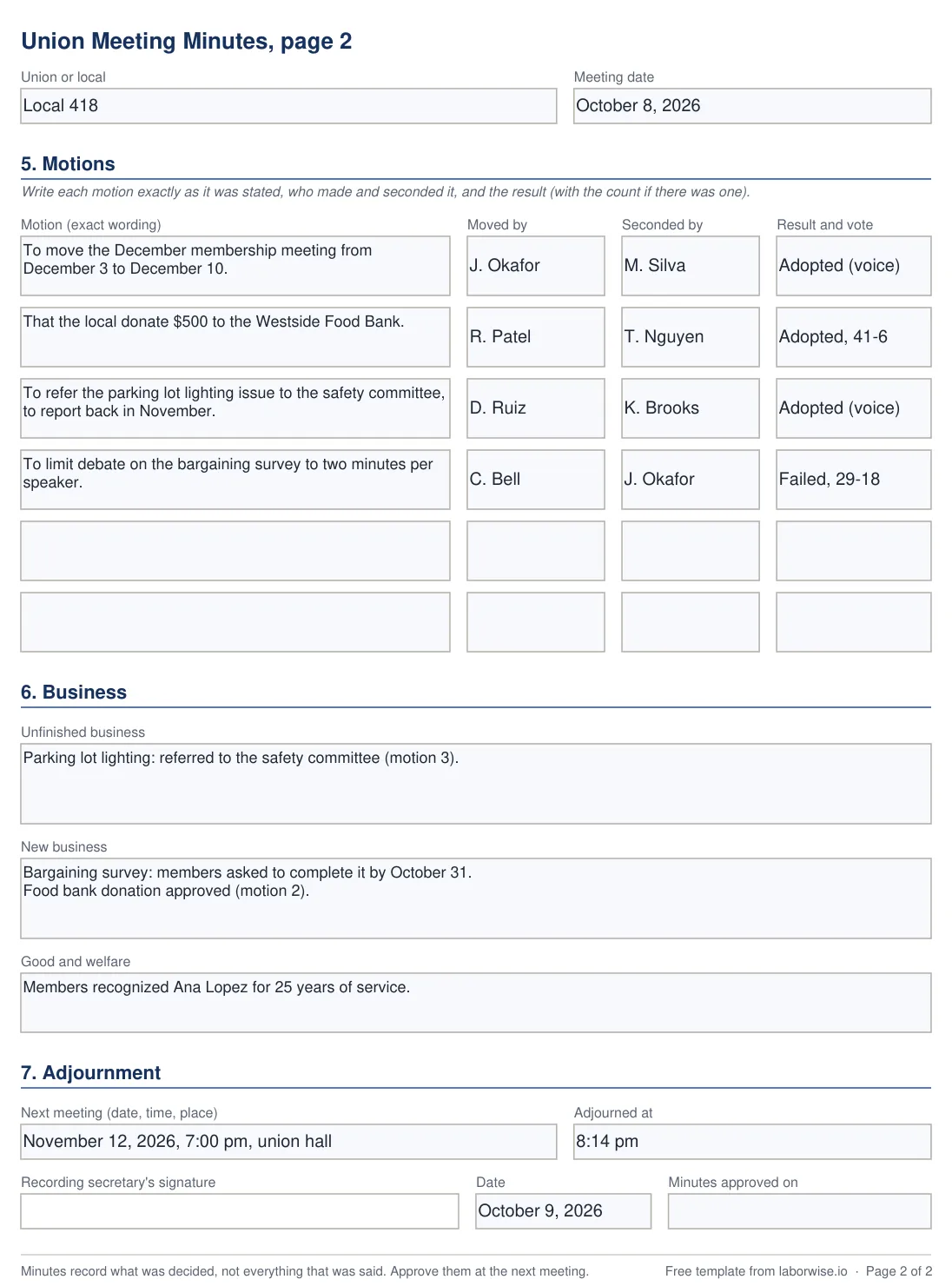
Page 2 of an example from the fictional Local 418, on our free template.
Here’s what the minutes of a short membership meeting look like, written out:
Local 418, regular membership meeting, October 8, 2026
The meeting was called to order at 7:02 pm at the union hall by President Pat Moreno. Recording Secretary Lee Chen took the minutes. All officers were present. 47 members attended; a quorum (25) was present.
The minutes of the September 10 meeting were approved as written.
Treasurer’s report: Treasurer Chris Bell reported an opening balance of $18,240.17, income of $6,115.00 and spending of $4,322.40, for a closing balance of $20,032.77. Filed for audit.
Officers’ reports: The president reported that contract talks begin November 12 and the bargaining survey closes October 31. The chief steward reported six open grievances; two were settled at Step 2.
Motions: Moved by J. Okafor, seconded by M. Silva, to move the December membership meeting to December 10. Adopted. Moved by R. Patel, seconded by T. Nguyen, that the local donate $500 to the Westside Food Bank. Adopted, 41 to 6. Moved by D. Ruiz, seconded by K. Brooks, to refer the parking lot lighting issue to the safety committee to report in November. Adopted. Moved by C. Bell, seconded by J. Okafor, to limit debate on the pending motion to adopt the bargaining survey to two minutes per speaker. Failed, 29 to 18 (two-thirds required).
Good and welfare: Members recognized Ana Lopez for 25 years of service.
The next meeting is November 12, 2026, at 7:00 pm. The meeting adjourned at 8:14 pm.
Lee Chen, Recording Secretary
Meeting minutes format
Most unions use one of two formats. One is a form, like our template, with a box for each part. It’s fast, it keeps meetings consistent, and the boxes make it hard to forget the quorum or a vote count. The other is written paragraphs, like the example above.
Whichever you pick, use it for every meeting, follow your union’s order of business, and file each set of minutes in the same place as the last.
Executive board meeting minutes
Board minutes follow the same rules, with a few differences:
- The board’s own quorum applies, usually set in the bylaws.
- Boards often handle personnel, legal or grievance matters in closed session. Record that the board went into executive session and any action it took, but keep the confidential details out of minutes that members can see, as your bylaws allow.
- Some bylaws require the board to report its actions to the next membership meeting. The board’s minutes make that easy.
Approving the minutes
At the next meeting, the chair asks for corrections to the last minutes. If there are none, the chair says they’re approved as written; if there are corrections, they’re approved as corrected. This usually happens without a formal motion, by general consent. Once approved, write “Approved” and the date on them. They’re now the union’s official record.
Under Robert’s Rules, the treasurer’s report doesn’t need a vote. It’s received and filed, which is why the example says “Filed for audit.” The auditors’ or trustees’ report is the one members adopt.
Recording secretary duties
The recording secretary usually:
- takes and writes up the minutes of membership and board meetings,
- reads or circulates the last minutes for approval,
- keeps the union’s minute book, bylaws and other official records,
- sends meeting notices and handles correspondence, if the bylaws say so.
Keep approved minutes for good. Years from now, someone will need to know when the members approved a dues increase or adopted a bylaw change, and the minute book is where they’ll look.
LaborWise’s Docs & files holds every set of minutes, your bylaws and your reports where the next secretary can find them, and its shared calendar holds your meeting dates. See all features.