Types of strikes and picket line rules: a guide for union officers
Economic, unfair labor practice, wildcat and sympathy strikes explained, with the picket line rules, notice requirements and strike pay basics officers need.
A strike is when workers stop working together to put pressure on their employer, usually over a new contract or an unfair labor practice. Members stop getting paid the day it starts, and depending on the kind of strike and how it’s run, some can lose their jobs.
Most of what follows is about the private sector under the National Labor Relations Act (NLRA), unless a section says otherwise. Public-sector strikes have their own rules, covered near the end.
Whether a strike is legal depends on your sector, your contract, the notice you’ve given and how the strike is run. Talk to your national union and a labor attorney before calling one. Nothing in this post is legal advice.
The right to strike
In the private sector, the NLRA protects workers’ right to act together for better wages and working conditions, and that includes striking. The law says nothing in it should be read to “interfere with or impede or diminish in any way the right to strike,” except as the act itself provides (29 U.S.C. § 163).
That right has limits. A strike’s protection depends on its purpose, its timing, the contract, and how strikers behave. The NLRB’s guide to the right to strike explains the rules in detail.
Types of strikes
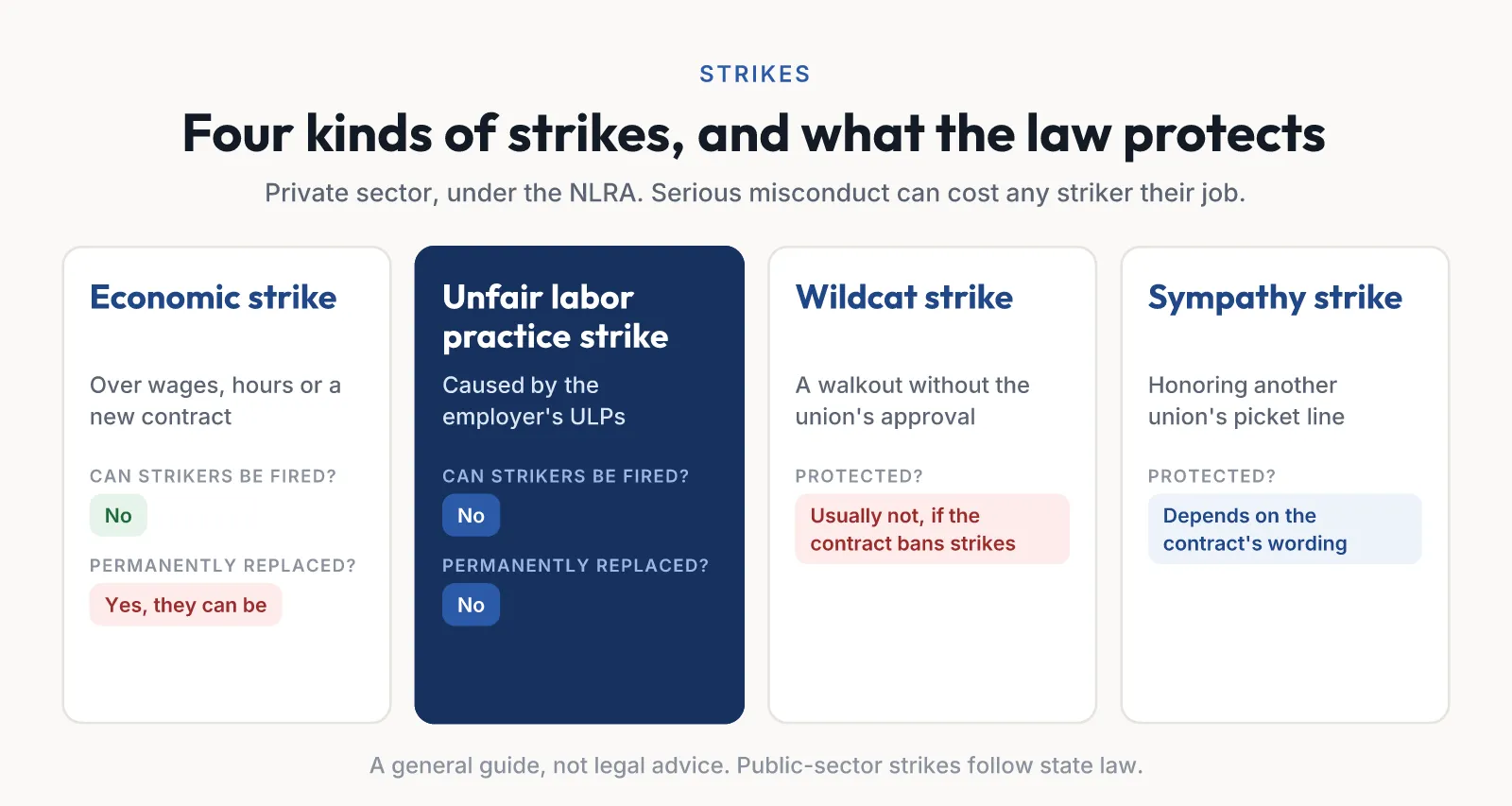
The main types of strikes, and how protected the strikers are. Serious misconduct can cost any striker their job.
Economic strike
An economic strike is over wages, hours or working conditions, usually during bargaining for a new contract. According to the NLRB, economic strikers can’t be fired, but the employer can hire permanent replacements. If it does, strikers who make an unconditional offer to return go on a preferential hiring list and get jobs back as they open up.
Unfair labor practice (ULP) strike
An unfair labor practice strike is a strike caused, at least in part, by the employer’s unfair labor practices, like refusing to bargain or firing union supporters. ULP strikers have more protection. The NLRB says they can’t be fired or permanently replaced, and when the strike ends they’re entitled to their jobs back, absent serious misconduct, even if replacements have to go.
An economic strike can become a ULP strike if the employer commits unfair labor practices that prolong it. The NLRB decides whether a strike is a ULP strike, whatever the union calls it, so file the charges and document the connection.
Wildcat strike
A wildcat strike is a walkout by workers without the union’s approval. While a contract with a no-strike clause is in effect, a wildcat strike is usually unprotected, and the strikers can be disciplined or fired. Union officers faced with one should get legal advice right away. Many contracts require the union to tell members to return to work.
Sympathy strike
A sympathy strike is when members refuse to cross another union’s picket line, or stop work to support another union’s strike. Whether that’s protected depends heavily on your contract’s no-strike clause. Some ban sympathy strikes outright, some protect the right to honor other picket lines, and some don’t say. Read the clause before members are asked to decide.
Strikes the law doesn’t protect
The NLRB says these are not protected:
- Strikes that break a no-strike clause, with exceptions for strikes over certain serious unfair labor practices.
- Sit-down strikes, where workers stay inside and refuse to work.
- Intermittent strikes, where the plan is to strike, return to work, and strike again.
- Strikes for an unlawful purpose, or strikes called without the required notice.
The NLRB has also held that a walkout over abnormally dangerous conditions doesn’t violate a no-strike clause, if the danger is real and can be shown. See insubordination for when an individual member can refuse unsafe work.
Notice before a strike
When a contract is in effect, the NLRA’s Section 8(d) requires the side that wants to end or change it to give the other side written notice 60 days before it expires, and to notify the Federal Mediation and Conciliation Service (FMCS) within 30 days after that if there’s no agreement. No strike or lockout is allowed during the 60 days (29 U.S.C. § 158(d)). Workers who strike during the notice period lose the law’s protection. See what happens when a contract expires.
Health care institutions have extra rules. The contract notice is 90 days, and under Section 8(g), a union must give the institution and the FMCS at least 10 days’ written notice before any strike or picketing, stating the date and time it will start.
Picket line rules
A picket line is a line of strikers or supporters outside a workplace, telling the public, other workers and delivery drivers about the dispute. Peaceful picketing is protected. Serious misconduct on the line can cost a striker their job.
On the picket line, do this:
- Keep moving, and keep entrances, exits, sidewalks and driveways clear.
- Carry signs with accurate, simple messages.
- Talk calmly to people crossing the line, and let them cross.
- Follow the picket captain and the union’s instructions.
- Write down anything that happens, with times, names and photos if you can.
And don’t:
- Block anyone from entering or leaving.
- Threaten anyone, including replacement workers and members who cross.
- Touch, push or damage people, vehicles or property.
- Picket somewhere the union hasn’t approved. Picketing a neutral employer, called secondary picketing, is generally illegal.
According to the NLRB, serious misconduct like physically blocking people from entering or leaving, threatening violence against non-strikers, or attacking management can cost both economic strikers and ULP strikers their right to reinstatement. Local laws and court orders can also limit where and how many people picket.
Crossing the picket line
Workers who cross a picket line are sometimes called scabs. Members who cross may face charges under the union’s constitution and bylaws, but the law limits what the union can do. In the private sector, members can generally resign from the union at any time, and a union can’t fine someone for crossing after they’ve resigned. Get advice before disciplining any member.
Lockouts
A lockout is the employer’s version of a strike: it keeps workers out to pressure the union. Whether a lockout is legal depends on when and why it happens, for example whether bargaining has reached impasse and whether it’s meant to pressure the union at the table or to punish union activity. A lockout that’s an unfair labor practice can be challenged at the NLRB.
Strikes in the public sector
Public-sector strikes follow different law. Federal workers can’t strike: federal law bars anyone who strikes against the federal government from holding a federal job (5 U.S.C. § 7311). Most states also ban strikes by state and local government workers, and those that allow them usually limit them to certain workers and require impasse procedures first. Penalties for an illegal public-sector strike can be severe. See public employment relations boards for your state’s board.
Railroad and airline workers are covered by the Railway Labor Act, which requires a long mediation process before a strike is allowed.
Strike votes and strike pay
Strike votes
A strike is usually authorized by a vote of the members, following the union’s constitution and bylaws. Many unions need approval from the national or international union too, and many require more than a simple majority. A strike authorization vote often comes before the strike itself, to show the employer the members are ready.
Strike pay
Many national unions and some locals have a strike fund that pays members a weekly benefit during an authorized strike, often tied to picket duty. Amounts and rules vary widely, and strike pay is usually much less than regular pay. Members should plan for lost wages and lost employer health coverage before a strike starts. A few states let striking workers collect unemployment benefits after a waiting period; check your state’s rules.
Plan before you walk out
The work that carries a strike gets done months before the first picket shift: a contract campaign, a clear member list with current contact information, picket schedules and captains, strike fund rules, and a record of every unfair labor practice. Keep it all where every officer can find it; in LaborWise, the member database holds current contact information for every member, member email reaches everyone at once, and tasks and the shared calendar keep picket shifts and deadlines in one place (see all features).