What is a collective bargaining agreement? A guide to your union contract
What a collective bargaining agreement is, what a typical union contract covers, how to read one, and how contracts are bargained, enforced and renewed.
A collective bargaining agreement, or CBA, is the written contract between a union and an employer. It sets the wages, hours and working conditions for everyone the union represents, and the rules both sides have to follow until it expires. Most members just call it “the contract.”
When a member asks whether they can be ordered to work a holiday, or a steward writes up a grievance over a suspension, the answer starts in the contract. Which law sits behind it depends on whether you’re in the private sector, the federal government, or a state or local government, and public-sector law varies from state to state. Read this as general information, not legal advice.
What is a collective bargaining agreement?
A collective bargaining agreement is a legally binding contract, reached through bargaining, between an employer and the union chosen by a majority of the workers in a bargaining unit. A few things set it apart from an ordinary contract:
- It covers the whole bargaining unit. The union is the exclusive representative of everyone in the unit, so the contract covers every worker in it, whether they’ve joined the union or not. In the private sector, that’s in Section 9(a) of the National Labor Relations Act.
- It’s the result of bargaining. Under the NLRA, the employer and the union have to bargain in good faith over wages, hours and other working conditions, and put any agreement they reach in a written contract if either side asks (29 U.S.C. § 158(d)). Neither side has to agree to a proposal or make a concession.
- It runs for a set term, often three years, though some are shorter or longer.
- It has its own way to settle disputes. Instead of going to court, disagreements about what the contract means usually go through the grievance procedure and, at the end, arbitration.
Unions call it different things: the contract, the labor agreement, the master agreement, or in some public-sector settings a memorandum of understanding (MOU). They all mean the same document. (MOU can also mean a smaller side agreement that changes the contract, which is how it’s used later in this guide.)
What’s in a typical union contract?
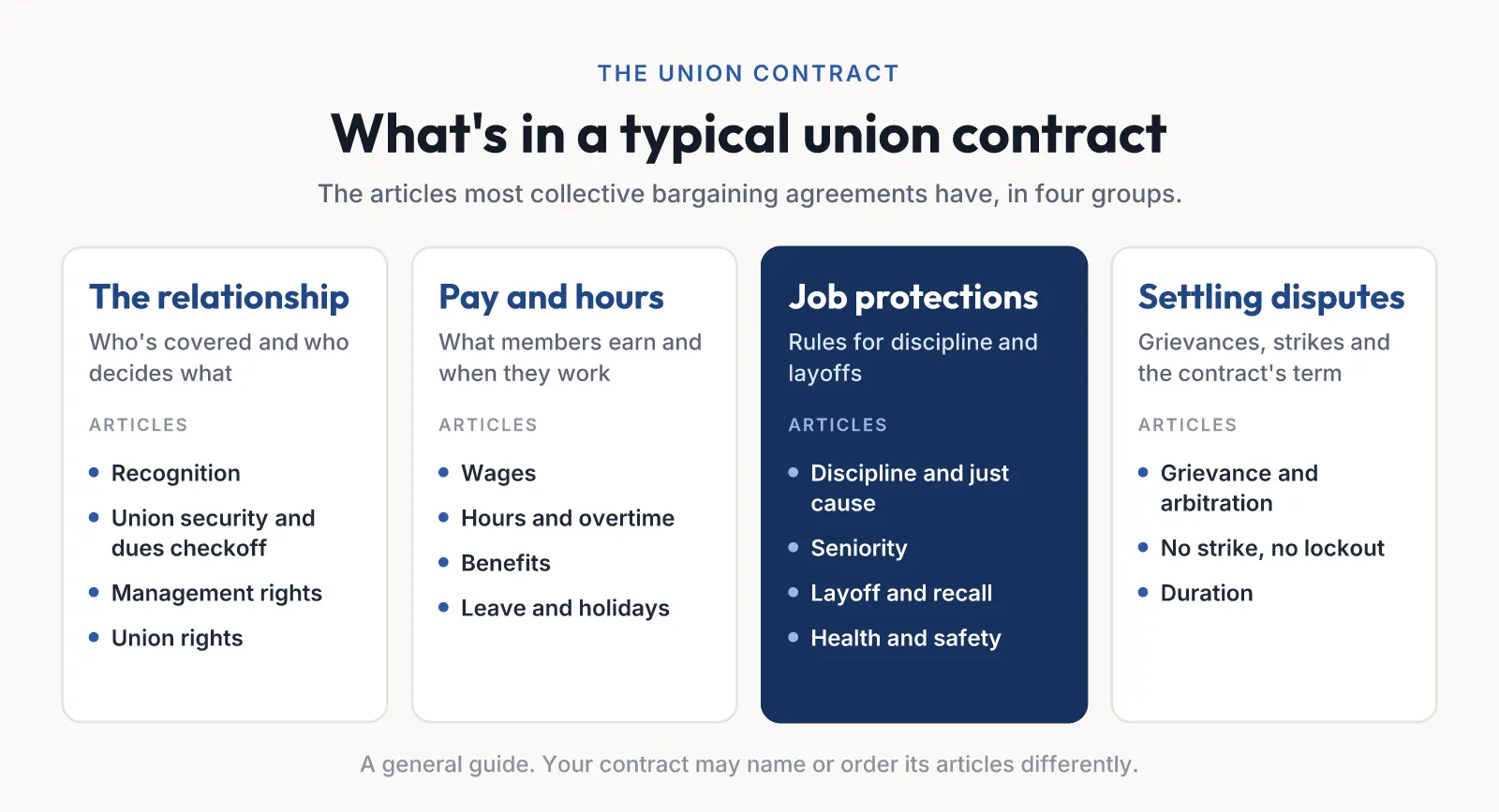
The articles most union contracts have. Yours may name or order them differently.
Contracts are divided into articles, each covering one subject, and articles into sections. The names and the order vary, but most contracts cover the same ground.
| Article | What it usually says |
|---|---|
| Recognition | The employer recognizes the union and defines the bargaining unit: which jobs are covered |
| Union security and dues checkoff | Whether workers must join or pay a fee, where the law allows it, and how dues are deducted |
| Management rights | What management can decide on its own, like directing the work, subject to the rest of the contract |
| Union rights | Stewards, time off for union business, access to the workplace, bulletin boards, information |
| Grievance and arbitration | The steps, time limits and who hears each one, ending in arbitration |
| Discipline | Usually that discipline requires just cause, and often progressive discipline |
| Seniority | How seniority is counted and used for bids, layoffs, recalls and overtime |
| Hours and overtime | The workweek, schedules, breaks, and how overtime is offered and paid |
| Wages | Pay rates, salary schedules, step increases, differentials |
| Benefits | Health insurance, retirement, and who pays what |
| Leave and holidays | Vacation, sick leave, personal days, holidays, leaves of absence |
| Health and safety | Safe working conditions, equipment, and a joint safety committee |
| No strike, no lockout | The union agrees not to strike and the employer not to lock out during the term |
| Duration | When the contract starts and ends, and how it renews |
Many contracts also have appendices (salary schedules, job lists) and side letters or MOUs signed during the contract’s term. Side letters are part of the agreement, so keep them with it. For definitions of these terms, see our union contract terms glossary.
Collective bargaining agreement example
Here’s what a few articles might look like, from a fictional contract between Local 418 and the Highway Department, with notes on what a steward should notice. Real contract language is often longer, but the parts are the same.
Article 1, Recognition. The Employer recognizes the Union as the exclusive bargaining representative for all full-time and regular part-time equipment operators, mechanics and laborers in the Highway Department, excluding supervisors, seasonal workers and office staff.
This article defines who the contract covers. If the department starts giving bargaining-unit work to seasonal workers or another department, this is where the argument starts.
Article 9, Discipline. No member shall be disciplined or discharged except for just cause. Discipline shall be progressive and shall normally consist of an oral warning, a written warning, a suspension and discharge. Written warnings shall be removed from the member’s file after eighteen (18) months without further discipline.
“Just cause” is the standard the seven tests of just cause measure. “Shall be progressive” means skipping steps needs a good reason. And under the 18-month rule, an old warning can’t be used to justify a heavier penalty.
Article 14, Section 3, Overtime Distribution. Overtime shall be offered by seniority, on a rotating basis, to members in the classification who normally perform the work. A member who is passed over in error shall be offered the next available overtime opportunity.
Here “shall” makes it mandatory. The second sentence sets a remedy, so a grievance asking for pay instead may run into this language. Check what the article says before you write the remedy.
Article 22, Duration. This Agreement shall be in effect from July 1, 2025 through June 30, 2028, and shall renew from year to year unless either party gives written notice to the other at least ninety (90) days before the expiration date.
Put the expiration date and the notice deadline on the union’s calendar now. Missing the notice date can roll the contract over for another year.
How to read your union contract
- Get the current, complete copy. That means the signed contract, plus every side letter, MOU and settlement that changed it. An old copy in a steward’s drawer can be years out of date.
- Start with the definitions. Words like “member,” “employee,” “day” and “seniority” may be defined in a way that changes what an article means. Is a “day” a calendar day or a workday?
- Watch the small words. “Shall” and “will” are requirements. “May” is a choice. “Except,” “subject to” and “provided that” introduce exceptions.
- Read the whole article, beyond the line you remember, and follow every cross-reference to other articles.
- List the deadlines: grievance time limits, notice periods, posting periods and the expiration date. A grievance with strong facts can still be thrown out for being filed a day late.
- Find out what’s not written down. A long-standing past practice can be enforceable even though it isn’t in the contract, and arbitration awards can settle what unclear language means.
When the language really is unclear, arbitrators look at the plain words first, then at what the parties said in bargaining and how they’ve applied it since. So keep the bargaining notes and old grievance settlements; an arbitrator may need them years later.
How a contract is bargained
A new contract is negotiated by a union bargaining team and the employer’s representatives, usually starting with a survey of the members and ending with their ratification vote on a tentative agreement. Both sides have to bargain in good faith over mandatory subjects: wages, hours and other terms and conditions of employment. Refusing to bargain, or changing those things without bargaining, can be an unfair labor practice. For each step from the survey to the vote, see how union contract negotiations work.
How long a contract lasts, and what happens when it expires
Many contracts run for three years; some run one or two years, and some five or more. What happens near the end depends on the law that covers you.
In the private sector, Section 8(d) of the NLRA says a side that wants to end or change the contract has to:
- give the other side written notice 60 days before the contract expires,
- offer to meet and bargain a new contract,
- notify the Federal Mediation and Conciliation Service within 30 days after that notice, and any state mediation agency, if there’s no agreement by then,
- and keep the contract’s terms in place, with no strike or lockout, for 60 days after the notice or until the contract expires, whichever is later.
At health care institutions, the periods are longer: 90 days’ notice to the other side, 60 days’ notice to the mediation agencies, and 90 days before a strike or lockout.
After the contract expires, the employer generally can’t change wages, hours or working conditions on its own while the parties are still bargaining. This is the status quo rule. Some contracts also have an evergreen clause that keeps them in effect until a new one is signed. The no-strike clause usually ends with the contract.
In the public sector, state and local government workers follow their state’s public-sector bargaining law, which often has its own impasse steps, like mediation, fact-finding or interest arbitration, and many public workers can’t legally strike. See our guide to public employment relations boards.
How a contract is enforced
When the employer breaks the contract, the union enforces it through the grievance procedure. See how to write a grievance and the grievance procedure, step by step. If the steps don’t resolve it, most contracts end in binding arbitration, where a neutral arbitrator decides what the contract means.
The union also has a duty to enforce the contract fairly for everyone in the unit. See the duty of fair representation.
Who can get a copy of the contract?
Every worker covered by a contract should be able to read it. In unions covered by the Labor-Management Reporting and Disclosure Act (most private-sector unions), federal law requires the local’s secretary or principal officer to send a copy of the contract to any worker whose rights it directly affects who asks for one, and to keep copies at the union office for members to inspect (29 U.S.C. § 414).
Public-sector contracts are often public records, and many government employers post them online. For federal workers, the Office of Personnel Management runs a database of federal collective bargaining agreements that agencies submit.
Before your next round of bargaining, read a few contracts other unions have signed with similar employers. They show how other employers handle the same issues and what language other unions have won.
Inside the local, stewards need the contract on the job, on their phone, the moment a member asks a question. Keep the current contract, every side letter and every settlement together, and give each new steward and officer a copy on day one.
If your union uses LaborWise, those documents sit together in Docs & files where every steward and officer can reach them, and each case records the contract articles it’s about. See all features.