How union contract negotiations work: from bargaining survey to ratification vote
How union contract negotiation works, step by step: the bargaining survey, proposals, bargaining sessions, impasse, the tentative agreement and ratification.
Every few years, a union and an employer sit down to negotiate a new contract. What the bargaining team wins, or gives up, sets members’ pay and working conditions for years.
Union contract negotiation starts long before the first session at the table, usually with a survey of the members months before the contract expires, and it ends with the members’ vote. The details depend on your law and your bylaws. Bargaining rules differ for the private sector, the federal government, and state and local governments, and your union’s constitution and bylaws set how the team is chosen and how the members vote. What follows is a general overview, and it isn’t legal advice.
The bargaining process at a glance
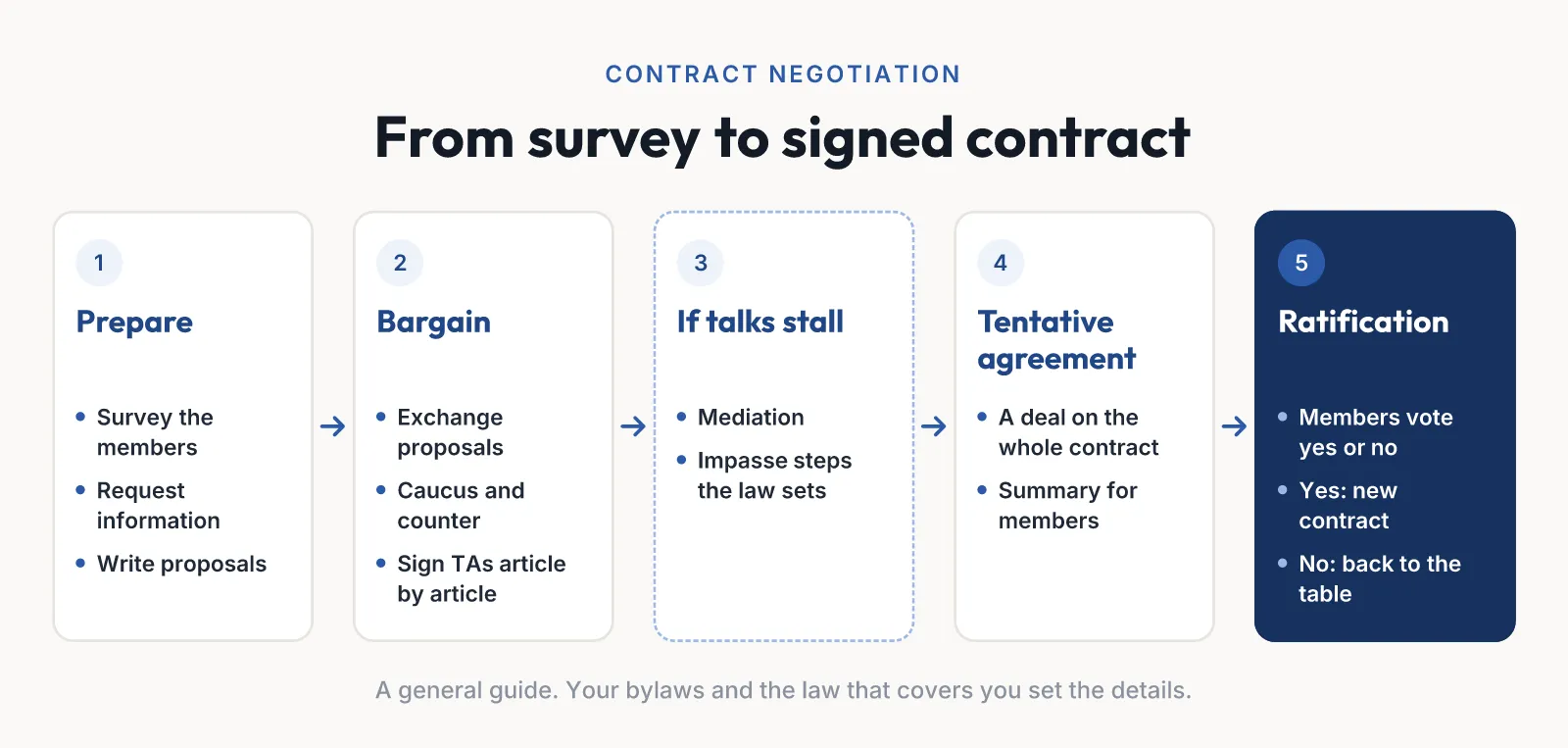
The usual steps. Talks can go back and forth between bargaining and mediation many times.
Step 1: Prepare
Preparation usually starts months before the contract expires. Send the information requests first: the employer can take weeks to answer them, and the team needs the numbers before it writes proposals.
Survey the members
A bargaining survey asks members what matters most to them. It tells the team what to fight for and gets members involved from the start. Good surveys are short and ask members to rank their priorities, so the team knows which ones come first. Common questions:
- What are the three most important issues for you in the next contract?
- How would you rank wages, health insurance, retirement, scheduling, staffing and job security?
- What problems at work should the contract fix?
- Would you be willing to take part in actions to support the bargaining team?
Get responses from every part of the bargaining unit: every shift, department, job title and worksite.
Request information
The employer usually has the information the union needs: wage rates, overtime, staffing levels, health plan costs and claims, and the list of everyone in the unit. In the private sector, the employer generally has to provide information that’s relevant to bargaining. Put requests in writing, early, and keep copies. If the employer says it can’t afford the union’s proposals, the union can generally ask to see the financial records that back that up.
Review the contract and the grievance history
Go through the current contract article by article. Which articles caused the most grievances? Where did the union lose arbitrations because the language was weak? What do members complain about that the contract doesn’t cover? See how to read your contract.
Choose the bargaining team
Your constitution and bylaws usually say who’s on the team: often the officers, plus members elected or appointed to represent different parts of the unit. Many unions also have help from a staff representative or business agent. Agree on who speaks at the table, who takes notes, and how the team makes decisions.
Write the proposals
Turn the survey results and the contract review into written proposals, with exact contract language. Most teams open with more than they expect to win, and decide in advance which issues are priorities and which can be traded.
Give notice
In the private sector, the side that wants to change the contract has to give written notice 60 days before it expires and notify the Federal Mediation and Conciliation Service (FMCS) within 30 days after that if there’s no agreement (29 U.S.C. § 158(d)). Check your contract too; many require earlier notice.
Step 2: Bargain
Ground rules
Many teams start by agreeing on ground rules: where and when to meet, who attends, how proposals are exchanged, whether there’s paid release time for the union team, and how tentative agreements are signed. A common rule is that nothing is agreed until everything is agreed, so articles signed early can still be traded until the whole contract is settled.
Exchanging proposals
Each side presents its proposals and explains them. Then the back-and-forth begins: counterproposals, questions, caucuses (private breaks for each team), and more counterproposals. Usually non-economic articles, like language on grievances or scheduling, are settled first, and wages and benefits last.
When the two sides agree on an article, both teams sign and date it as a tentative agreement, or TA, on that article.
The duty to bargain in good faith
Under the National Labor Relations Act, both sides have to meet at reasonable times and bargain in good faith over mandatory subjects: wages, hours and other terms and conditions of employment. Neither side has to agree to a proposal or make a concession (29 U.S.C. § 158(d)). Refusing to meet, refusing to provide information, or changing working conditions without bargaining can be an unfair labor practice.
Keep good notes
Have a dedicated note-taker at every session. Write down every proposal, every explanation the employer gives for its proposals, and every TA. Bargaining notes matter long after the contract is signed: when language turns out to be unclear, arbitrators look at what the parties said at the table.
Keep members informed
Send regular bargaining updates and hold meetings, so members hear what happened at the table from the team before they hear the employer’s version. Give them simple ways to show support, like wearing union buttons on the same day or signing a petition. When half the unit shows up to work wearing the same button on a bargaining day, the employer’s team knows the members are following along.
Step 3: If talks stall
Mediation
When talks stall, either side can ask for a mediator. In the private sector, the Federal Mediation and Conciliation Service provides mediators. Its staff has been cut sharply since 2025, so ask early. A mediator can’t impose a deal; they help each side understand the other’s position and find room to settle.
Impasse
Impasse is the point where both sides have bargained in good faith and are deadlocked. What happens next depends on the law:
- Private sector: once the contract has expired and the notice periods have passed, the union can strike, impasse or not. After a genuine impasse, the employer may be able to put its last offer into effect. Whether there’s a real impasse is often disputed, and it can be decided by the NLRB. See types of strikes and picket line rules.
- Public sector: state laws often set impasse steps like mediation, fact-finding (a neutral recommends a settlement) and interest arbitration (a neutral decides what the new contract says), and many public workers can’t strike. See public employment relations boards.
Until there’s a new contract or a genuine impasse, the employer generally can’t change wages, hours or working conditions on its own. This is called the status quo rule.
Step 4: The tentative agreement
When the teams reach a deal on the whole contract, they sign a tentative agreement on the full package. It’s tentative because the members haven’t voted on it yet.
Before the vote, the team should:
- Write a clear summary of every change: what’s new, what’s improved, what was given up.
- Explain the reasons, including what the employer refused and why the team recommends the deal, or doesn’t.
- Make the full language available, so members can read the actual text as well as the summary.
Step 5: The ratification vote
Contract ratification is the members’ vote to accept or reject the tentative agreement. Your union’s constitution and bylaws decide who can vote (often only members in good standing in the bargaining unit), how notice is given, and how the vote is held: at a meeting, by mail, in person over several days, or online.
- If members ratify it, it becomes the new contract. Get the final signed copy, every side letter and every appendix, and make sure every steward has them.
- If members reject it, the team goes back to the table, now with clear evidence that the members want more.
Keep a record of the vote, how many voted, and the result. See how to take meeting minutes if the vote happens at a meeting.
After ratification
- Distribute the new contract to stewards and members, and train stewards on what changed.
- Check the first paychecks for new rates and retro pay, and watch the new schedules and benefits as they take effect.
- Start a list of problems for next time.
Then put the bargaining file away where the next team can find it: the survey, information requests, proposals, counterproposals, signed TAs and notes. Those papers are evidence of what the language means, and they’re where the next round starts. New officers often find nothing at all from the last round.
LaborWise’s Docs & files holds every proposal, TA and set of notes in one place, member email sends bargaining updates to the whole unit at once, and tasks and the shared calendar keep the team on schedule. See all features.