Union officer positions: what the president, vice president, secretary, treasurer and trustees do
The officer positions most unions have, what the president, vice president, recording secretary, treasurer and trustees do, and how union officers are elected.
Every union is run by officers its members elect. The titles and the number of positions vary from one union to the next, but most have a version of the same lineup: a president, a vice president, a recording secretary, someone in charge of the money, trustees who check the books, and an executive board.
Your own constitution and bylaws set your union’s offices, duties, terms and election rules, so read those alongside this. Unions that represent private-sector workers are also covered by a federal law, the Labor-Management Reporting and Disclosure Act (LMRDA), which sets minimum rules for elections and union money. This is general information about how most unions do it, not legal advice.
Union officer positions at a glance
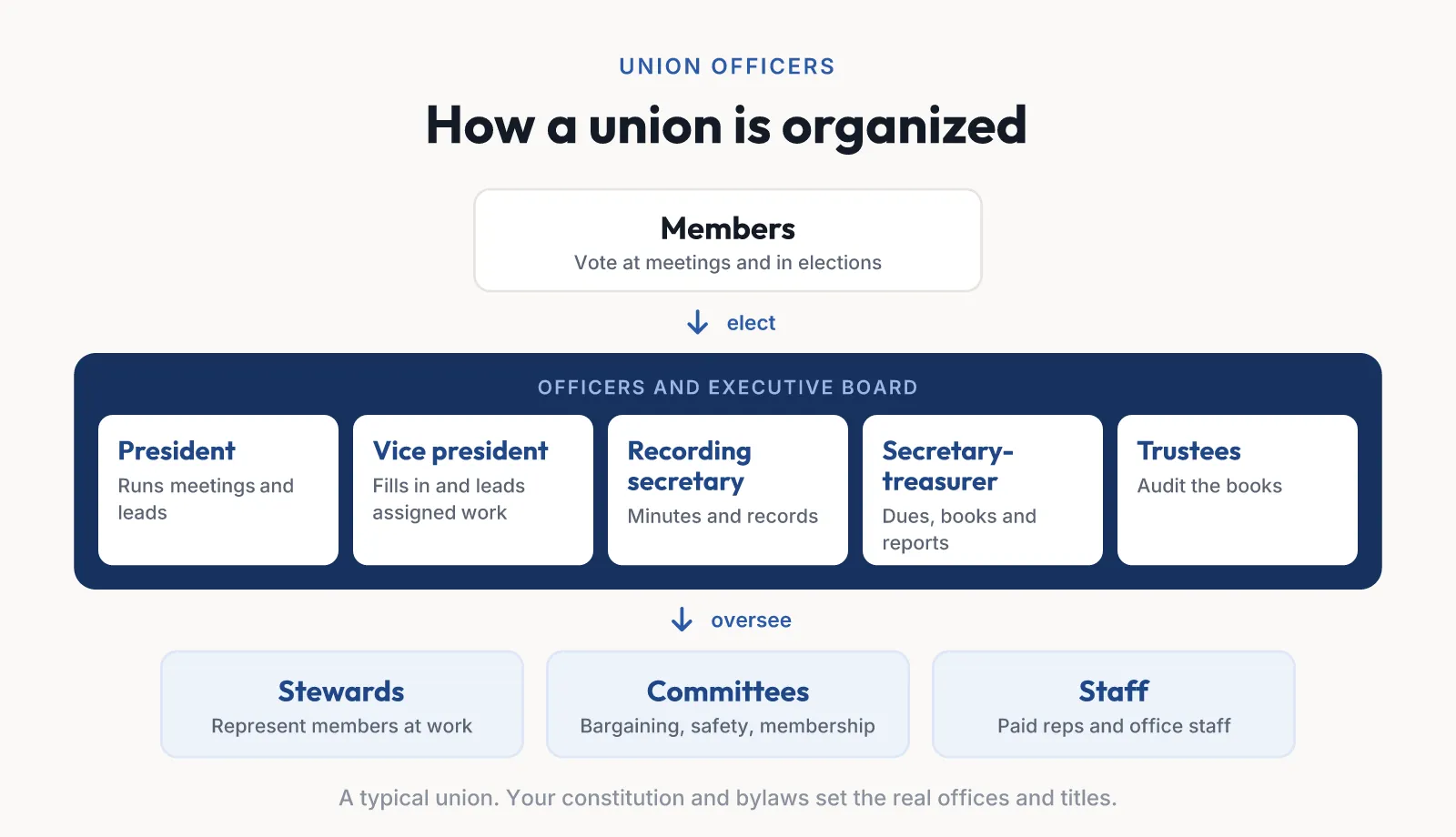
A typical union’s officers. Your constitution and bylaws set the real offices.
| Position | Main job |
|---|---|
| President | Runs meetings, leads the union, and speaks for it |
| Vice president | Fills in for the president and leads assigned work |
| Recording secretary | Keeps the minutes and the union’s records |
| Financial secretary | Collects and records dues and keeps the membership list |
| Treasurer | Pays the bills, keeps the books and reports on the money |
| Trustees | Audit the books and watch over the union’s property |
| Executive board | Acts for the members between membership meetings |
Union president
The president is the union’s chief officer and the one who speaks for it, with the employer, the press and the public. The president chairs membership meetings and executive board meetings, using Robert’s Rules of Order or whatever rules the bylaws adopt, and enforces the constitution and bylaws.
In most unions the president also appoints committees, and in many unions the stewards. The president signs checks and contracts, usually with the treasurer, and often leads bargaining and oversees grievances and any paid staff.
The bigger the union, the less representation work the president tends to do personally, and the more the job becomes leading, delegating and keeping the other officers working together.
Vice president
The vice president fills in when the president is absent and, under most bylaws, takes over if the president’s office becomes vacant. Beyond that, the job depends on the union. Many vice presidents chair committees, lead a unit, shift or region, or coordinate the stewards. Large unions often have several vice presidents, each responsible for a group of members.
Recording secretary
The recording secretary keeps the union’s official record. That starts with the minutes of membership and executive board meetings, which the secretary reads for approval at the next meeting (see how to take meeting minutes). The secretary also keeps past minutes, the constitution and bylaws, and other official records, and usually handles the union’s correspondence and sends meeting notices.
Our free meeting minutes template has a place for everything the minutes need.
Financial secretary and treasurer
Many unions split the money work between two officers. Others combine it into one office, the secretary-treasurer.
- The financial secretary collects and records dues, issues receipts, and keeps the membership records: who belongs, their status, and whether their dues are paid. Our free member roster template covers the basics.
- The treasurer deposits the union’s money, pays the bills the members or the board authorize, keeps the books, and reports on the union’s finances at meetings.
In unions covered by the LMRDA, the president and the treasurer, or the officers in those roles, sign the union’s annual financial report to the Department of Labor. See LM-2, LM-3 and LM-4 reports.
Federal law also requires every officer or staff member who handles a covered union’s money to be bonded, for at least 10% of the funds handled the year before, unless the union’s property and annual receipts are $5,000 or less (29 U.S.C. § 502).
Trustees
Most unions elect a small board of trustees, often three, to look after the members’ money and property. Trustees typically audit the books at set times, check that money was spent as the members or the board authorized, look after the union’s property, and report what they find to the members.
Two other things go by similar names, and they’re different jobs.
A trusteeship is when a national union takes over the running of a local and puts in a trustee to manage it. Federal law limits the reasons, such as correcting corruption or financial malpractice or restoring democratic procedures, and requires the union to report it to the Department of Labor (29 U.S.C. §§ 461 and 462).
Trustees of a union benefit fund, like a pension, health or training fund set up under a contract, run that fund rather than the union. In these jointly run funds, the union and the employers are equally represented (29 U.S.C. § 186).
Executive board
The executive board, sometimes called the executive committee or executive council, is made up of the officers and, in many unions, board members elected at large or from each unit. It acts for the members between membership meetings, within limits the bylaws set: approving routine spending, deciding which grievances go to arbitration, setting meeting agendas, and making recommendations to the members.
Other union positions
Depending on the union, you may also find:
- a sergeant-at-arms, who keeps order at meetings and checks that only members attend,
- delegates who represent the union at conventions or labor councils,
- stewards and chief stewards, who represent members at work,
- committee chairs for bargaining, health and safety, political action or membership,
- business agents and staff reps, often paid, who handle grievances and bargaining.
For the representation jobs, see what a union rep does.
How union officers are elected
Your constitution and bylaws set the terms and the election process. For unions covered by the LMRDA, federal law adds minimum rules (29 U.S.C. § 481):
- Local unions must elect officers at least every three years by secret ballot.
- Intermediate bodies, like district councils, at least every four years.
- National and international unions at least every five years, by secret ballot or at a convention of delegates elected by secret ballot.
- Members must get a reasonable chance to nominate candidates, and every member in good standing can run, subject to reasonable qualifications applied to everyone.
- The union must mail a notice of the election to every member at least 15 days before it.
- Candidates can have observers at the polls and at the count, and the ballots and election records must be kept for one year.
Unions that represent only state or local government workers generally aren’t covered by the LMRDA. Their elections follow their own constitution and bylaws, and sometimes state law.
What every officer owes the members
The money and property an officer looks after belong to the members. For officers of covered unions, federal law makes that a fiduciary duty: they have to use the union’s money and property only for the members’ benefit, according to the constitution and bylaws (29 U.S.C. § 501). Day to day, that means spending only what the members or the board have authorized, keeping honest, complete records and sharing them with the members, following the constitution and bylaws even when it’s inconvenient, and representing every worker fairly, as the duty of fair representation requires.
When the officers change
New officers often inherit a pile of paper, a few passwords and not much else. On day one, get the member list, every open grievance with its next deadline, and access to the bank account and records. Our free new officer checklist walks through the handoff step by step.
LaborWise keeps the roster, cases, deadlines, meeting notes and files together, so new officers start with the full record.